Impacts of comets and asteroids on Jupiter's natural satellite could transport critical
The authors of the newexperiment conducted by the University of Texas at Austin. Scientists have developed a computer model to understand what happens on Europa after a comet or asteroid hits the moon's icy shell. Its cover is estimated to be tens of kilometers thick.
Computer modeling shows that meltwater sinks into the ocean within a few hundred years of the impact.
Credit: Carnahan et al.
According to the data received, if the impact isstrong enough to strike particles from a comet or asteroid to a depth of 5 km, the heated meltwater will sink through the rest of the ice. Thanks to this, various oxidants - a class of chemicals necessary for life - can get from the surface of the moon into the ocean. There they can support any potential life in protected waters.
At the moment, collisions with comets andasteroids is one of the most likely mechanisms for the origin of life on Europa. Scientists have already discovered dozens of craters on its surface, many of which are characterized by undulating surfaces, which is evidence of frozen melt water and post-impact movement under the crater.
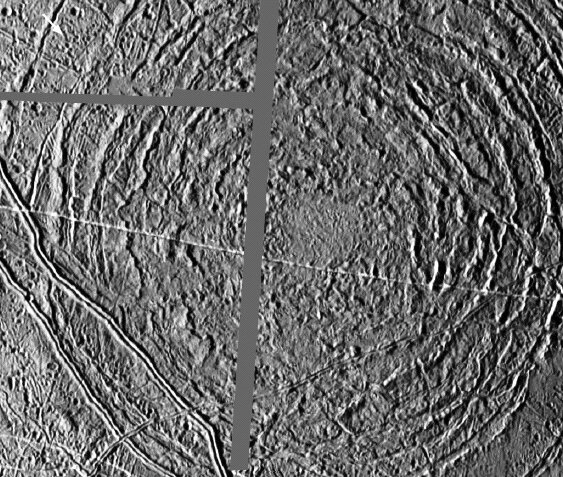
Can oxidizers get in from where they arenaturally formed on the surface of Europa, into the ocean - one of the biggest questions for planetary scientists. Despite the results of the new study, scientists need more data. They will be collected by the spacecraft as part of NASA's future Europa Clipper mission. This will help answer the question of whether there is life on Jupiter's moon.
Read more:
Does science exist in extreme conditions? We answer in numbers
Scientists have found out who benefited from the death of dinosaurs
Look at the photo of the Earth from space: it was made by the first private module