The authors of a new study have found a metabolite that turns white (“bad”) fat cells into cells
Metabolic diseases are often causedimbalance of energy homeostasis - when the body receives more energy than it expends. That's why some therapeutic approaches focus on converting white fat cells (known as adipocytes) into brown fat cells. White adipocytes store excess energy and ultimately lead to metabolic diseases such as obesity. And brown adipocytes dissolve accumulated energy into heat, which ultimately increases energy consumption in the body and helps restore its balance.
As part of the study, scientists used dataReFRAME Calibr drug repurposing libraries of 14,000 known drug compounds that have been approved by the FDA for the treatment of other diseases or have undergone extensive testing for safety in humans. Using high-throughput screening, the scientists scanned ReFRAME in search of a drug with these specific capabilities.
This is how they discovered zafirlukast, which is approved by the FDA.a drug used to treat asthma. It turned out that it can convert adipocyte precursor cells (known as preadipocytes) into predominantly brown adipocytes, and the white adipocytes themselves into brown ones.
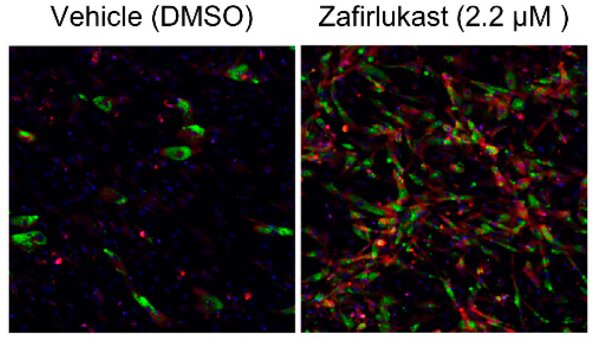 Zafirlukast induces the formation of brownadipocyte tissue. For preadipocytes treated with zafirlukast (right image), brown adipocytes (shown in red) were more abundant than experimentally cultured preadipocytes (left image). Courtesy: Scripps Research and Calibr
The problem is that it is toxic when taken inhigher doses and scientists didn't know how zafirlukast converted fat cells. So biologists turned to metabolite experts for help. They deconstructed the chemicals in zafirlukast's mechanism and found a metabolite that provided the same functional effect as zafirlukast without the side effects.
Using liquid chromatographyand mass spectrometry, scientists looked for metabolites in adipose tissue that would lead to the formation of brown adipocytes. By reducing 30,000 metabolic signatures to 17 metabolites, they discovered myristoylglycine, an endogenous metabolite that induces the formation of brown adipocytes without damaging the cell. Of the thousands of metabolic signatures measured in the assay, only myristoylglycine had this particular signature, even among metabolites that were nearly identical in structure.
Read more:
Created a compact nuclear reactor for safe energy production
Unusual structures found on the edge of the solar system. Only the Voyagers have been there.
Black hole 'spit out' torn star three years after swallowing
Cover photo: jackie_niam