An international team of astronomers analyzed photometric and spectroscopic observations
Object OGLE-BLG504.12.201843 (or O-201843 for short) was first discovered in 2015 as part of the Optical Gravitational Lensing Experiment (OGLE). Previous observations of this source have shown that it exhibits photometric variability with a period of 0.523419 days. Its almost year-long outbreaks are repeated every 950–1020 days.
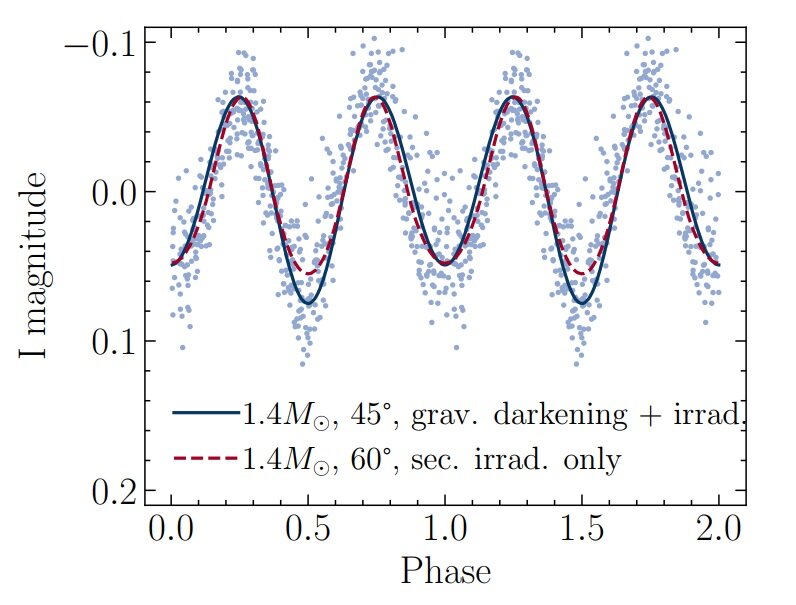 Phase photometry of OGLE-BLG504.12.201843 at rest.
Credit & Copyright: Landry et al., 2022
The nature of O-201843 is still unclear, however,Taking into account its outburst, the object was initially classified as a candidate for cataclysmic variable (CV). They are binary star systems that consist of a primary white dwarf that accretes material from a normal companion star. They increase brightness unevenly and then fall back to a resting state.
Accretion is the process of increasing the mass of a celestial body through the gravitational attraction of matter onto it from the surrounding space.
After analyzing spectroscopic data, scientistsfound that O-201843 has Balmer absorption. The source was either a bright secondary star or a cold accretion disk. However, no features of a white dwarf or the usual signs of an unstable accretion disk were observed.
Summing up, the researchers noted that O-201843 may be a U Gem-type dwarf nova with extreme properties.
Read more:
An unknown species of winged insect "hidden" in amber for more than 35 million years
Gas leak from Nord Stream was shown from space
See how Jupiter and the Moon approached in the night sky
Cover: illustration of a dwarf nova, hubblesite.org