The researchers used observational data from the Isaac Newton optical telescope located on
In a new work, Chinese researchersanalyzed the light curves of eclipsing systems discovered by Spanish scientists and showed that 12 of them belong to semi-separated binaries, in which mass exchange between stars occurs. The authors of the study note that in the systems they found, only secondary (less massive) components filled their Roche lobes. The substance of such stars flows through the inner Lagrange point to its "partner".
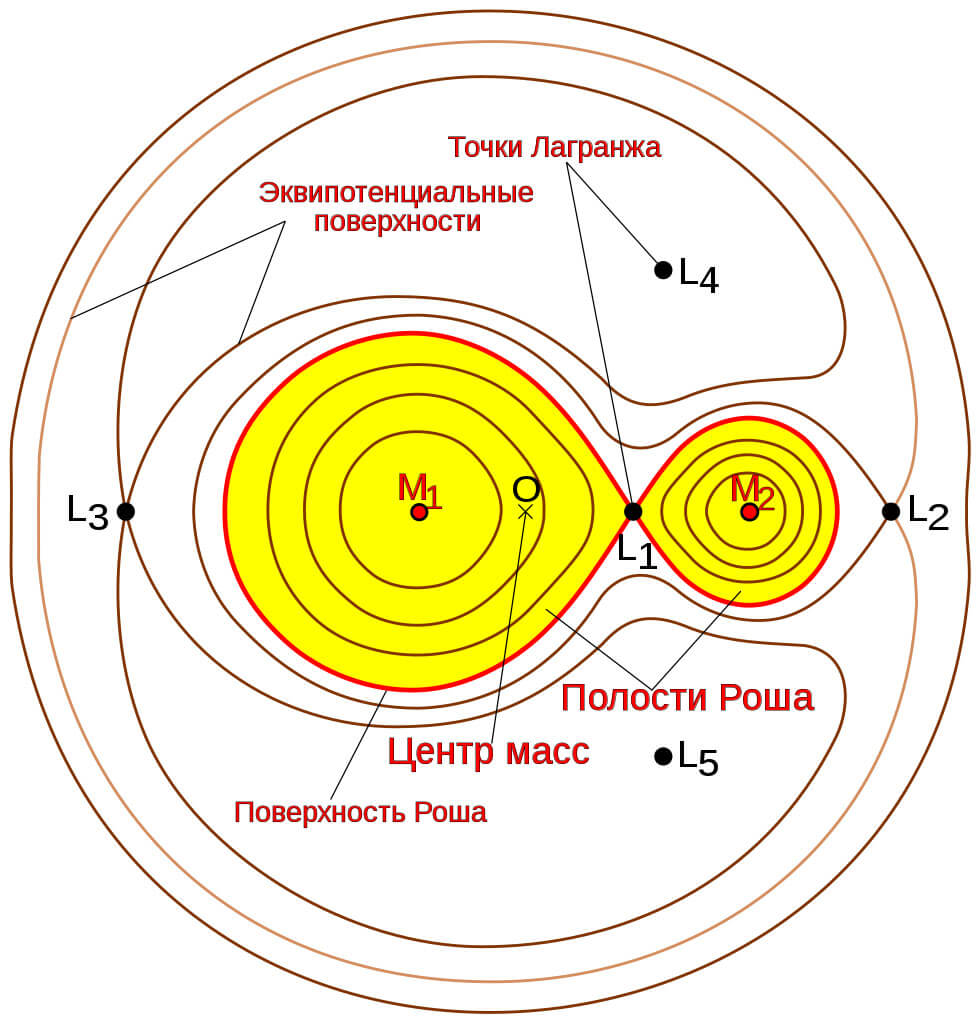 Roche lobe, the region around a star in a binary system, the boundary of which is an equipotential surface containing the first Lagrange point
Astrophysicists note that the relationship betweenmass ratio and filling factor of the primary star shows that the systems are at the stage of slow mass transfer from less massive components to their companions. The researchers also found that the temperature distribution of the primary and secondary components of these binary stars is similar to that of the semi-separated systems of the Milky Way.
According to scientists, this confirms that evolutionmassive binary systems in the Andromeda galaxy should be similar to the processes that took place in the Milky Way. The discovery of scientists confirms the correctness of the theory of the development of binary star systems, which was formulated on the basis of observations only of our galaxy.
Read more:
MIT builds stationary heat engine that outperforms turbines
After ten years of work, scientists questioned the standard model of physics
See what sunrise looks like on Mars