High-definition radar satellites have discovered more than 19,000 undersea volcanoes across the Earth,
Before this, only a quarter of the Earth's seafloor wasmapped using sonar, which uses sound waves to detect objects hidden underwater. In a 2011 sonar census, scientists identified more than 24,000 seamounts formed by volcanic activity. However, according to an article in Science, more than 27,000 objects remain unaffected.
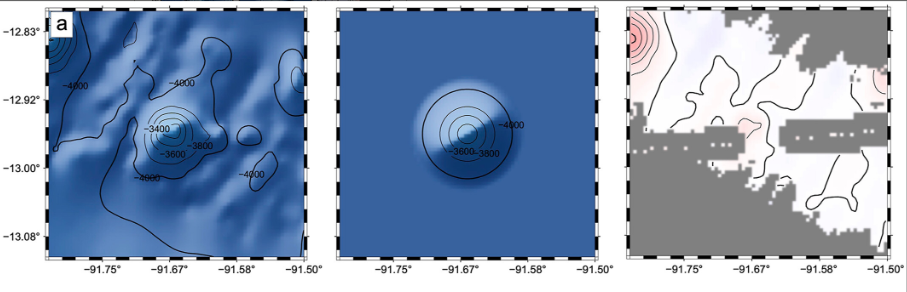 (a) SIO-08100 is a small 933 m high seamount. Credit: Earth and Space Science
However, a new study shows that scientistsyou don't need to rely on hydroacoustic surveys to explore the underwater world. Radar satellites provide more accurate data on the topography of the seafloor. Scientists extracted data from several satellites, including the European Space Agency's CryoSat-2. It turned out that they found underwater mounds up to 1,100 meters high. However, scientists predict that with the help of this technology they will estimate the height of small underwater volcanoes with an accuracy of approximately 370 m.
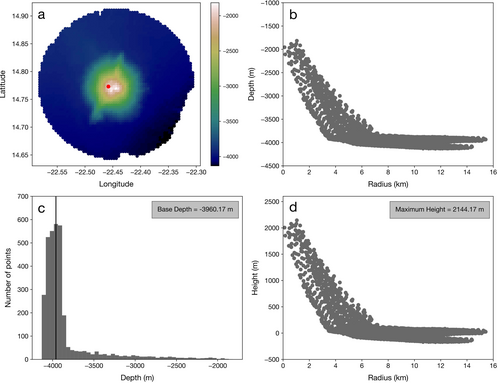 (a and b) KW-00648 seamount depth data.The red dot indicates the center of the seamount. (c) The histogram is used to determine the base depth. (d) Height of data points shifted to base depth. Credit: Earth and Space Science
To date, scientists have mappedseamounts in the northeast Atlantic Ocean, which will help explain the evolution of the mantle plume feeding more than 100 volcanoes in Iceland. These updated maps will also provide a better understanding of ocean currents and upwellings. They occur when water from the ocean floor rises to the surface.
Read more:
A photo appeared inside the second deepest underwater sinkhole in the world
See what happened to Mercury when it got as close as possible to the Sun
Scientists have figured out the nature of the mysterious ancient "monster"
Cover: The Pao Pao Seamount in the South Pacific, mapped by sonar, while thousands of other seamounts have been spotted using satellites
Image courtesy of NOAA's Office of Oceanic and Research