The animal appears as a dried out lump of brown fur and skin with tiny hands and ears. Recently Canadian
Scientists have characterized the found animal as Marmotini (Ground squirrels) or ground squirrel - a member of the family of squirrel rodents that usually live on or in the ground, and not in trees.
Arctic ground squirrels are commonin the Yukon, and researchers often find Ice Age nests. But it's rare that a squirrel's remains can be recovered entirely and in such good condition, Grant Zazula, a Yukon government paleontologist, told CBC in an interview.
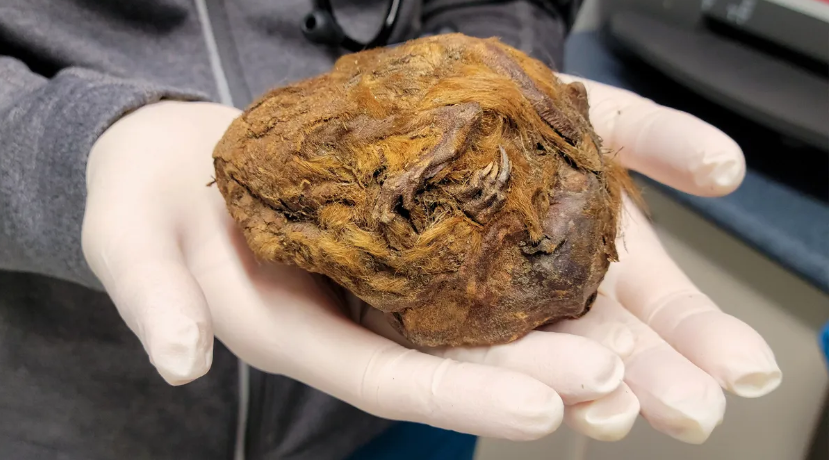 A 30,000-year-old Arctic ground squirrel discovered in Hester Creek. Photo: Yukon Interpretation Center - Berengia
Local veterinarian of the Alpine VeterinaryMedical Center Jess Heath helped x-ray the remains. However, scientists did not expect too much from the images. Typically, the bones of mummified animals lose calcium over the years, blurring X-ray images. But the experts were in for a surprise: the x-ray showed a solid bone structure.
“Apparently, before its death the squirrel wasin excellent condition. She just curled up like she was sleeping,” explains the veterinarian. An X-ray showed that it was a young squirrel; it died in its first year of hibernation. What killed her is unknown.
Read more:
It turned out that photosynthesis does not work the way scientists thought. Now they want to hack it
Distant radio galaxy turned out to be a black hole, which is directed directly at Earth
Found a way to reduce weight and blood sugar. Scientists promise the effect of surgery
Cover photo: Diego Delso, CC-BY-SA