In 2016, scientists discovered an object that they thought was a planet and named HD 131399Ab.It's in the HD 131399 system ,
How did it all start?
Then scientists established that the orbit of the “planet”around its host star HD 131399A, the brightest of the three stars, is the widest known in a multi-star system. It is equal to 550 earth years. In this case, the “planet” rotates at a distance of 80 AU. from the sun. Such orbits are often unstable due to the complex and varying gravitational pull from the two other stars in the system. It has long been thought that the existence of planets in such orbits is unlikely. This is another reason why scientists are so inspired by the new discovery. In addition, a planet that orbits three stars is itself a rather rare phenomenon.
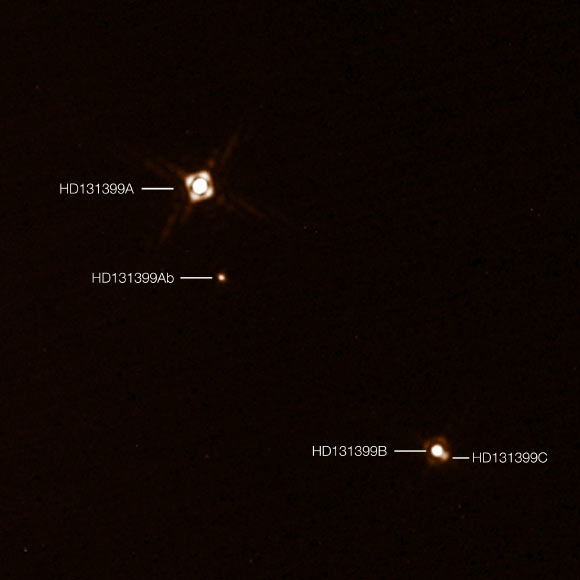 This composite image shows the object HD 131399Ab in the triple star system HD 131399. The image was captured by VLT's SPHERE imager.
Image Credit: C. Wagner et al./ESO
"About half of the planet's orbit, whichlasts 550 Earth years, three stars are visible in the sky,” said team member Kevin Wagner from the University of Arizona. "The dimmer two stars are always much closer together and change in apparent distance from the brightest star throughout the year."
According to astronomers, the “planet” HD 131399Ab was considered at least four times more massive than Jupiter. Scientists assumed that its surface temperature was 580°C.
Astronomers estimated the age of the “planet” to be approximatelyat 16 million years. This made it one of the youngest exoplanets discovered to date, as well as one of the few to be directly imaged.
What changed?
Research conducted in 2017An international team of astronomers has shown that perhaps HD 131399 Ab may not be a planet at all, but a background star. The researchers presented evidence supporting their hypothesis in a paper published in The Astronomical Journal.
Re-analysis of existing SPHERE data, as well asNew photometric and spectroscopic observations using two other instruments have led researchers to question knowledge about HD 131399 Ab. A team led by Eric Nielsen of the SETI Institute re-examined the object using the Gemini Planet Imager (GPI). , on the Gemini South Telescope in Chile, the NIRC2 near-infrared imager on the Keck II Telescope in Hawaii, and the SPHERE spectral and astrometry instrument for HD 131399 Ab.
“Data analysis reveals unexpectedspectroscopic and astrometric results that prompted a reanalysis of some of the already published VLT/SPHERE data,” the astronomers write in the paper.
Analyzing the speed of "escape"HD 131399 Ab, researchers have ruled out the possibility that the object is an associated planet. According to the authors of the article, the probability that HD131399Ab is a background object is approximately 43,000 times higher. The team also ruled out other hypotheses, such as the possibility that HD131399Ab is a planet or planetary mass object in the process of being ejected from the system.
According to scientists, the most plausiblethe hypothesis is that HD 131399 Ab is a background star. The fact is that the spectra and magnitudes of the object obtained using GPI and the revised SPHERE data are mainly consistent with a K or M dwarf.
What's the bottom line?
As it became known in April 2022,An international team of scientists who published a study in the journal Science 8 years ago has now retracted the article. The hypothesis that 131399 Ab was moving rapidly in the background along a trajectory coinciding with the star system HD 131399, put forward in 2017, prompted the authors of the original study to reconsider their results. And also conduct longer observations.
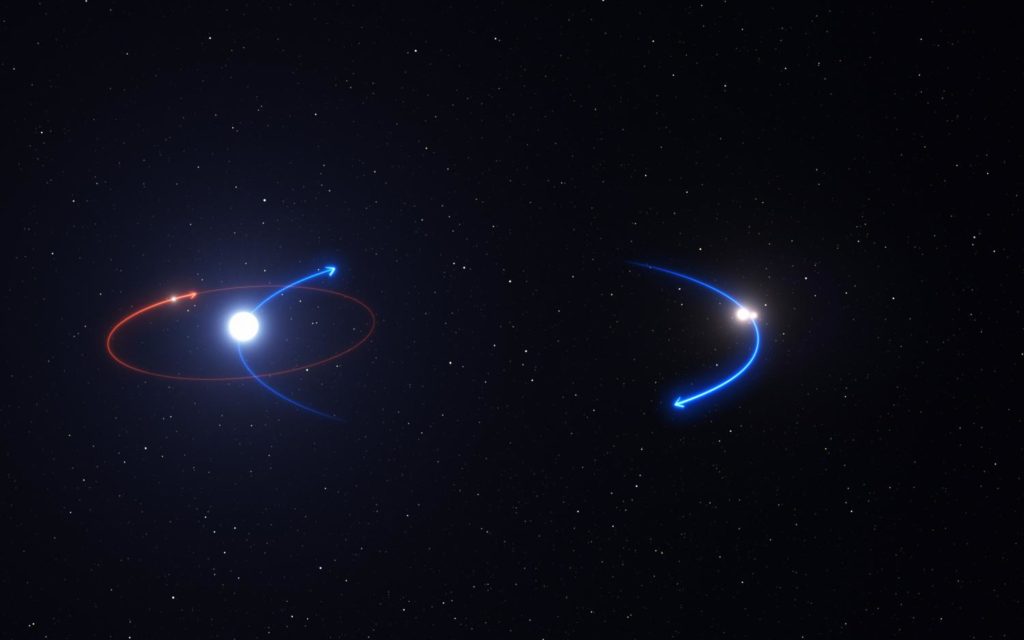 This graph shows the orbit of the "planet", in the HD 131399 system (red line) and the orbits of the stars (blue lines).
A photo
Scientists monitored the star system HD 131399over a long period of time. This allowed them to take pictures of the star system in motion. As the authors of the work stated, they found “a clear difference in the parallaxes between the object and HD 131399.” This is confirmation that the light from the “planet” actually came much further away than the light from the stars in the system. The discovery rules out the possibility that the light came from a planet in the HD 131399 system. Most likely, it was something much more distant and background.
Researchers told the press thattheir work highlights the risks associated with assumptions about stationary backgrounds in stellar systems. They hope their experience will help improve astronomy. All authors of the original article agreed to retract it.
Read more
Is the standard model of physics no longer relevant? The main thing about the new work of scientists at the collider
Scientists 'resurrect' an ancient enzyme to feed 9 billion people by 2050
Found traces of the strongest earthquake in the history of mankind
</ p>