A research team led by physicists from the SLAC National Accelerator Laboratory
Basic model of the universe
Lambda-CDM (ΛCDM, Lambda-CDM model) -modern standard cosmological model. In it, the spatially flat Universe is filled, in addition to ordinary baryonic matter, with dark energy and cold dark matter. According to this model, to be consistent with observations, the age of the Universe should be taken to be 13.799 ± 0.021 billion years.
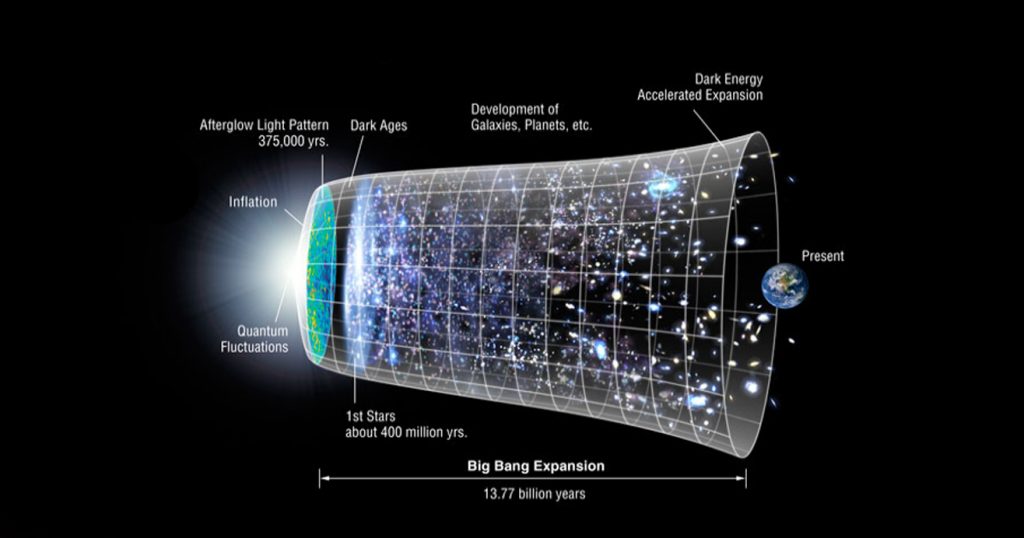 ΛCDM visualization.Credits and rights:NASA/LAMBDA Archive/WMAP Science Team
The main problem of observations
Conclusion about the distribution of cluster massesX-ray emission from galaxies is most reliable when the energy of the gas inside the clusters is balanced by the gravitational pull that holds the entire system together. Therefore, measurements of mass distributions in real clusters are focused on those that have passed into a “relaxed” state. When comparing with theoretical predictions, it is important to consider this choice of relaxing clusters.
Scientists' solution
Physicists from Stanford University studied computer-simulated clusters created as part of The Three Hundred Project.
As part of The Three Hundred Project, scientists are studying324 large galaxy clusters simulated using various full-physics hydrodynamic resimulations and semi-analytical models. Its goal is to provide a large catalog of theoretically modeled galaxy clusters for cosmological and astrophysical applications.
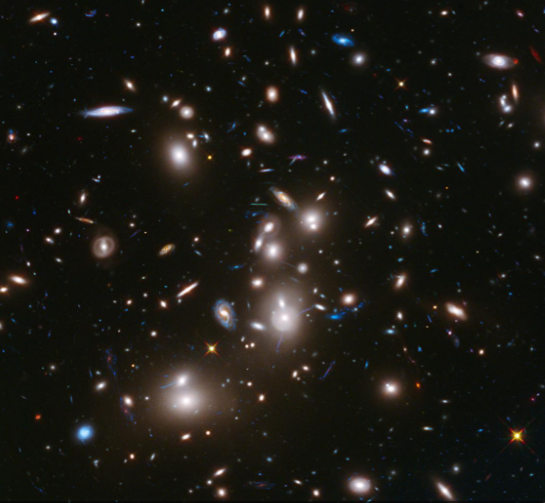 A long exposure image of the massive galaxy cluster Abell 2744 taken by the Hubble Space Telescope. It shows some of the faintest and youngest galaxies discovered in space
Credit: NASA/ESA/STScI
Scientists have calculated what it should look likeX-ray emission for each simulated cluster. They then applied the same observational criteria they used to identify “relaxed” galaxy clusters from real data. These were correlated with the simulated images to winnow the set.
The researchers then measured the relationship betweenthree properties of clusters—its mass, its degree of concentration at the center, and its redshift, which reflects the age of the Universe. The scientists used data from simulated clusters from the Three Hundred Project, clusters, and 44 real clusters observed by NASA's Chandra X-ray Observatory.
What did physicists find out?
Physicists find consistent resultsfrom both data sets. In general, clusters have become more centrally concentrated over time. At the same time, the mass of less massive clusters turned out to be more concentrated in the center than that of less massive objects. The measured relationships were found to agree very well between observations and theory. This ultimately “provided strong support for the Lambda-CDM paradigm,” the scientists write.
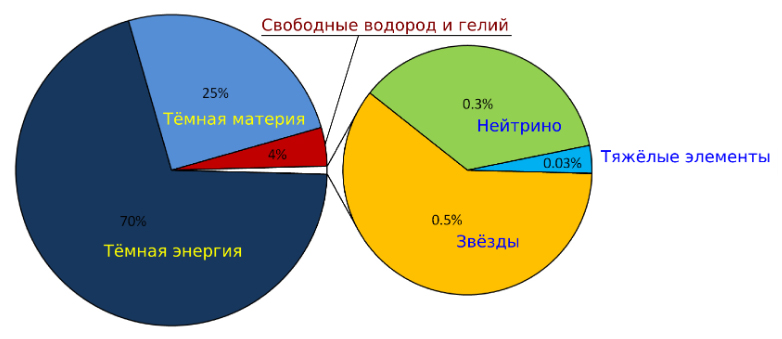 Composition of the Universe according to the ΛCDM model. Credit & Copyright: RedAndr, Azcolvin429derivative,CC BY-SA 3.0
What's next?
In the future, scientists hope that they will succeedexpand the size of both observed and simulated galaxy cluster datasets. SLAC-supported projects over the next few years, including the Vera Rubin Observatory's Legacy Survey of Space and Time and the fourth-generation Cosmic Microwave Background (CMB-S4) experiment, will help identify many more galaxy clusters. In addition, several space missions are planned to help physicists. For example, the launch of the European Space Agency's ATHENA satellite. Using the latest data, scientists will make more measurements in the X-ray range in the future.
SLAC cosmologists are also working to increasethe size and accuracy of computer simulations of the cosmos, which will allow for more detailed studies of galaxy clusters and set strict limits on alternative cosmological scenarios.
Read more:
It turned out that photosynthesis does not work the way scientists thought. Now they want to hack it
Distant radio galaxy turned out to be a black hole, which is directed directly at Earth
Found a way to reduce weight and blood sugar. Scientists promise the effect of surgery
On the cover: Timeline of the Universe
Author: Design Alex Mittelmann, Coldcreation