On the first day of the experiment, the researchers showed mice images of various objects, such as
Scientists found that almost all mice began to learn a new subject.This, according to the researchers, confirms that the test animals understood what they were seeingSomething familiar, albeit in an unusual way.
The results of the experiment were confirmed regardless of the shooting angle, symmetry, composition, and changes in color or brightness of the photograph.
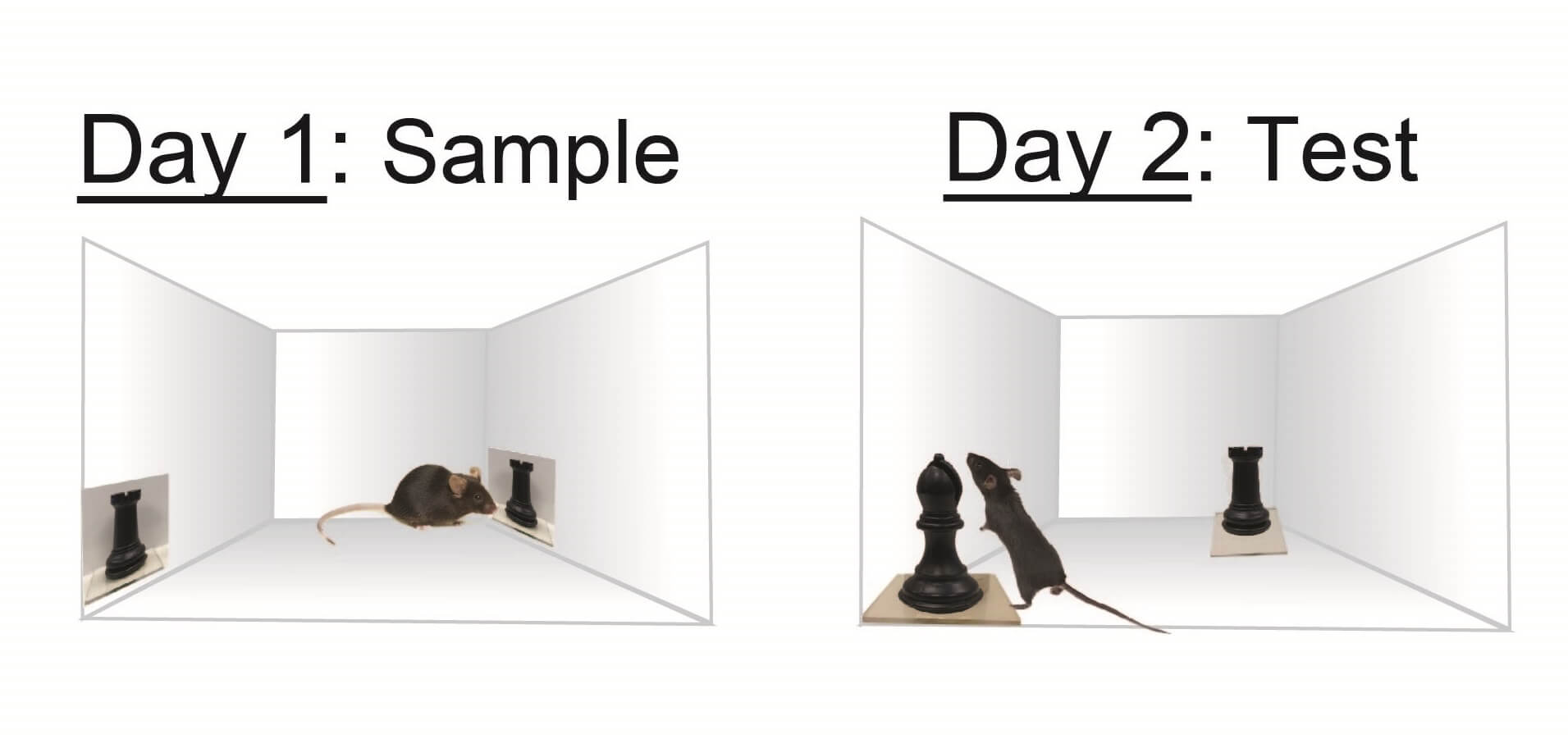 Scheme of the experiment. Image: Florida Atlantic University
In addition, scientists have found that, likein humans, in mice, the hippocampus is used to match the equivalent of a two-dimensional and three-dimensional object. The study showed that the ability to remember an image, which is necessary for object recognition, depends on the activity of neurons in the C1 region of the dorsal hippocampus. When exposed to this area, mice lost the ability to match images to objects.
"Our study calls into questionnotions about the limited perception of mice, which makes them unsuitable for modeling human memory and visual perception, says Robert Stackman, professor of neuroscience. "They also disprove the notion that recognition based recognition is independent of the hippocampus."
Scientists note that the ability to establishthe equivalence of the image to the object was considered the defining ability of primates. The results of the study show that mice also have such cognitive abilities.
“Taken together, our results provide"strong evidence that mice can serve as a model for investigating complex aspects of higher-order mammalian visual perception and recognition," Stackman adds.
Read more:
"James Webb" took the clearest photo of a star in history
Voluntary death. We tell how the euthanasia procedure works around the world
Scientists stumble upon 1,500-year-old archaeological anomaly