Международная группа ученых под руководством Университета Гете во Франкфурте проанализировала редкий
The transition zone is the name that scientistsdivide the boundary layer that separates the upper and lower parts of the Earth's mantle. It is located at a depth of 410 to 660 km. The upper part of the mantle is composed primarily of an olive green material called olivine. Under enormous pressure at the upper boundary of the transition zone, it changes its crystal structure and turns into wadsleyite, and deeper into an even denser ringwoodite.
The research team analyzed the diamond,mined in Botswana in Africa. It formed at a depth of 660 km, directly at the boundary of the transition zone and the lower mantle, where the predominant mineral is ringwoodite. Diamonds from this region are very rare, even among diamonds that form at great depths, their share is only 1%. Tests have shown that the stone contains numerous ringwoodite inclusions with a high water content.
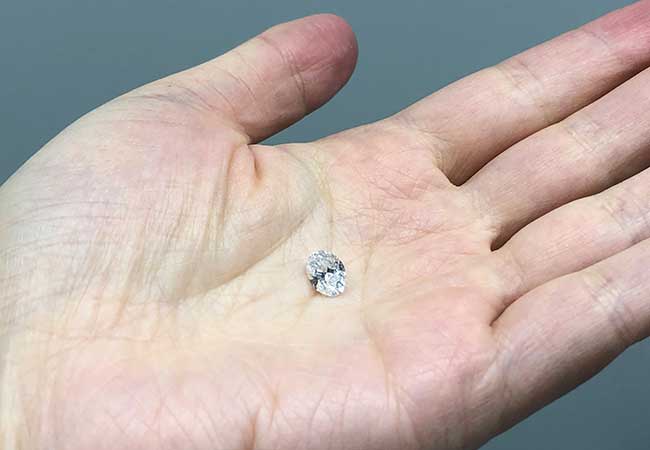 A diamond found in Botswana that formed inside ringwoodite. Image: Tingting Gu, Gemological Institute of America, New York, NY, USA
Forming superdense materials at the boundarytransition zones prevent the movement of material between the upper and lower parts of the mantle, as a result, the transition zone accumulates the remains of lithospheric plates that have sunk in the process, scientists say. Previously, scientists assumed that bottom sediments and ocean waters could accumulate with them, but only this study provided the first evidence.
The high water content in the transition zone playsof great importance for modeling the processes occurring inside our planet, scientists say. Adding water rocks to the model makes the whole structure more mobile, speeding up the transfer of material between different structures of the earth's interior.
Read more:
It turned out what happens to the human brain after one hour in the forest
It became known which tea destroys protein in the brain
Planetologists have found signs of life on Saturn's moon