An international team of researchers has discovered signs of the ancient origins of a rare genetic
For their work, scientists used the geneticinformation from a skeleton found in the northeast of Portugal. Radiocarbon analysis showed that the age of this find is about 1,000 years. Analysis of the genome immediately revealed the presence of a rare mutation, but the researchers conducted additional tests.
We were immediately excited when we firstsaw the results. But the ancient DNA was highly degraded, of poor quality, and had many irregularities, which means that we were initially cautious in our conclusions.
Joao Teixeira, research fellow at the Australian National University and study co-author
To test the hypothesis, scientists conductedcomputer modeling, comparing ancient DNA with a reference modern counterpart. This made it possible to exclude violations that are caused by degradation due to time.
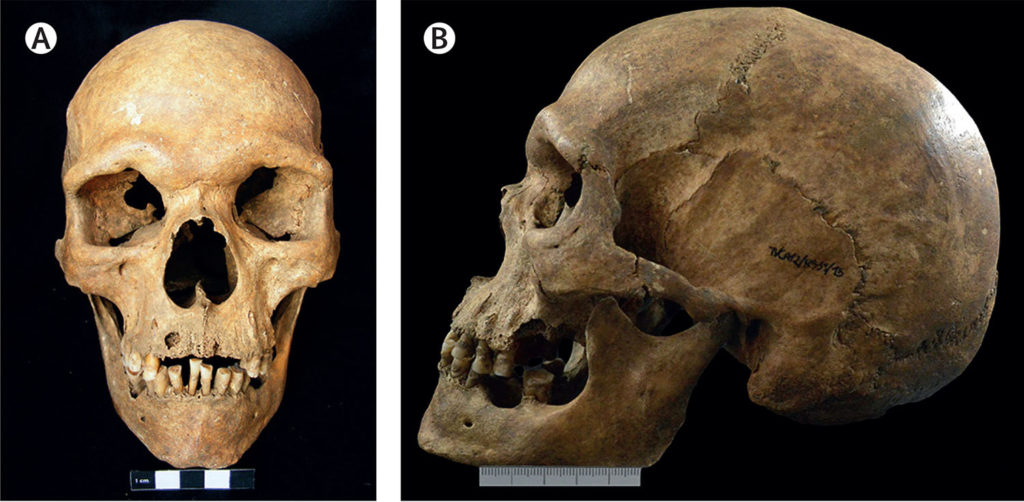 Photographs of the skull showing malocclusion, characteristic of Klinefelter's syndrome. Image: Xavier Roca-Rada et al., The Lancet
In addition, the found sample of the skeleton is wellpreserved, and therefore scientists were able to restore the external signs characteristic of Klinefelter's syndrome. In particular, scientists were able to confirm an unusually high growth for that time (1.8 m), wide hips and unevenly worn teeth, which indicate incorrect jaw occlusion.
Researchers believe that an integrated approach,using genetics, bone analysis and computer modeling could be used to study the past prevalence of other genetic diseases, such as Down syndrome.
Read more:
Earth-sized sunspot grows 10 times in 2 days: it is directed at us
This is the "twin" of the Earth in the past: a unique planet-ocean was found not far from us
Einstein was right again: after half a century, physicists proved the stability of black holes