A team of archaeologists led by Diego Salazar and Gabriel Easton from the University of Chile conducted
According to scientists, traces of the wave were found ondistance over 1.6 thousand km. from the shore. The researchers suggest that an earthquake with a magnitude of about 9.5 on the Richter scale raised a wave of 15-20 meters above sea level.
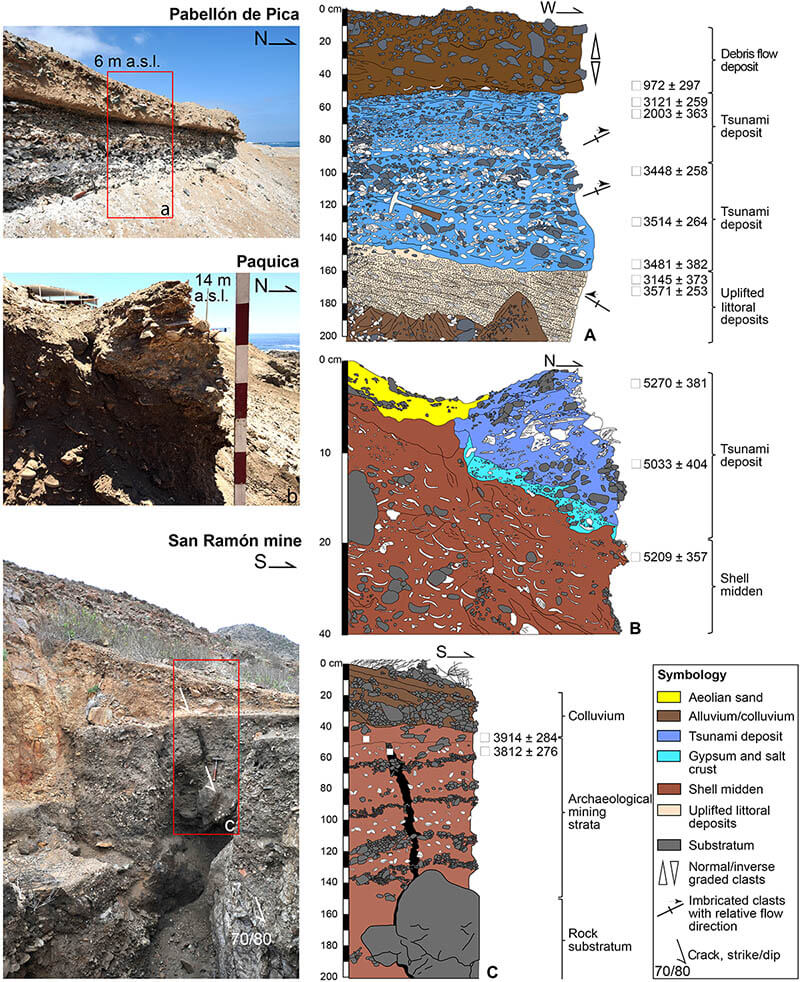 (A) Sediments up to six meters above sea levelsea at Pabellón de Pica, (B) Footprints at 14 m above sea level at Paquica Sur, (C) Archaeological layers at the San Ramon 15 mine affected by a seismic fissure. Source: Salazar, University of Chile
The coast of Chile is in a subduction zone, lineson the border of lithospheric plates, along which some blocks of the earth's crust subside under others: the oceanic Nazca plate slowly goes under the South American continental plate. Due to this location, the coastal region is characterized by increased seismic activity.
However, as scientists note, stability andThe diversity of marine resources attracted hunter-gatherer communities to the area. People developed and settled the coasts in the Atacama Desert region more than 12 thousand years ago.
Researchers believe that the powerful tsunami changedthe way of life of these tribes. The settlements of the ancient inhabitants moved further from the sea, the burial places were abandoned, and in addition, the total number of inhabited places decreased significantly.
Scientists suggest that the tsunami on the one handcarried away a large number of inhabitants, and on the other hand, pushed the remaining settlers deep into the mainland. High mortality is well confirmed by later data: it is known that a tsunami of similar scale at the end of the 19th century claimed the lives of up to 85% of the population of individual Chilean villages located off the coast.
In addition, archaeologists show that evensettlements closely connected with the sea by occupation were moved inland. Residents of such settlements actively used marine resources, but lived at a distance of 30–40 km from the coast. The researchers note that in many places, coastal areas remained intact for thousands of years after the earthquake.
Scientists have not yet been able to explain how the memory of the catastrophe and the ban on the creation of settlements by the sea were preserved for a long time among the people who did not have a written language.
Read more:
There is another “planet” inside the Earth: how it saved nascent life
New study refutes light energy transfer theory
Everything you knew about the tyrannosaurus is not true: how science is changing its Hollywood image