An international team of astronomers has studied how starbursts in the TRAPPIST-1 system affect internal heating
Previously, it was believed that flares on stars are negativelyaffect the habitability of planets. For example, they break the protective atmosphere. A new study has shown that flares can contribute to the creation of habitable near-surface environments.
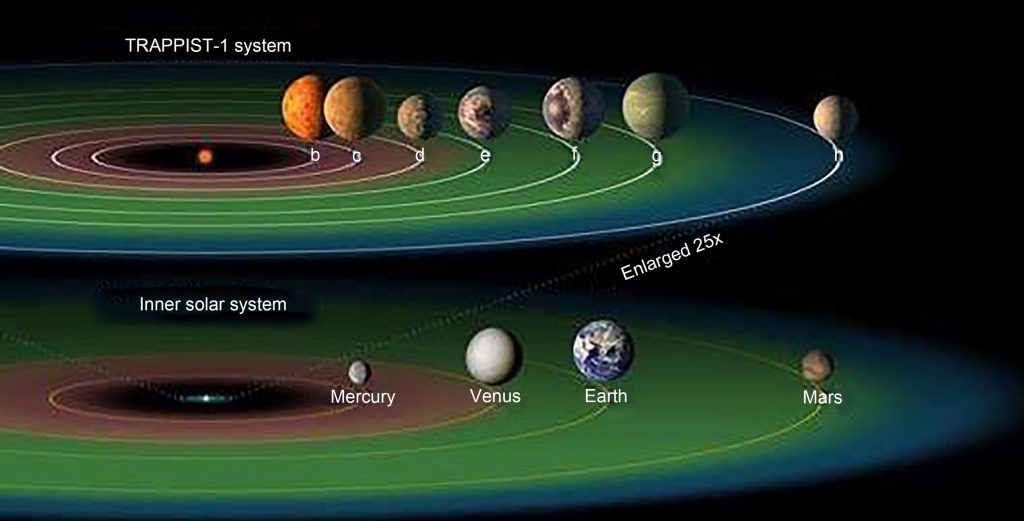 Comparison of the Solar System and the TRAPPIST-1 system. Image Credit & Copyright: NASA/JPL-Caltech
The TRAPPIST-1 system isexoplanet system, which is located approximately 39 light years from Earth. It consists of at least seven potentially rocky exoplanets that orbit the star. Its mass is 12 times less than the Sun. Due to the small size of the planets' parent star (an M dwarf) in TRAPPIST-1, their orbits are also much smaller.
Now scientists have found new evidence that the planets in TRAPPIST-1 could be habitable. Thanks to stellar flares, there are suitable conditions for this.
Read more:
The tomb of the “midwife of Jesus” was unearthed: scientists told what they found there
Einstein is wrong again and his main theory was rewritten: how it changes the world
Published test video of the world's first propeller with 11 blades