Titan, Saturn's largest moon, is a natural laboratory for studying the origins of life.
Simple organic molecules thaton Earth they are presented in liquid form, on Titan they look like solid ice mineral crystals. The reason is low temperatures - up to −178 °C. During the experiment, the scientists discovered that two molecules that are likely to be present in abundance on Titan—acetonitrile (ACN) and propionitrile (PCN)—are predominantly found in one crystalline form. It creates highly polar nanosurfaces that can serve as templates for the self-assembly of other molecules.
Thanks to the Cassini mission, scientists learned thatTitan is a great place to study the origin of life. Like Earth, Titan has a dense atmosphere, but it is mostly composed of nitrogen with some methane. It is the only known body in space other than Earth where scientists have found clear evidence of stable pools of surface liquid. Fueled by solar energy, Saturn's magnetic field and cosmic rays, nitrogen and methane react on Titan to form organic molecules of varying sizes and complexity. ACN and PCN are thought to be present in the Moon's characteristic yellow haze as aerosols, and they fall to the surface, settling as solid pieces of minerals.
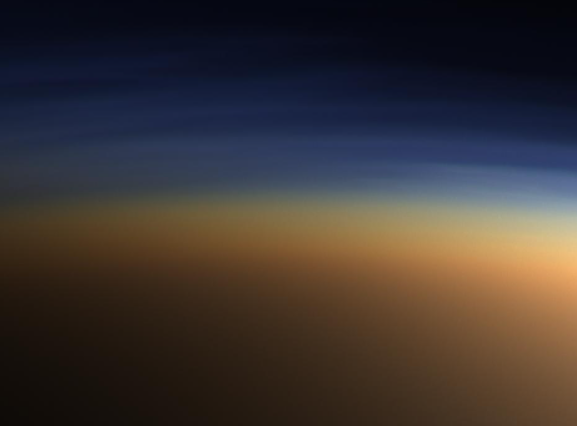 Color image of layers of haze in Titan's atmosphere. Credit: NASA
The properties of these molecules on Earth are goodare known, but their characteristics in conditions similar to Titan have not yet been studied. “In the lab, we recreated the conditions on Titan in tiny glass cylinders,” says Tomce Runczewski, Ph.D., the project's principal investigator. “In the experiment, we used nitrogen, as well as ACN and PCN to simulate precipitation.” The researchers then slightly increase and decrease the temperature to simulate temperature fluctuations on the surface of the Moon.
The resulting crystals were analyzedwith the help of synchrotron and neutron diffraction equipment, spectroscopic experiments and calorimetric measurements. “We have found out a lot about previously unknown structures of planetary ices. For example, we found that one crystalline form of PCN does not expand uniformly in three dimensions. Detailed knowledge of these minerals will help to better understand what the surface of Titan is like,” concludes Runczewski.
To read Further
A supercapacitor the size of a speck of dust has appeared: it is 3 thousand times smaller than its analogues
Tyrannosaurus Rex had neural sensors in its teeth to recognize prey
The age-old mystery of the source of cosmic rays in the Milky Way revealed