A team of scientists coordinated by the Julius-Maximilians-Universität (JMU) in Germany has created a unique
Lunar orbiters have already mappedseveral deep pits on the lunar surface. They are considered "skylights" in lava caves. Such objects are of great scientific interest. The point is that they provide access to pristine lunar material - perhaps even to deposits of water ice. In addition, such caves can become a habitat for lunar explorers and colonizers. They can serve as a natural shield against radiation, micrometeorites and extreme surface temperatures.
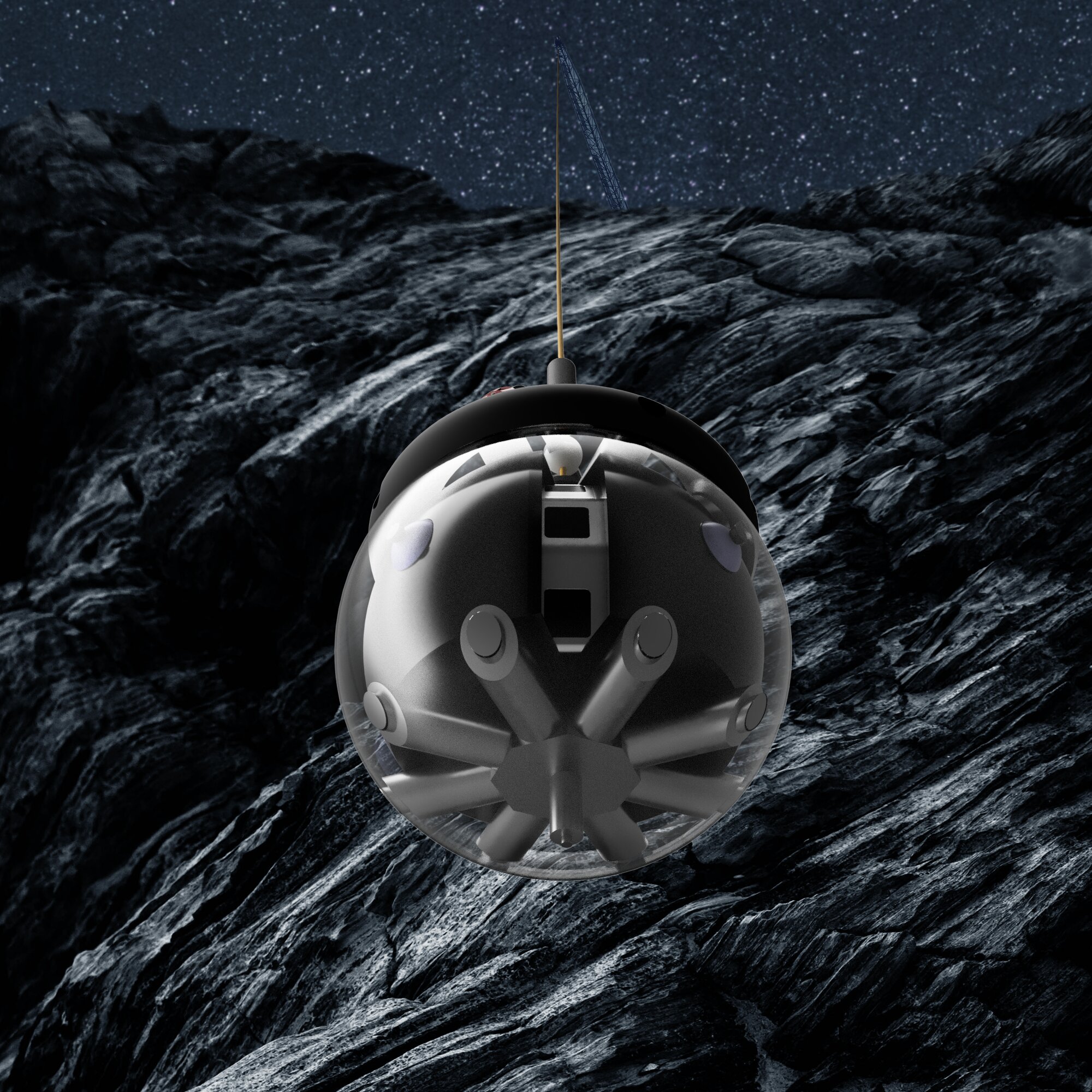 Credit: Julia-Maximilian University.
DAEDALUS is equipped with a stereoscopic camera,laser location and lidar systems for 3D mapping of cave "interiors". In addition, the robot's body is equipped with temperature sensors, a radiation dosimeter and mechanical "arms" that will help the device get rid of obstacles in its path and study the properties of rocks. It is worth noting that DAEDALUS is capable of operating autonomously. Its suspension cable will act as a Wi-Fi receiver, allowing the robot to transmit data from the pits.
The spherical design allows for 360-degree viewing of the environment.
Read more
Physicists have created an analogue of a black hole and confirmed Hawking's theory. Where it leads?
Mars Express helped find out where and how the water disappeared from the Red Planet
The most mysterious natural phenomenon. Where does ball lightning come from and how is it dangerous?