SARS-CoV-2 has evolved to acquire mutations in the spike protein, the part of the virus that acts as awith his
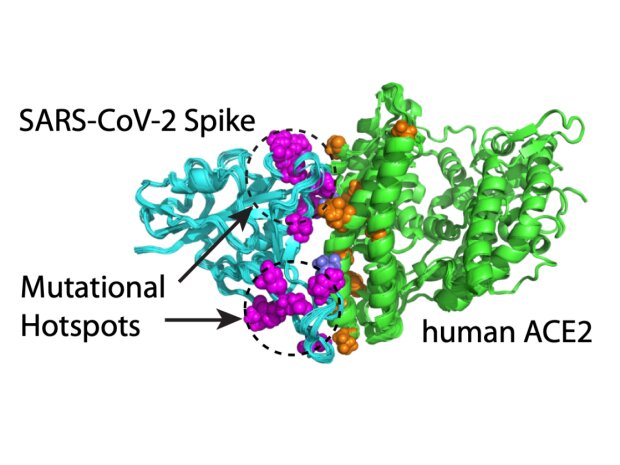 Credit: Hin Hark Gun and Christine Gansalus, NYU Department of Biology.
Scientists suggest that it is these mutations in the spike protein that are the key reason for the rapid spread of the virus in some parts of the world.
In recent months, there have been new and moreinfectious strains of the coronavirus, leading to new waves of the epidemic in countries such as India and Brazil. The worsening situation requires methods for the rapid prediction of new infectious viral strains. But keeping track of new options is not an easy task; genome sequencing shows that the SARS-CoV-2 spike protein alone, for example, has about 5,000 possible variants.
Screening for such a wide range of optionsposes a huge challenge to traditional experimental methods, the scientists note. The advantage of computer simulations is that one hundred mutations can be easily estimated in a few days.
Scientists have turned to a computational method that models how the SARS-CoV-2 spike protein recognizesThe ACE2 receptor – a protein on the surface of many cell types – to enter host cells. They evaluated 1,003 combinations of mutations in the coronavirus spike proteins, including those that led to a spike in infections in Brazil, South Africa, the United Kingdom and India.
A systematic assessment of the options showed thatSpike mutations that bind tightly to the ACE2 receptor occur in two clusters, or "hot spots," of mutations at the binding interface. They are located in structurally flexible regions. This means that mutations that increase binding have effectively reprogrammed the spine conformation to enhance its ability to recognize ACE2 receptors.
The study is published in Journal of Molecular Biology.
Read also
Skyborg autonomous drone makes first flight
A huge moth was found in Australia. Her wingspan is 25 cm
Scientists have turned concrete houses into batteries