Researchers from Curtin New University have shown that on Earth in 200–300 million years a single
Over the past 2 billion years, the continents on Earthconstantly collided, from time to time forming a single space. On average, this happens once every 600 million years. Scientists have used a supercomputer to model how and when the next supercontinent will form.
Exploring the expected development of tectonic platesEarth with the help of a supercomputer, scientists have shown that in less than 300 million years the Pacific Ocean will cease to exist, and the continents will unite into a single space, which they called Amasia.
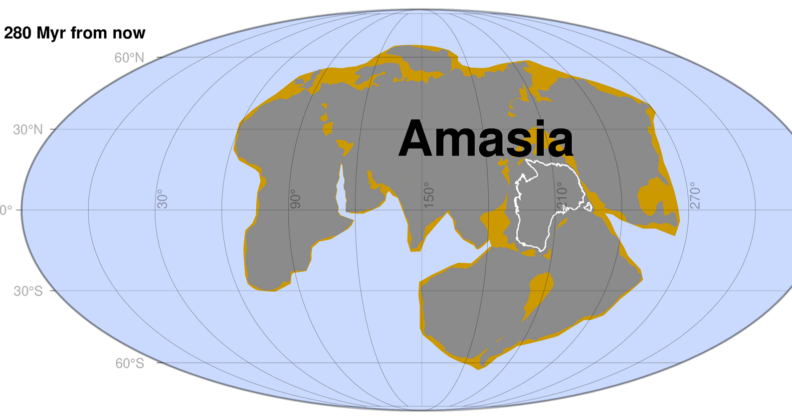 Proposed model for the Amasia supercontinent. Image: Curtin University
The Pacific Ocean is what's left of the super oceanPanthalassa, which formed about 700 million years ago, when the previous supercontinent began to break up into existing continents. It is the oldest ocean on earth and has been shrinking since the time of the dinosaurs. Now its size is shrinking by a few centimeters per year and, according to scientists, it will completely disappear in 200-300 million years.
At the first stage, America will face Asia, andthen Australia. At the very end, the latter, together with Antarctica, will close the remnants of the ocean into a single space. Researchers believe that the climate on Earth will also undergo significant changes. They believe that sea levels will be lower and the vast interior of the supercontinent will be very dry with high daily temperature swings.
Read more:
It turned out what happens to the human brain after one hour in the forest
It became known which tea destroys protein in the brain
Strange sea creatures in the depths of the ocean turned out to be similar to humans