A study published in the journal Science of The Total Environment,showed that the use of recycled
New road building material createdresearchers from the Royal Melbourne Institute of Technology (RMIT) in Melbourne (Australia). It is a blend of crushed disposable face masks and processed construction debris, designed to meet civil engineering safety standards.
Analysis has shown that face masks help add stiffness and strength to final products intended to be used as a base for roads and sidewalks.
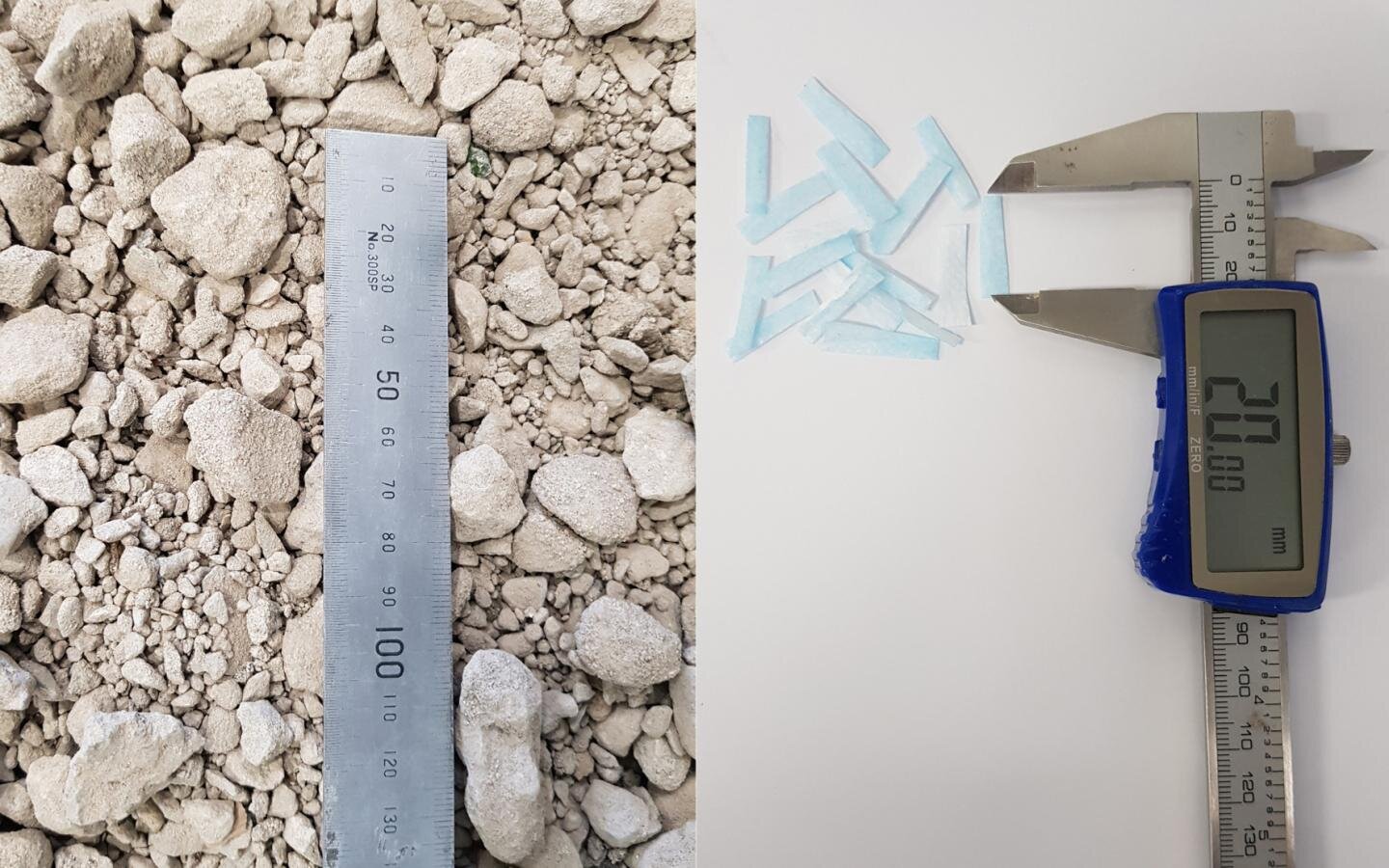 The new material is a mixture of recycled concrete aggregate (left) and small strips of crushed disposable face masks (right). Credit: RMIT.
New research first in questionexploring the potential applications of disposable surgical masks for civil engineering. The use of personal protective equipment (PPE) has skyrocketed during the COVID-19 pandemic, with an estimated 6.8 billion disposable face masks in use worldwide every day.
Roads consist of four layers: the roadbed, the base, the base, and the asphalt on top.All layers must be strong and flexible to withstand the pressure of heavy vehicles and prevent cracking.Treated Construction Crushed Stone – Recycled Concrete Aggregate (RCA) – has the potential toused on its own for the three layers of the base. Researchers have found that adding shredded face masks to RCA improvesmaterial, while simultaneously solving environmental problems in two directions: PPE disposal and construction waste.
Read more
Look at an 8 trillion pixel image of Mars
Scientists have developed a replacement for the theory of relativity. What is the essence of the "theory of everything"?
Scientists have found evidence of interbreeding of modern humans with Neanderthals