Findings from a new study of supernova 2014C help astronomers better understand how massive
In 2014, astronomers suddenly saw a brighta spot in the sky is a sure sign that a star has exploded in space. To study it, scientists used telescopes that perceive not only visible light, but also X-rays, radio waves and infrared radiation. This way, astronomers can determine the physical characteristics of the system.
Observations in the first 500 days after the explosionshowed that over time, the supernova emitted more X-rays, which was unusual and observed only in a small number of exploding stars. “It was as if the shock wave was interacting with dense material,” Vikram Dwarkadas, a professor of astronomy and astrophysics at the University of Chicago, said in a press release .
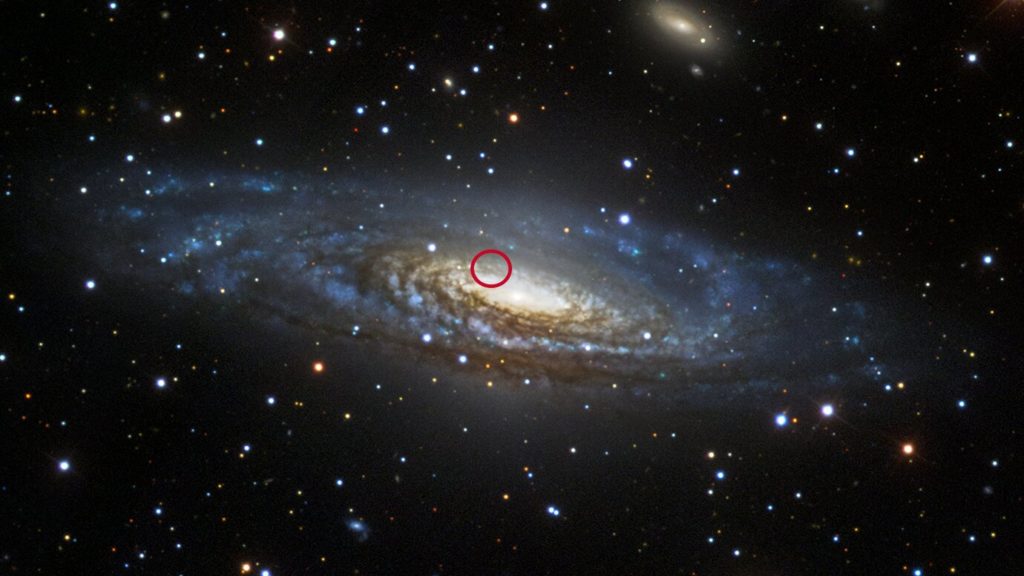 The very faintly visible 2014C explosion is outlined in red.
Credit: Sloan Digital Sky Survey
When the star exploded, it produced a shockwave. Its speed was 108 million km/h in all directions. Modeling showed that the shock wave reached the cloud and this affected its movement.
However, the nature of this cloud and its shape remain a mystery. Scientists are sure of one thing, this is definitely not an ideal sphere, otherwise the movement of radio waves would be more uniform.
According to scientists, a new study has shownvaluable information about the evolution of these stars and the mass ejected from them during the explosion. More broadly, the work will help scientists “learn more about the life and death of these relatively mysterious stars,” the University of Chicago noted.
Read more:
It has been hunted for centuries: what do we know about the planet Vulcan next to the Sun
Physicists have experimentally confirmed a new fundamental law for liquids
Astronomers have found a planet near the Earth: it has a very strange orbit
</ p>