In a new study, scientists have discovered strong polarization of a young supernova remnant. So
For the study, scientists usedStratospheric observatory for infrared astronomy with an onboard high-resolution broadband camera SOFIA HAWC+. They conducted D-band observations of the young supernova remnant Cassiopeia A (Cas A) showing high polarization at the level of 5–30%. Silicate grains, which are abundant in cosmic dust, are responsible for it.
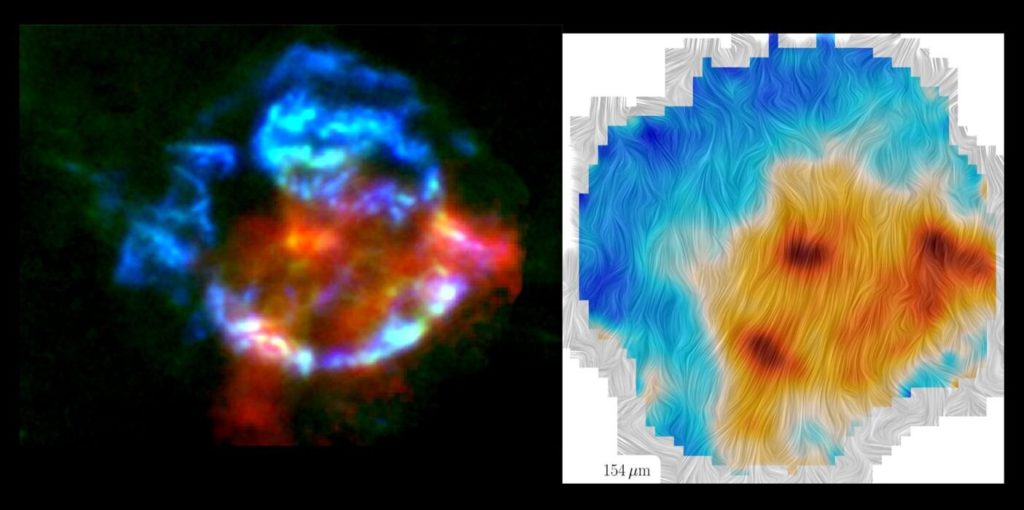 Left image: Mosaic images of SOFIA (154 microns in red), Herschel (70 microns in green) and Spitzer (24 microns in blue).
Right panel: magnetic field fluxes in the SOFIA far-infrared image (154 microns).
Credit: SETI Institute
Jonhee Ro, Research Fellow, SETI Instituteand the lead author of this study, stated that the polarized dust emission from SNR Cas A is not random interstellar emission. As the study authors note, studying far-infrared radiation is quite difficult because it is “everywhere in the sky.” Searching for radiation associated with supernovae is equivalent to searching for a needle in a haystack. Observing polarization makes things easier for scientists.
Previously, theoretical models predicted that the formation of dust in supernovae could explain its presence in the early universe.
Cassiopeia A is a relatively young SNR,located in the constellation Cassiopeia and approximately 11,000 light-years from Earth, and its light likely first reached Earth around 1671. SOFIA's HAWC+ is a far-infrared camera and imaging polarimeter. It helps image total and polarized flow in five broad wavelength ranges. Cas A's polarization map was acquired at 154 microns (D-band).
Read more
The Japanese dumped a giant turbine into the ocean to get endless energy from the current.
Astronomers from Japan have found an unknown structure in the galaxy
Researchers filmed a 'hidden' ecosystem in an Antarctic river