Dark matter may consist of ultra-light dark photons that have heated our Universe. To this
What is the peculiarity of the new hypothesis?
The peculiarity of the new hypothesis is that itagrees perfectly with observations made by the Cosmic Origin Spectrograph (COS) aboard the Hubble Space Telescope. He studies the "cosmic web," the complex and sparse web of filaments between galaxies that fills the cosmos.
What data did the spectrograph collect?
Cosmic intergalactic filaments are hotter than predicted by hydrodynamic simulations of the Standard Structure Formation Model, according to data collected by COS.
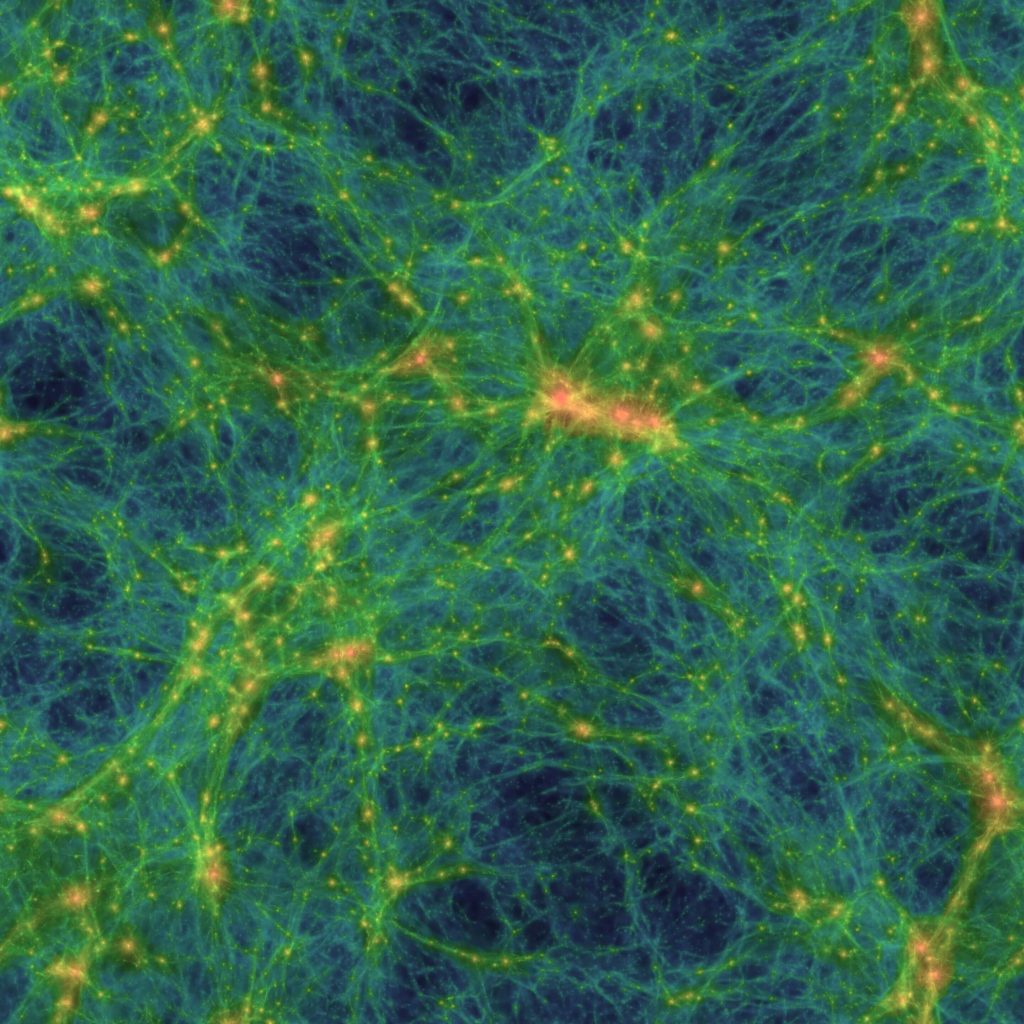 A two-dimensional projection of the cosmic web, obtained as a result of simulation on a supercomputer.
Credit: Dr. Ewald Puchwein and the Sherwood-Relics Collaboration
Because dark photons can theoreticallybe converted into low-frequency photons and heat cosmic structures, they complement new experimental information, the authors of the study explain. It was conducted by SISSA staff in collaboration with researchers from Tel Aviv, Nottingham and New York Universities.
What are dark photons?
Dark photons are new hypotheticalelementary particles. They are considered carriers of a new fundamental interaction, a "mediator" between ordinary and dark matter. According to the hypothesis, they interact precisely thanks to these particles.
Similarly, photons are the carriers of force forelectromagnetism. However, unlike them, dark photons can have mass. In particular, the ultralight dark photon - with a mass only twenty orders of magnitude smaller than the mass of an electron - is a good candidate for the role of dark matter.
 An artist's idea of the motion of photons. Credit: Robert Couse-Baker
Any newa force of nature that arises within the framework of a theoretical extension of the Standard Model and behaves like an electromagnetic interaction. Often in such models there is an unstable or non-zero mass dark photon. It quickly decays into other particles, such as electron-positron pairs. In addition, the dark photon, according to the hypothesis, is able to directly interact with known particles, such as electrons or muons. But only if these particles carry a charge associated with the above new interaction.
How are dark photons related to the cosmic web?
It is also expected that dark and ordinary photonswill mix like different types of neutrinos. This will allow them to be converted into low-frequency photons. They, in turn, will heat the cosmic web. However, unlike other heating mechanisms based on astrophysical processes, such as star formation and galactic winds, this process is more diffuse and efficient even in regions of space with low density.
missing element
Typically, astrophysicists used cosmic threads,to explore the small-scale properties of dark matter. However, in the new study, scientists used data from the low-redshift intergalactic medium as a calorimeter for the first time. The goal is to test whether all the heating processes that astronomers have previously observed are sufficient to reproduce the data obtained at COS.
 one of the most massive galaxy clusters known, RX J1347.5–1145, whose center is visible here in a dark "hole" in ALMA observations. Source: ALMA, CC BY 4.0, via Wikimedia Commons
Einstein's theory of relativity states thatA clock located closer to a large body (such as the Earth) will run slower than a clock located further away, such as in space. This phenomenon, known as gravitational redshift, has previously been confirmed by researchers.
In the end, they discovered that this is not the case: there is some missing element. Therefore, scientists have suggested that the whole thing is in dark photons.
What's next?
In a new study, physicists have determinedmass and mixing of a dark photon with a photon of the Standard Model. It is necessary to eliminate inconsistencies between observations and simulations. In the future, this experiment will lead to further theoretical and observational studies to explore the possibility that a dark photon may constitute dark matter.
Read more:
Scientists from the permafrost zone: how they develop smart clothes and a cancer vaccine
Scientists "cheated" time and sent a photon into the past: how this breakthrough will change physics
10 scientific facts that turned out to be fakes. Cards