A scientist from Tokyo Metropolitan University showed that large gamma ray emitting bubbles around
Numerical simulation successfully reproducedtemperature profile observed using an X-ray telescope. Such processes have been observed in other galaxies. According to a new study, similar winds blew in the Milky Way until recently.
There are many massive objects in the Universe,which have yet to be explained. Among them are “Fermi bubbles,” so named because they were first discovered by the Fermi Gamma-ray Space Telescope in 2010. The bubbles are huge regions emitting gamma rays that extend on either side of the Milky Way's center for about 50,000 light years. Despite their scale, the mechanism of their formation has yet to be deciphered.
Professor Yutaka Fujita from Tokyo MetropolitanUniversity presented theoretical evidence by reproducing the process of Fermi bubble formation in several simulations. He took into account fast winds from the central black hole. They “inject” the necessary energy into the gas surrounding the center of the galaxy. It turned out that, most likely, the Fermi bubbles were formed due to fast winds that have been blowing at speeds of 1,000 km/s over the past 10 million years. These are streams of highly charged particles that move at high speeds and spread in space.
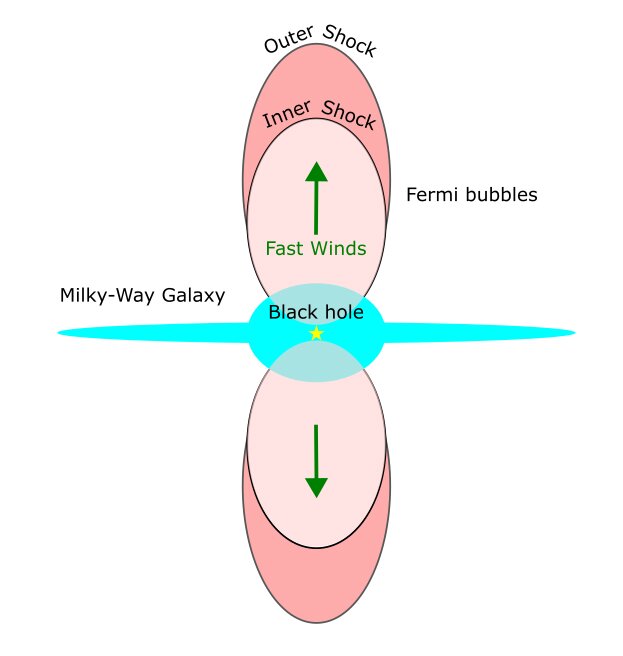 Swift winds emanating from the galacticcenter, create forward and reverse shock (forward shock, reverse shock). The latter forms a contour of Fermi bubbles. Credit: Tokyo Metropolitan University
They spread “outward” and interactwith the surrounding halo gas, causing a backshock that creates a characteristic temperature peak. Fermi bubbles correspond to the volume inside this back shock wave front. The modeling also showed that the bubbles did not appear as a result of a cosmic explosion.
Read more:
The tomb of the “midwife of Jesus” was unearthed: scientists told what they found there
Einstein is wrong again and his main theory was rewritten: how it changes the world
Published test video of the world's first propeller with 11 blades
On the cover: Fermi Bubble Graphic, NASA