Meraxes gigas is a predatory dinosaur from the family Carcharodontosaurus. Although Meraxes is not the largest
The first bones of Meraxes gigas (Meraxes gigas) werediscovered by paleontologists back in 2012 in Patagonia. Researchers have spent the last few years extracting, preparing and analyzing the sample. As a result, they were able to assemble one of the most complete skeletons of carcharodontosaurus,
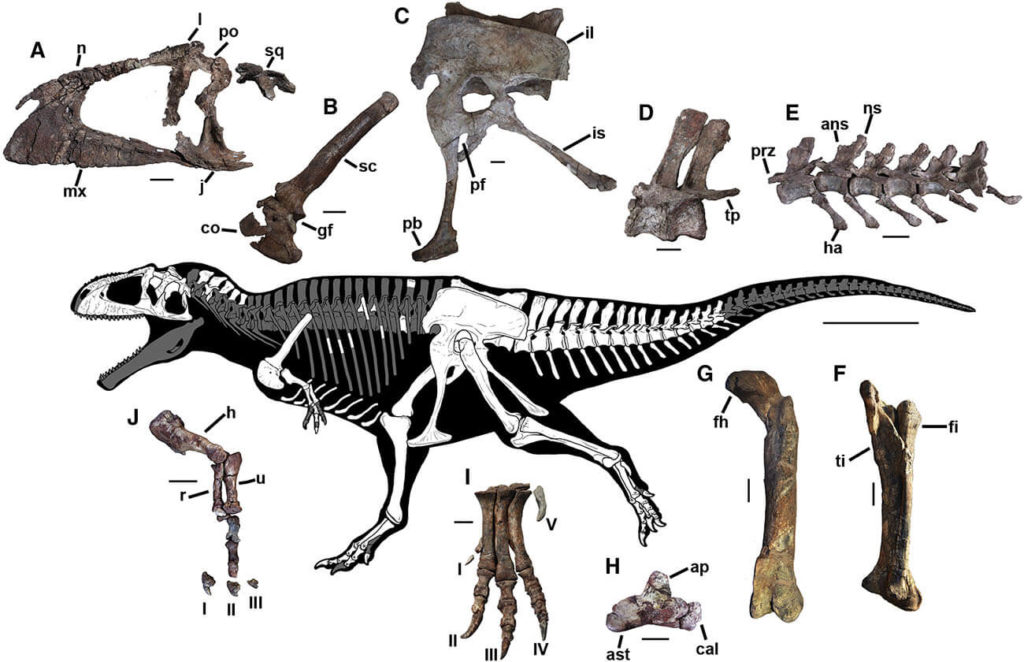 Recovered parts of the skeleton of Meraxes gigas. Image: Juan I. Canale et al., Current Biology
Meraxes is one of the rare representatives of hisa genus in which the bones of the upper limbs have been preserved. The researchers found that the length of the "arms" in these dinosaurs was about half the length of the femur. A similar relationship has previously been found for the T-Rex tyrannosaurs and abelisaurids.
In addition to the length of the arms, these species also turned out to be similar.according to other anatomical parameters. At the same time, as the researchers note, these two species are genetically weakly related and represent different branches of the genealogical tree of carnivorous dinosaurs.
With the help of statistics obtained fromIn a study of meraxes, the researchers found that the large carnivorous dinosaurs in all three theropod families grew at the same rate. As they evolved, their skulls became larger and their arms gradually shortened.
Researchers believe that this developmentis not associated with a change in hand function, as previously thought. And with the redistribution of the role of various organs in the body. The development of the brain allowed more "intelligent" dinosaurs to do without long limbs to search for food.
We don't have to worry so much aboutwhy the hands are used, because the hands actually get smaller as a result of the skulls becoming massive. Whatever the hands were or weren't used for, they take on a secondary function as the skull is optimized to handle larger prey.
Peter Macowicki, researcher at the University of Minnesota, co-author of the paper
Cover image: Carlos Papolio, University of Minnesota
Read more:
The main myth about dinosaurs has been refuted: scientists have understood how reptiles took over the planet
350 million years ago, something strange happened to the Earth: it affected habitability
A huge ozone hole has been found. It is dangerous for 50% of the world's population and is visible all year round.