Scientists wondered if we could send comets to "friendly" planets and seed them with terrestrial life
Comets are the source of life
The idea that comets might be linked to the origin of life on Earth was considered speculative until a few decades ago. However, the case that they influenced the emergence of the complex organic building blocks of life is becoming increasingly compelling. There was even such a term as cometary panspermia, which was first used by SirFred Hoyle in the early 1980s. A theory that was once controversial is slowly gaining groundscientific respectability and support.
More recently, scientists have even tested the idea thatthat comet and asteroid impacts on Jupiter's natural moon could transport critical ingredients for life into its hidden ocean of liquid water. The study showed that this is possible even if the "space bombardment" did not break through the icy shell of the gas giant's moon.
Accidental panspermia
The idea that life spreads throughout the universe is called panspermia, first proposed by the Greek philosopher AnaxagorasIn fact, according to panspermia, life exists throughout the universe and is spread by asteroids, comets, and even dust — "cosmic seeds" according to Anaxagoras.
Some researchers have suggested that powerful meteorite impacts on planets such as Earth or Mars couldAt the same time, the Red Planet has lower gravity than ours.Thanks to this, more than 270 such objects came to Earthand on other planets in other star systems.
It is believed that in the past, billions of years ago, there was microbial life on the Red Planet.It was to search for its traces that the rover Perseverance went.According to the idea of scientists, bacteria from Mars could be on rocks that were thrown into space from asteroid impacts.Perhaps they survived the journey through space and "made it" to a hospitable planet.Given the sheer number of such asteroid-planet collisions in star systems across the Milky Way, the idea of such an expansion of life doesn't seem so crazy.Researchers.
Scientists have called this process accidental or natural panspermia. If this is intentional, then we are talking about directed panspermia.
"Infection" with life
The authors of the new study believe that, physically, this idea is possible (with many caveats).One of the problems is the huge cost of ships that will populate other worlds.However, scientists have an idea to use natural "couriers" - comets.
This idea was inspired by "the events of recent years," the researchers write.For example, in 2017, an interstellar object'Oumuamua passed through the Solar System.Two years later, the interstellar comet 2I/Borisov also briefly visited it.They were the first observable interstellar objects (ISOs) to pass through the Solar System.Scientists wondered how many more such ISOs had made or would dothe same journey?
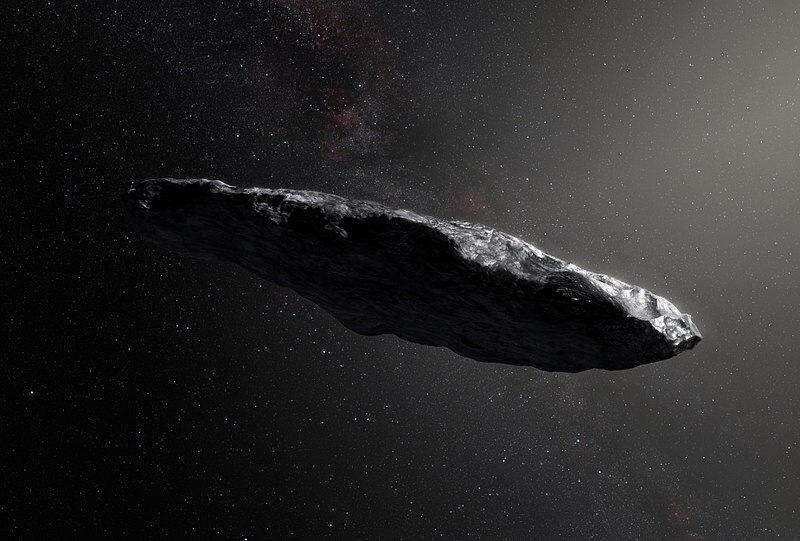 Oumuamua. Photo: ESO/M. Kornmesser
The discovery of two ISOs in such a short period is the result of advances in technology and a growing number of telescopes observing the sky.According to the authors of the article, in the future we will be able not only to observe even more interstellar objects, but also to use them for our own purposes.
"Interstellar comets will provide inexpensive“directed panspermia,” the scientists write. A 2021 study predicted that only about 6.9 objects such as 2I/Borisov should pass within one AU of the Sun in a year. And when the Vera Rubin Observatory begins operation in 2023, astronomers will be able to observe five ISOs per year.
Ideal Candidate
The authors of the new article paid special attention tocomet Borisov. Its exact size is unknown, but it is estimated that the diameter of the object reaches 16 km. This is enough to protect the inoculum (life that can be sent into the Universe) from radiation. The comet lost mass during its journey through the inner Solar System, “but that’s a good thing,” the researchers write. The dust she left behind "...may be a mechanism for spreading the inoculum," they explain.
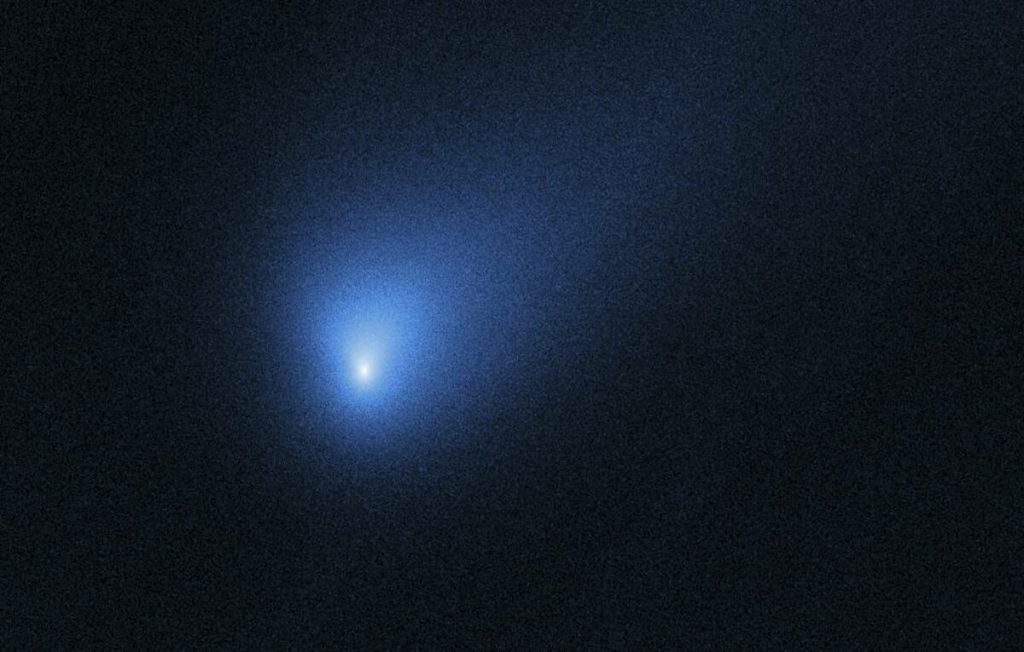 An image of the interstellar comet 2I/Borisov taken by the Hubble Space Telescope. Photo: NASA
The authors are confident that comets like Borisovcan be used to spread life throughout the Milky Way. Panspermia using ISO is the perfect combination of a natural and directed process. Scientists believe that it is entirely possible to deliver biological inoculum to a comet without trying to change its trajectory.
What kind of life to send into space?
Scientists consider the collection to be an ideal inoculumprimitive life forms. “On planets with liquid water on the surface, such as Earth and early Mars, it could evolve into diverse and complex life,” the authors write. Also, terrestrial metagenes would be suitable for moons such as Enceladus.
At the same time, the inoculum does not necessarily have tolimited to single-celled organisms. Scientists propose sending tiny multicellular organisms, such as the hardy tardigrades. They are known to survive the vacuum and radiation conditions of space.
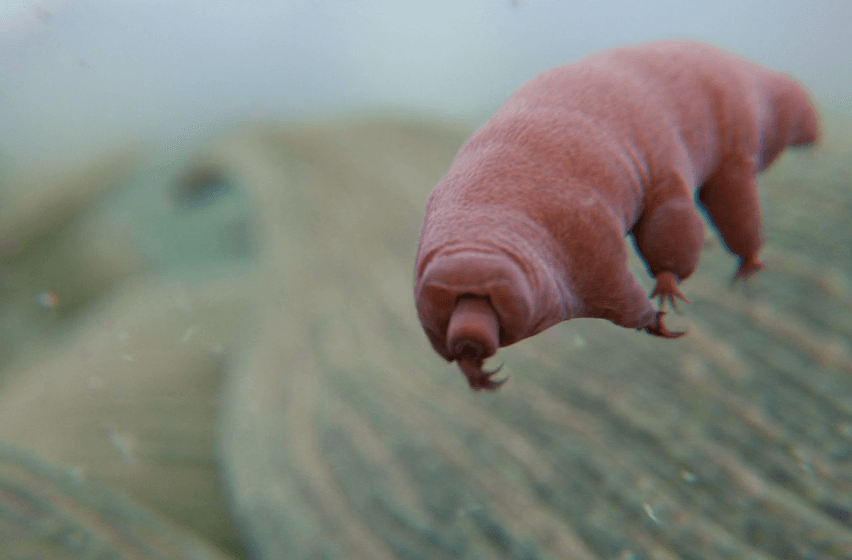 Tardigrade. Illustration: Rebekah Smith
If humanity ever launches a programdirected panspermia, then genetically modified organisms can also be used. Scientists propose sending them to Titan, Saturn's largest moon. This is the only body, besides the Earth, with surface liquid. “But, as synthetic biotechnology advances, we may be able to create life forms that will thrive on Titan and other nonaquatic habitats found on exoplanets in the future,” the authors explain.
How good is this idea?
The more powerful earthly technologies become, the morethe consequences of their use are larger. Advances such as genetic modification and climate engineering raise new questions about the safety and responsibility of humanity. One of the concerns of scientists is how ethical the purposeful spread of life in space is.
"You'd think mad scientists would want“subjugate the entire galaxy,” write the authors of the study. — However, this is still a long way off. There is time to think soberly about this and take into account all the risks.” In other words, before the time comes to ask the critical questions of “can we” and “should we” seed the galaxy with terrestrial life, we need to find suitable planets. And, most likely, they will already be inhabited.
But there may already be a billion planetsand the moons that support life, but natural panspermia has not yet reached them. If panspermia is a natural part of the universe, like life on earth, it is normal that humanity will play a role in the spread of life. Maybe people just have to do this. What if life on Earth appeared as a result of directed panspermia and a long-extinct civilization did what we are now planning?
Read more:
It turned out how old the water we drink today
17-year-old engineer came up with a magnetless motor: it can be used in electric vehicles
Two planets have been found not far from Earth. Perhaps they are inhabited