German researchers studied the regeneration abilities of sea spiders of the species Pycnogonum litorale. Contrary to
The researchers amputated the hind limbs anddifferent parts of the body in 23 immature and adult sea spiders and monitored the recovery process. The study showed that the adult sea spiders showed no signs of regeneration, but some of them survived two years later. On the contrary, young arthropods completely (or almost completely) restored all damage.
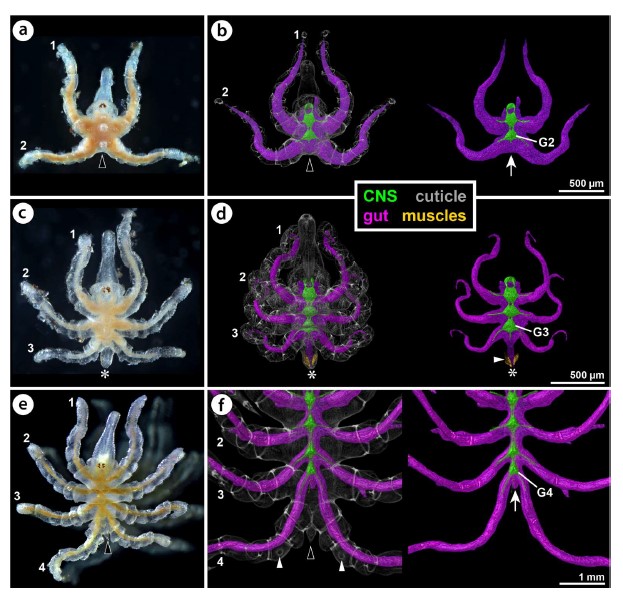 Regeneration in sea spiders: images (left) and visualization of various systems and tissues (right) during three successive molts. Image: Georg Brenneis et al., PNAS
Regeneration - animal abilityto recover from the loss of a body part is widespread in the animal kingdom, but manifests itself in different ways. It is known that the simplest living organisms can restore almost all functions. For example, flatworms can re-grow their body from just a few cells.
For a long time it was believed that, unlike otherspecies, moulting arthropods cannot regenerate damage to the main axis and are limited only by their ability to grow new limbs. The results of a new study refute this hypothesis.
Biologists will continue to analyze to uncover the cellular, molecular and genetic mechanisms of regeneration.
In the end, perhaps the mechanisms we find in arthropods will help treat loss of limbs or fingers in humans. There is always room for hope.
Gerhard Scholz, co-author of the study from the Humboldt University in Berlin, in an interview with AFP
Read more:
Earth's core will soon be spinning in a different direction
A giant sunspot is turning towards the Earth. It is visible to the naked eye
10 seconds closer to the end of the world: what will happen if the Doomsday Clock strikes
On the cover: spider of the species Pycnogonum litorale. Image: Georg Brenneis et al., PNAS