Barred spiral galaxy NGC 1512 and its small neighbor NGC 1510 were captured by the 4-meter telescope
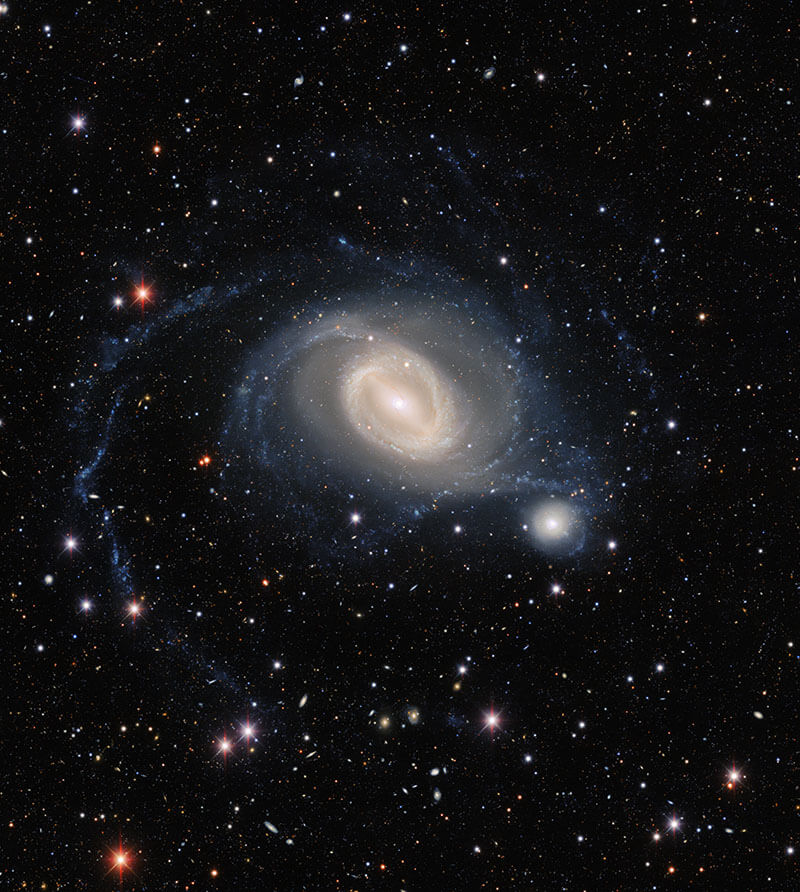 Image: Dark Energy Survey/DOE/FNAL/DECam/CTIO/NOIRLab/NSF/AURA
The galaxies NGC 1512 and NGC 1510 are located ona distance of about 60 million light years from Earth. The researchers note that the “stellar stream” connecting the two galaxies indicates gravitational interaction between them. This interaction has been going on for 400 million years and will eventually end with the merger of two galaxies into one.
Astrophysicists note that the jumper in NGC 1512acts as a cosmic vortex, funneling the raw materials needed for star formation from the outer ring to the heart of the galaxy. This flow of gas and dust fuels intense star birth in the bright, blue, twinkling inner disk, a circumnuclear star formation ring that spans 2,400 light-years.
Scientists believe that both the bar and the star forming ring are partly the result of the interaction of two galaxies.
The dwarf galaxy is also influencedbig neighbor: constant gravitational influence caused the vortex movement of gas and dust in NGC 1510 and launched star formation processes. This, according to astrophysicists, causes the galaxy to glow blue, indicating the emergence of new hot stars.
The same system of two galaxies was previously photographed by Hubble. Below you can see what NGC 1512 and NGC 1510 looked like in 2017 from space.
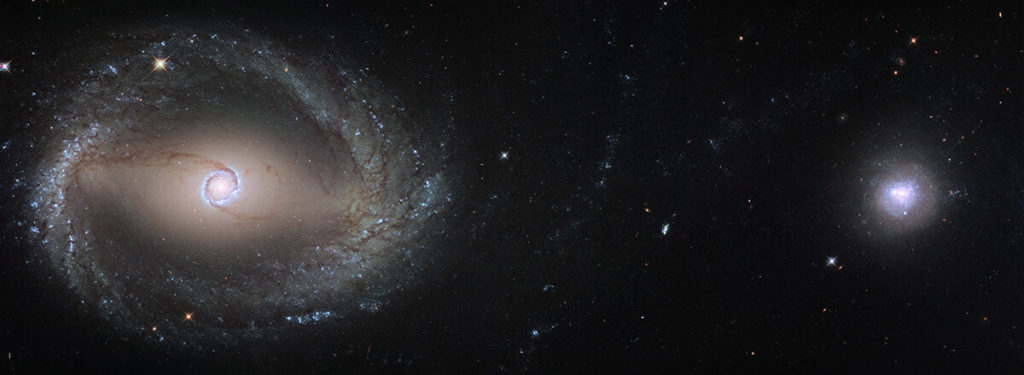 Image: ESA/Hubble, NASA
Read more
Look at the "silent" drone with a new generation of ion propulsion
Uranus is a very strange planet. We explain why astronomers want to send a probe to it
Scientists propose to revise the foundations of quantum physics and show where they do not work