Passengers on a cruise ship witnessed a rare “hybrid-total” solar eclipse—the first in
The astnonomic phenomenon was accompanied by the appearancecolossal corona—the Sun's glowing outer atmosphere, multiple prominent plasma loops, and the appearance of a "diamond ring." These phenomena could be seen from Australia on Thursday morning (April 20). The entire action lasted 60 seconds.
Hybrid solar eclipses area combination of a total solar eclipse, where the Moon completely blocks sunlight from reaching the Earth, and an annular solar eclipse, where the outer ring of sunlight is still visible around the Moon.
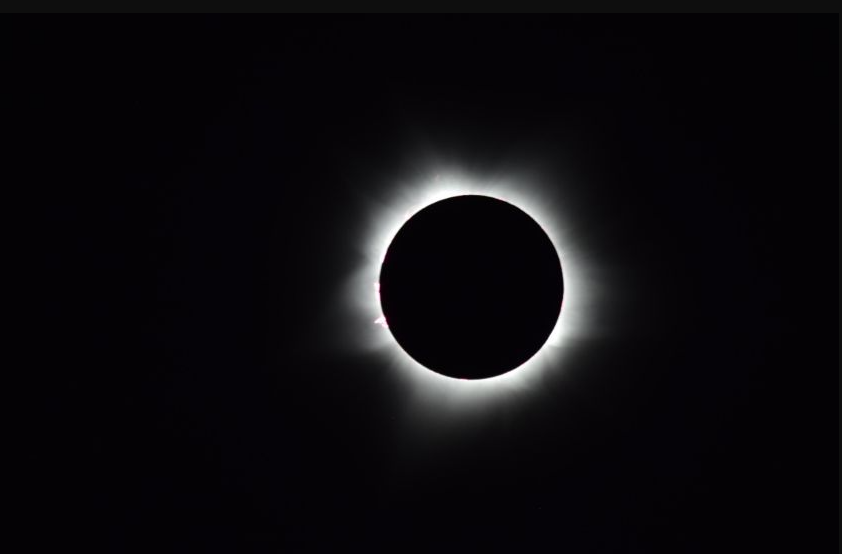 The appearance of the solar corona was accompanied by prominences on the surface of the Sun. Photo by: Den Charrois
As Jamie Carter writes for Live Science, approx.2,000 eclipse hunters watched the eclipse off the waters of Exmouth Gulf, Western Australia, aboard the Pacific Explorer. To do this, they covered 1,575 km (850 nautical miles) in four days. In the images that showed the start of the hybrid eclipse (on the cover), the Moon appears to be biting the Sun, Carter notes.
Next year there will be a total solar eclipsewill be seen in Mexico, USA and Canada on April 8, 2024. Passengers on the Pacific Explorer who witnessed Thursday's eclipse will be able to see the phenomenon again in about eight years. The next hybrid total solar eclipse will occur on November 14, 2031 and will be visible from the Pacific Ocean.
Read more:
There was a photo inside the second deepest underwater sinkhole in the world
See what happened to Mercury when it got as close as possible to the Sun
Scientists are ready to recognize the new tree as the oldest in the world
Cover photo credit: Den Charrois