The researchers obtained images of the spiral galaxy IC 5332, located at a distance of more than 29 million light
The diameter of IC 5332 is approximately 66,000 mm.light years. It is slightly larger than the Milky Way. The distant galaxy is located so that the symmetrical curves of the spiral arms can be seen in detail from the Earth.
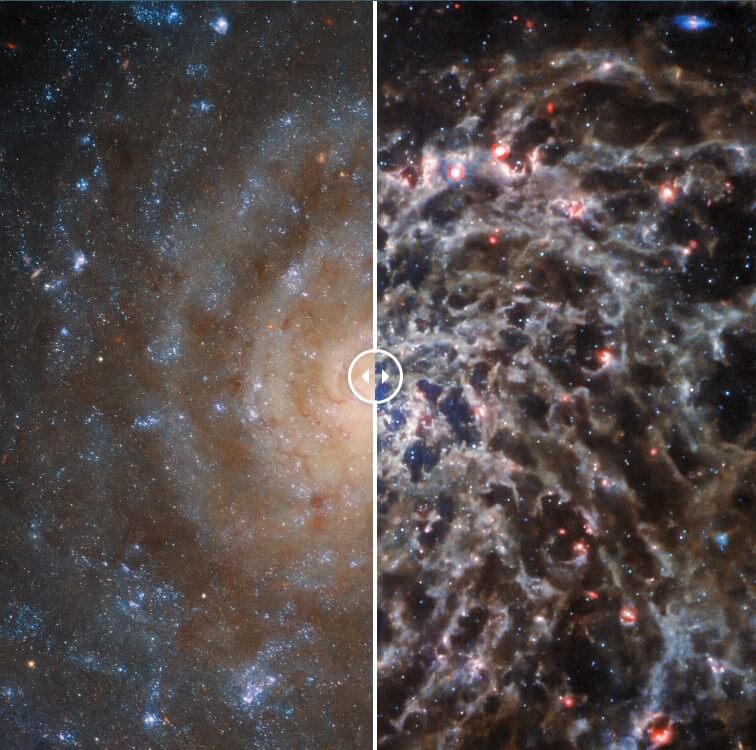 A comparative image of the spiral galaxy IC 5332 taken by Hubble (left) and James Webb (right).Image: ESA/Webb, NASA & CSA, J.Lee and the PHANGS-JWST and PHANGS-HST Teams
The new images show a detailed image inmid-infrared by the James Webb telescope and a beautiful image of the same galaxy in ultraviolet and visible light by Hubble. Some differences are immediately evident. Hubble shows the dark regions that seem to separate the spiral arms, while a second telescope takes pictures of a continuous tangle of matter.
This difference is due to the presence in the galaxydusty areas. Ultraviolet and visible light are much more susceptible to scattering by interstellar dust than infrared light. The dusty regions can therefore be easily identified in the Hubble image as darker regions through which much of the galaxy's ultraviolet and visible light has been unable to pass.

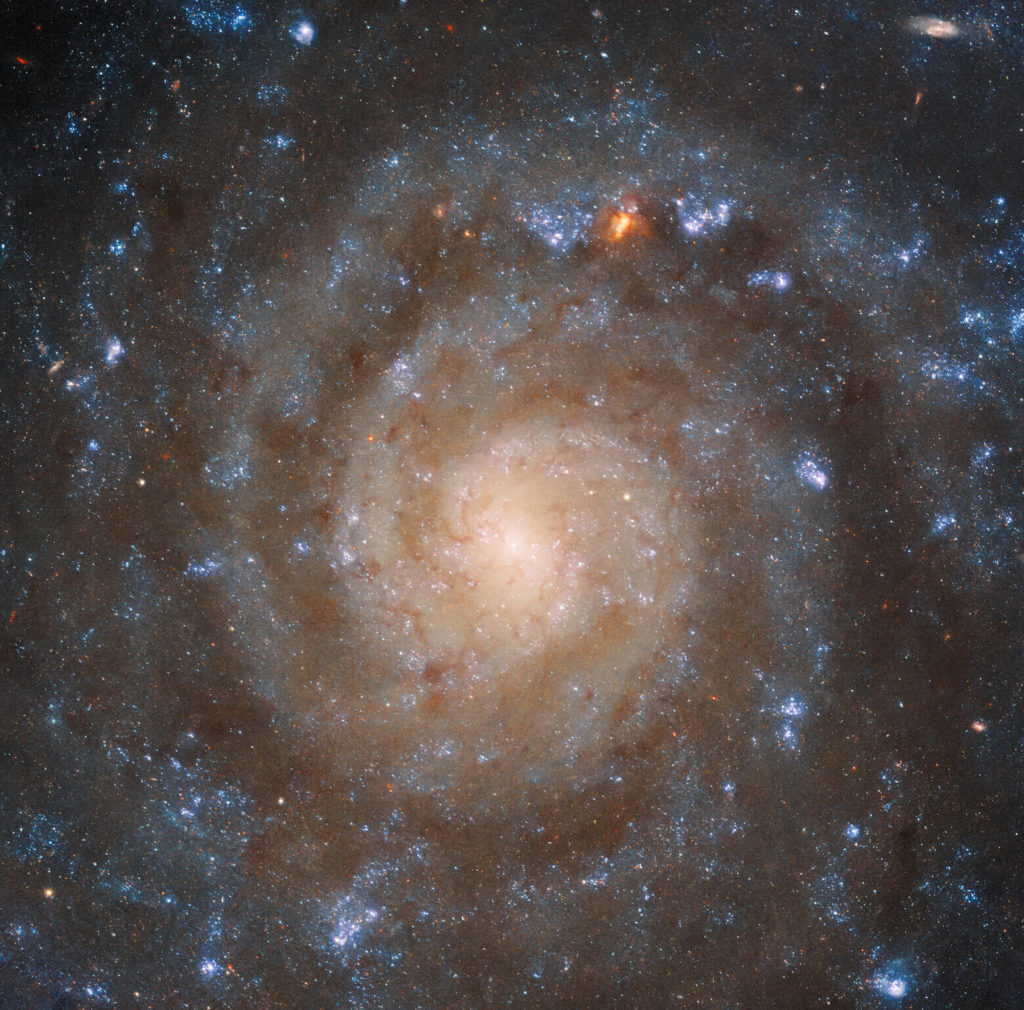
The spiral galaxy IC 5332 in images taken by Hubble (right) and James Webb (left).Image: ESA/Webb, NASA & CSA, J.Lee and the PHANGS-JWST and PHANGS-HST Teams
The "James Webb" image shows a spirala galaxy with unprecedented detail due to observations with the mid-infrared instrument (MIRI), the ESA explains. This is the only instrument of the telescope that is sensitive to the mid-infrared range of the electromagnetic spectrum (especially in the wavelength range of 5–28 µm), all the rest operate in the near-infrared range.
Electromagnetic radiation in this part of the spectrum is very difficult to observe because most of it is absorbed by the Earth's atmosphere, and the heat from theFor example, Hubble, which is operatingIn space, he could not observe the mid-infrared because his mirrors were not cool enough.Therefore, the infrared radiation of the mirrors themselves would prevail over any attempts at observation.
Чтобы добиться нужного эффекта, ученые охладили зеркала, которые использует MIRI до –266°C. Это означает, что они работает в среде, которая всего на 7°C теплее абсолютного нуля.
Read more:
It turned out what happens to the human brain after one hour in the forest
It became known which tea destroys protein in the brain
Planetologists have found signs of life on Saturn's moon