ExoMars is a joint program of the European Space Agency and the Russian state corporation Roscosmos
Scientists captured a new image of the young volcanic region Elysium Planitia on Mars [10.3 ° N, 159.5 ° E] on April 14, 2021 with the CaSSIS camera on the Trace Gas Orbiter (TGO) orbiter.
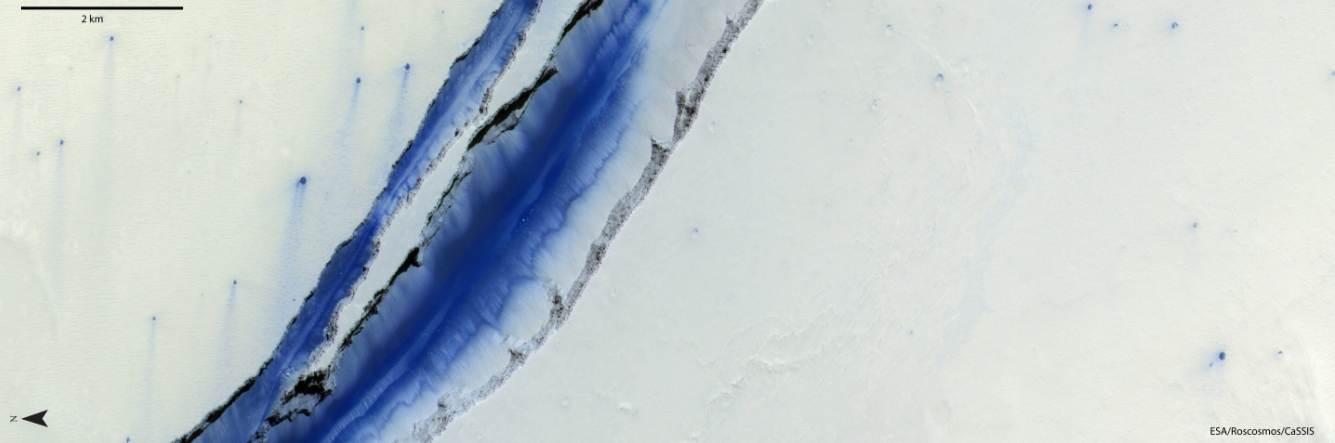
The picture shows two blue paralleltroughs known as Cerberus Fossae are young tectonic fractures thousands of kilometers long on Mars. They were formed as a result of tectonic processes and stretch for thousands of kilometers across the volcanic region. In this image, the CaSSIS camera is pointing directly into one of these 2 km wide fissures.
Cerberus Fossae translates from Latin as "FaultsCerberus ". This is a reference to a mythical creature, a three-headed dog that guards the exit from the realm of the dead in Hades. He does not allow the dead to return to the world of the living, and the living to visit the dead.
One of the cracks is one kilometer wide,and the depth of the structure is several hundred meters. The faults on Mars are filled with coarse sand, presumably basaltic. This sand is shown in blue in the combined images from the CaSSIS camera.
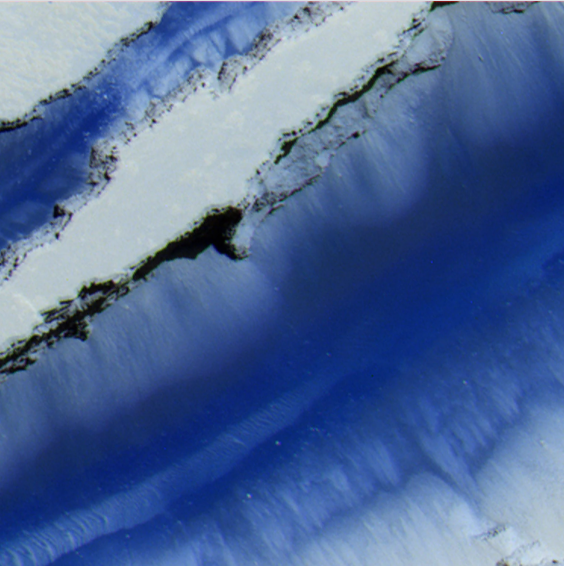
Elysium Planitia (“Elysium Planitia”) —the second largest volcanic region on Mars. Its dimensions are 1700×2400 km. Scientists have identified the Cerberus Fossae region as the first tectonically active region on Mars.
To read Further
The most detailed model of the Universe has been published online. Anyone can study it
Physicists come close to discovering the fifth force while creating perfect crystals
Physicists have cooled atoms to the lowest temperature in the world