In honor of the official opening ceremony of the Inoue Solar Telescope (The Daniel K.Inouye Solar Telescope or DKIST)
It is reported that the images were taken during observations of the Sun on June 3, 2022.The published image shows an area with a diameter of 82,500 km with a resolution of 18 km per pixel.
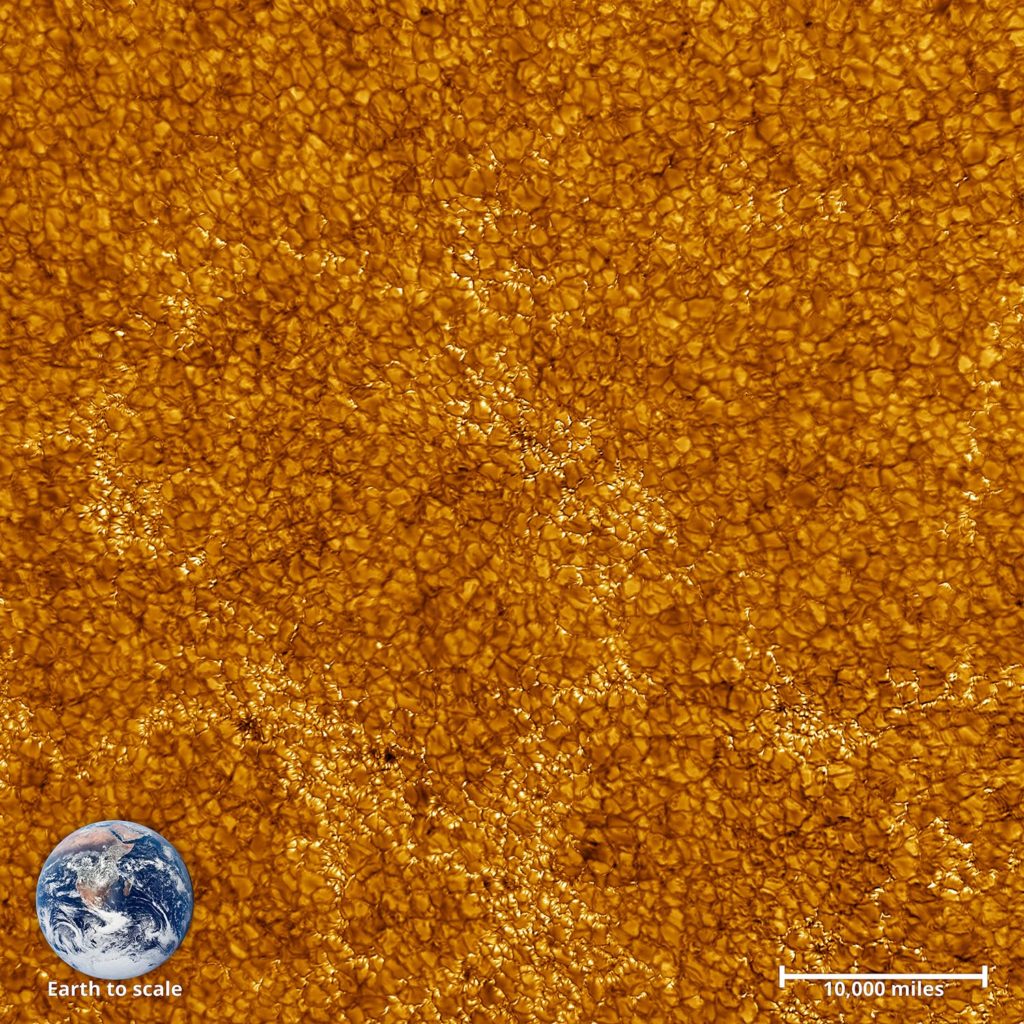 The surface of the Sun, obtained using the visiblebroadband thermal imager. The image shows a region with a diameter of 82.5 thousand km with a resolution of 18 km. The image was obtained in the "G-band" Fraunhofer at a wavelength of 430 nanometers. Image: NSO/AURA/NSF. Full resolution image available here.
Recall that the chromosphere is the outer part of the shellSun located above the photosphere. Its name refers to the reddish color caused by the fact that the red Hα (H-alpha) emission line of hydrogen dominates in the visible spectrum. The image was obtained on the basis of observations of electromagnetic radiation with a wavelength of 486.13 and 430 nm.
Inoue is a four-meter solar telescope,set on the island of Maui in Hawaii. It is currently the largest solar telescope in the world. The telescope's design uses an off-axis design to reduce stray light and advanced polarimetry that measures magnetic fields in the Sun's corona. And the telescope's 4-meter mirror creates three times more detailed images of the star closest to Earth.
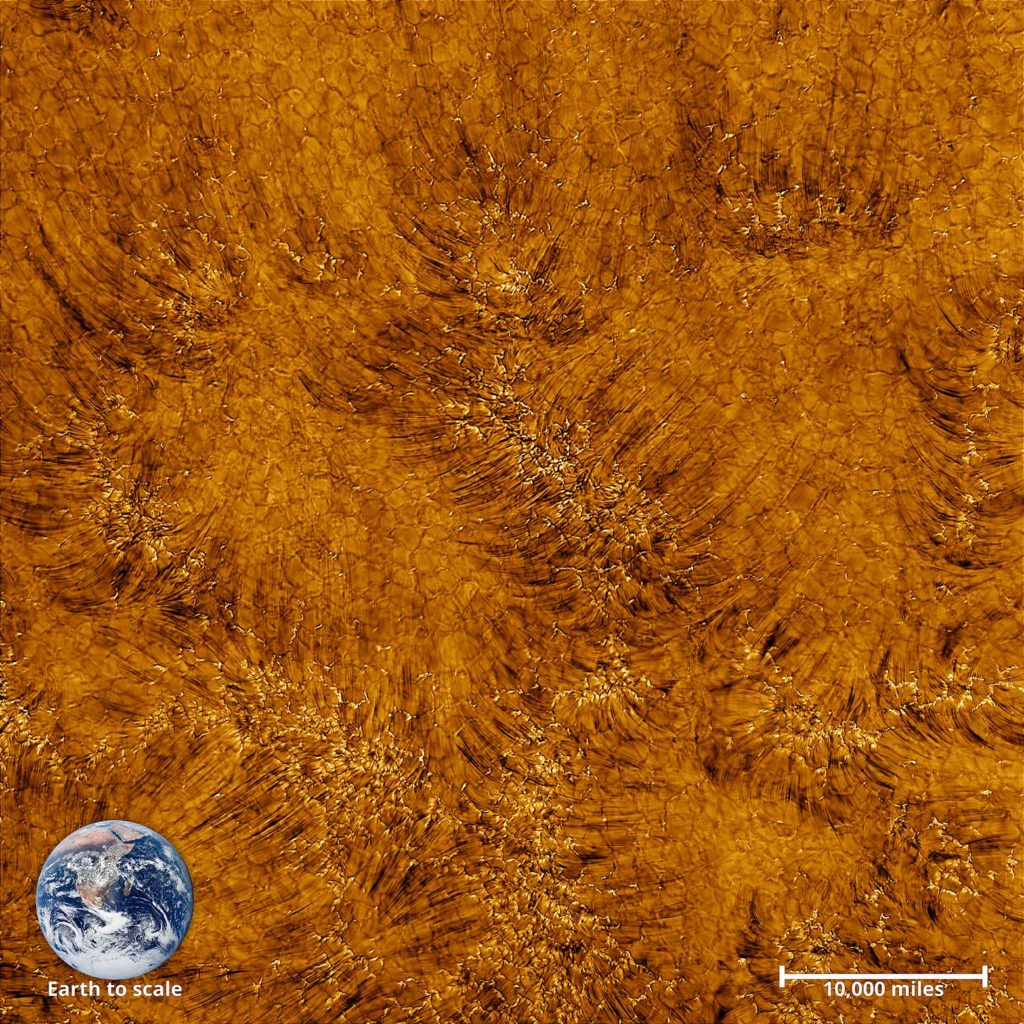 First image of the chromosphere.This image was taken at 486.13 nm using the hydrogen-beta line from the Balmer series. Image: NSO/AURA/NSF. Full resolution image available here.
In addition, the device is equipped with a spectrograph,which captures the specific "fingerprints" of hundreds of atoms and ions on the surface of the Sun and in its atmosphere. This is used to analyze stellar dynamics. The National Solar Observatory notes that since the start of work in February 2022, the telescope's data has been used for several dozen scientific publications.
Read more:
The ancient Vikings suffered from a dangerous disease. It is caused by a parasite from Africa
Plant on Mars produces oxygen at the rate of an average tree
Physicists have cooled atoms to record temperatures. They are a billion times colder than outer space.