The space telescope team has released a celebratory image taken by Hubble.
Free floating evaporating gas globulein this image, a dark spot in the upper left corner of the central part of the image, floating in a sea of red light. The red hue of dust clouds is formed by a special type of light radiation - H-alpha radiation. It has a wavelength of 656.281 nm and occurs when an electron passes from the third to the second energy level.
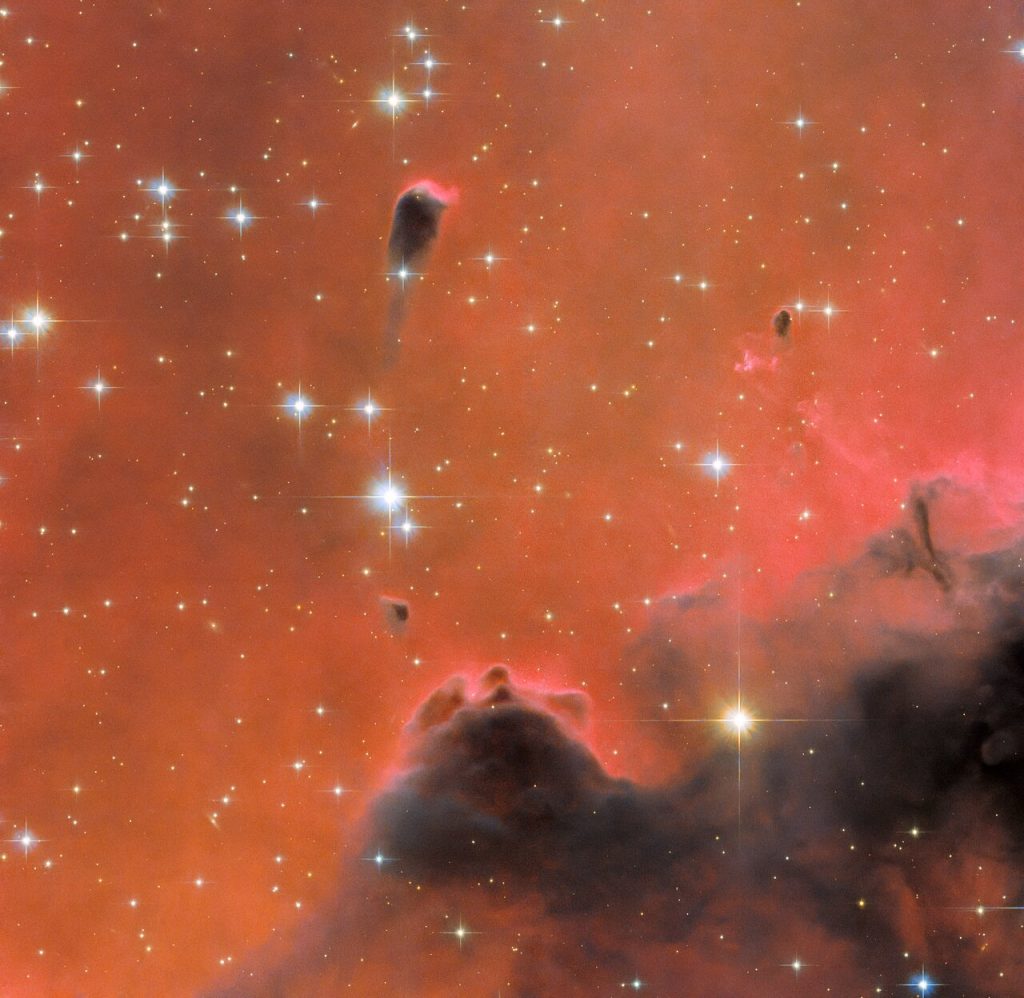 A free-floating globule in the Westerhout 5 Nebula.Image: ESA/Hubble & NASA, R.Sahai
An evaporating gas globule (EGG) is an areahydrogen is about 100 astronomical units in size. The gas covered by such an area is protected from the effects of ionizing ultraviolet radiation. EGGs are regions of gas that are dense enough to cause photoevaporation to occur more slowly than that of the surrounding gas.
Free-floating, evaporating gas globules differ from regular EGGs in that they have several regions resembling the head and tail of a tadpole.
These objects are of particular interest toastrophysicists because their density makes it difficult for the intense ultraviolet radiation found in regions rich in young stars to penetrate through them. Their relative opacity means that the gas in them is protected from ionization and photoevaporation.
Read more:
Two planets have been found not far from Earth. Perhaps they are inhabited
A unique meteor rewrote the history of the solar system: where did it come from
The prototype module of the new ISS was blown up at the NASA center. Look how it was