Jeff Morgenthaler of the Planetary Science Institute has discovered a large volcanic eruption on Jupiter's moon Io.
The IoIO Observatory is located near Bensonin Arizona. It has been used to monitor volcanic activity on Io since 2017. Observations show eruptions of varying sizes almost every year, but the largest one was observed in the fall of 2022.
IoIO uses the coronagraphic method, whichdims the light coming from Jupiter to produce images of faint gases near the very bright planet. The brightening of two of them, sodium and ionized sulfur, began in the period from July to September 2022 and continued until December. As scientists note, this indicates volcanic activity.
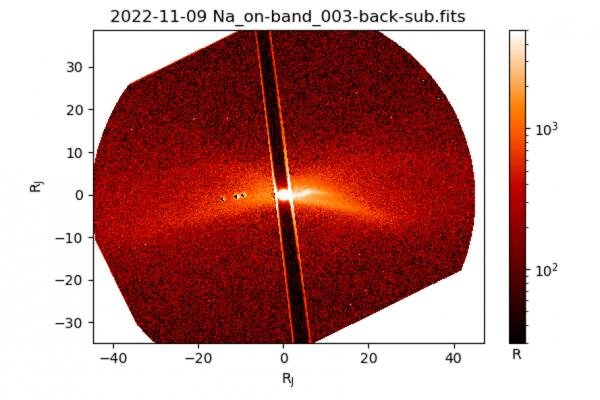 Outburst image of Jupiter's sodium nebula from IoIO. Author: Jeff Morgenthaler, PSI
The observations are important for NASA's Juno mission, whichhas been in Jupiter's orbit since 2016. The probe flew past Europa during the “outburst” and is gradually approaching Io. The close flyby will take place in December 2023. Some of Juno's instruments are sensitive to changes in the plasma environment around the gas giant. “Juno's measurements will tell us whether the composition of this volcanic eruption was different from previous ones,” concludes the study author.
Of the four large satellites of Jupiter (they are alsoGalilean moons are known) the icy moon Io is closest to the gas giant. It is also the most volcanically active object in the Solar System. The eruptions result from the tidal stresses it is subjected to due to Jupiter and the other two large moons, Europa and Ganymede. That’s why it’s called the moon of “fire and ice.”
Read more:
The tomb of the “midwife of Jesus” was unearthed: scientists told what they found there
Einstein is wrong again and his main theory was rewritten: how it changes the world
Published test video of the world's first propeller with 11 blades
Cover photo: print screen