Abell 78 is located at a distance of about 5 thousand light years from Earth in the constellation Cygnus and is
Low and medium mass stars can be bornanew in the final stages of his life. This happens when ionized gas ejected from a star is attracted back to its surface. This creates a shock that briefly reignites thermonuclear fusion. However, this process is very fast. Astronomers have found only a few examples of such stars.
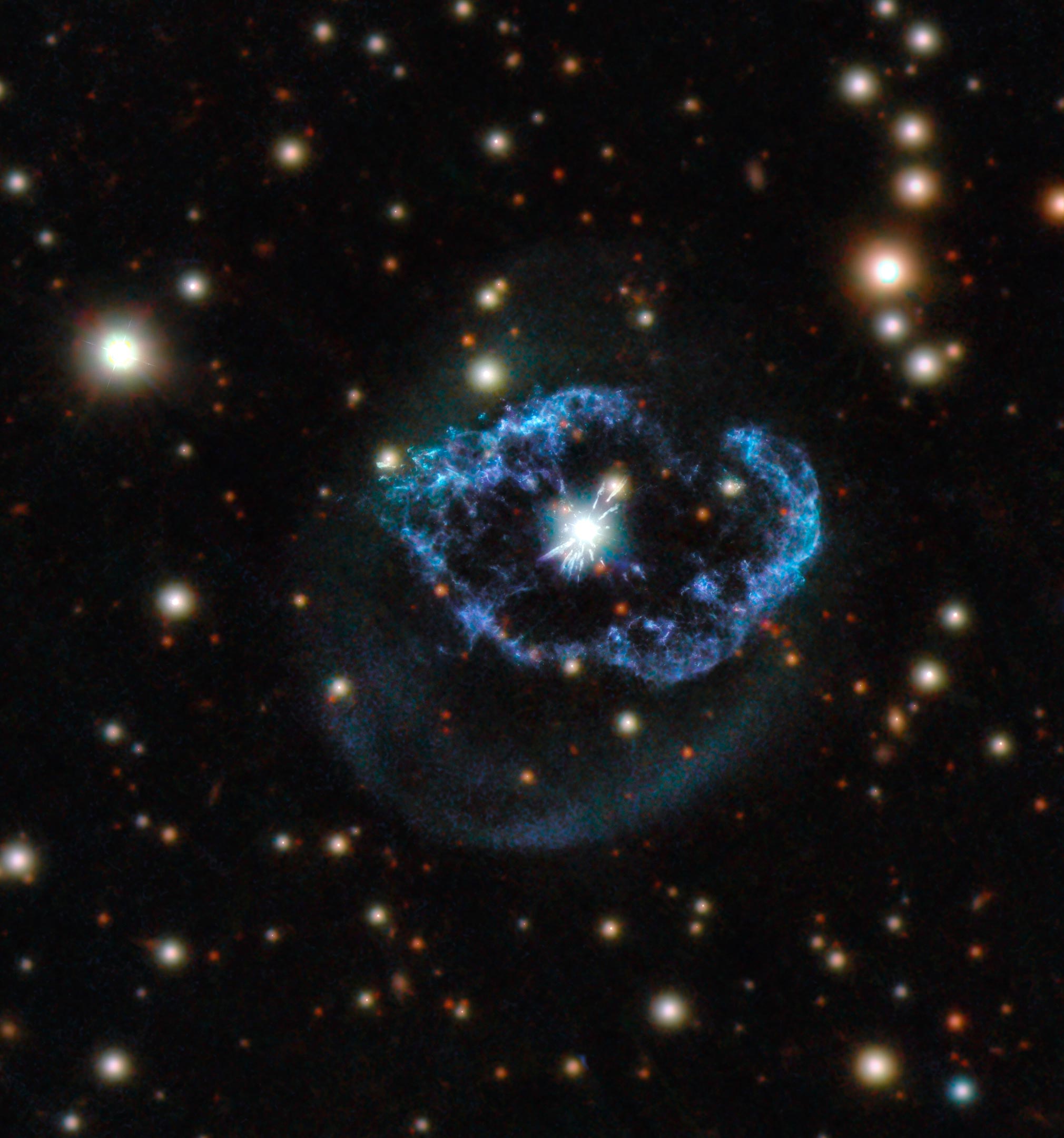 Credit: ESA / Hubble and NASA, M. Guerrero, Credit: Judy Schmidt
When the stars have run out of fuel, maybeseveral things happen. Those heavier than 1.4 solar masses - the Chandrasekhar limit - will explode into supernovae. But stars of lesser mass, which can no longer create radiation pressure to withstand the force of gravity, avoid this fate and simply collapse to form white dwarfs. Before they do, however, the stars shed their outer layers as ionized gas, creating planetary nebulae.
At this moment, about 15–20% of such stars mayexperience the process of being born again. This occurs when ionized gas ejected by stellar winds is pulled back by gravity. A shock is created, which momentarily restarts thermonuclear fusion and a final flash appears on the surface of the star. This process releases a lot of dust, which obscures the star from view.
Read more
Uranus has received the status of the strangest planet in the solar system. Why?
Physicists have created an analogue of a black hole and confirmed Hawking's theory. Where it leads?
Abortion and science: what will happen to the children who will give birth
Subramanian Chandrasekhar - American astrophysicistand a theoretical physicist of Indian origin, a Nobel laureate in physics. Member of the Royal Society of London, the US National Academy of Sciences, and a number of academies of sciences and scientific societies, including the Indian Academy of Sciences.