In the last few days, Mercury has looked like a comet, when the planet closest to the Sun is at its maximum
It is very difficult for an outside observer to see the tailMercury, so it remained undiscovered until the 21st century. But the astrophotographer captured the giant plume thanks to a special filter that highlights the yellow waves of light emitted by excited sodium particles in the tail.
Some comets have characteristic doubletails, one consists of gas that leaks from the inside, and the other consists of dust from their surface. Both are blown away from the comet in the same direction by charged particles from the Sun known as the solar wind.
Mercury, the smallest solar planetsystem, has a single comet-like tail consisting primarily of sodium ions that are dispersed from the planet's surface by the solar wind and micrometeorite impacts. Researchers have known about Mercury's tail since 2001 and have since discovered that it increases and decreases depending on the planet's proximity to the Sun.
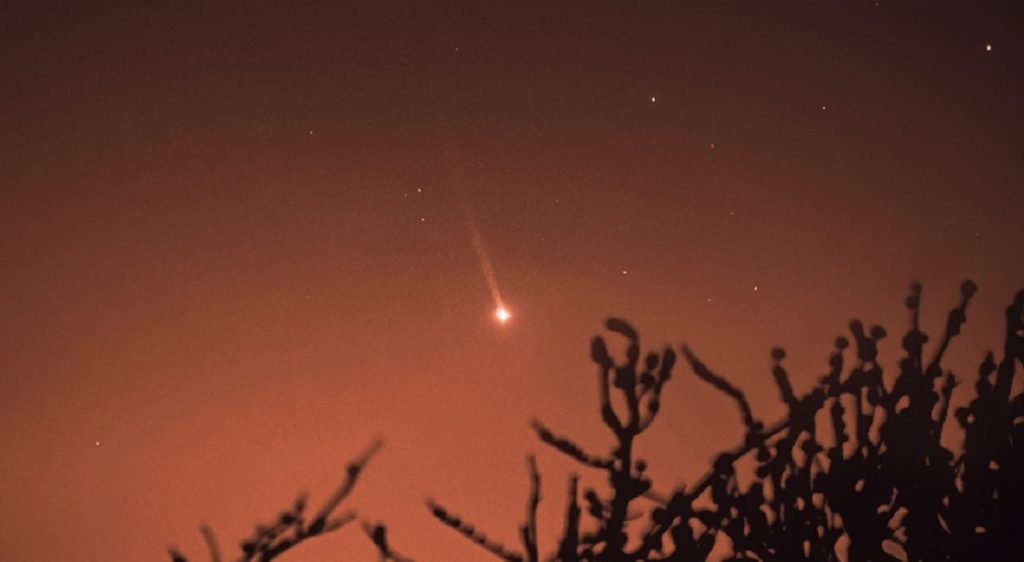 The tail of Mercury was photographed using a special filter to improve its visibility. Image courtesy of Dr. Sebastian Voltmer | www.voltmer.photo
According to Spaceweather.com, at its peak the length of the tail is about 24 million km, which is about 62 times greater than the distance between the Earth and the Moon. The tail extends over such a vast distance because Mercury has a weak atmosphere and is close to the star, allowing the solar wind to easily rip apart the planet's surface.
Read more:
New solar cell breaks world efficiency record
It turned out what is happening with the documents of Leonardo da Vinci: they began to change
Listen to the sound of solar plasma as it hits the Earth