Spanish photographer Aleix Roig photographed the rare “Christmas comet” C/2022 E3 (ZTF) on the morning of January 12
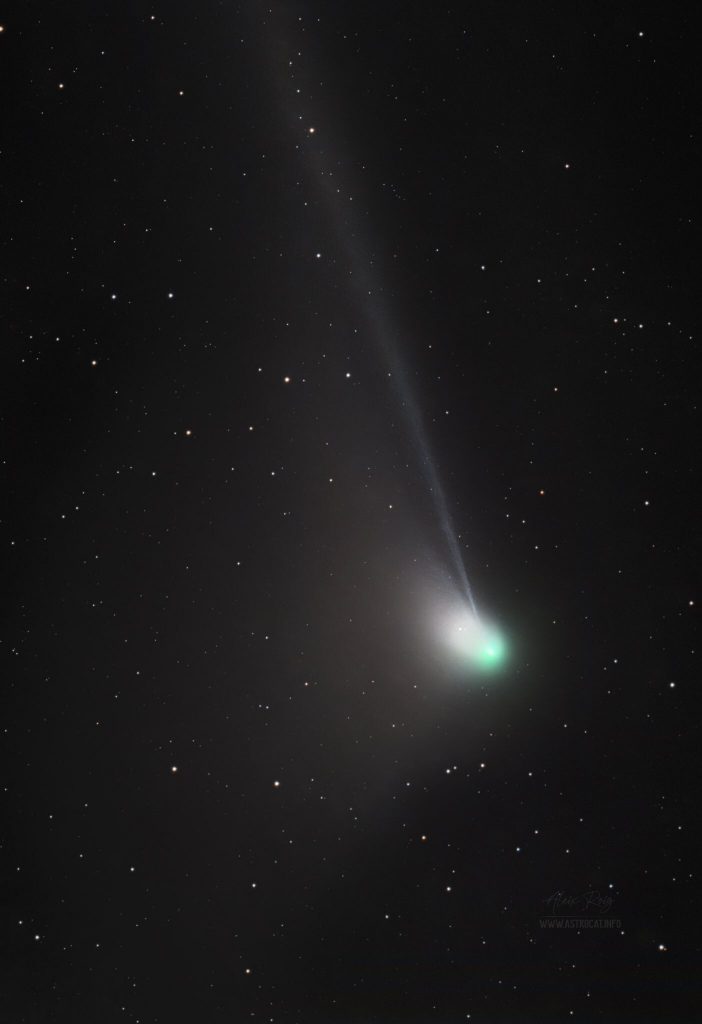 C/2022 E3 (ZTF) at perihelion. Image: Aleix Roig
Roig took this picture in his ownobservatory Astrocat Observatory, located "in the backyard of his house." At the same time, as the author of the picture himself notes, since the comet continues to approach the Earth, it can already be observed with ordinary binoculars. According to the Comet Observation Database (COBS), the current apparent magnitude of C/2022 E3 (ZTF) is 6.5.
Recall that apparent magnitude isan indicator that determines the brightness of a celestial object from the point of view of an earthly observer. Moreover, the smaller it is, the better such an astronomical body is visible. It is believed that objects with an apparent magnitude less than 6 can be seen with the naked eye. C/2022 E3 (ZTF) will reach this value after January 22.
And at the closest approach to the Earth (duringperigee), which will occur on February 1 at 20:54 Moscow time, the brightness of the comet will be about 5.5. In the night sky, the comet can be observed in the region of the constellation of the Northern Crown.
Read more:
The strongest class X flare occurred on the Sun
Look at the consequences of the collision in 1181 of two stars
Blazar, which was found 20 years ago, turned out to be an extreme object
On the cover: Artistic illustration of an abstract comet against the night sky