Scientists from the University of California San Diego and Berkeley studied seismic data collected by the mission
Analyzing numerous traces on the surfaceThe Red Planet, scientists have suggested that there were once entire oceans of water on Mars. Most researchers believed that most of it left in the form of groundwater. Interacting with rocks, it had to form the minerals that make up the underground cement.
If you put water in contact with rocks you will get a whole new set of minerals like clay, water will not be a liquid. It will become part of the mineral structure.
Michael Manga, study co-author at UC Berkeley
The InSight spacecraft landed onElysium Planitia near the equator of Mars in 2018. On board the device, among other things, a seismograph is installed that records marsquakes and meteorite falls.
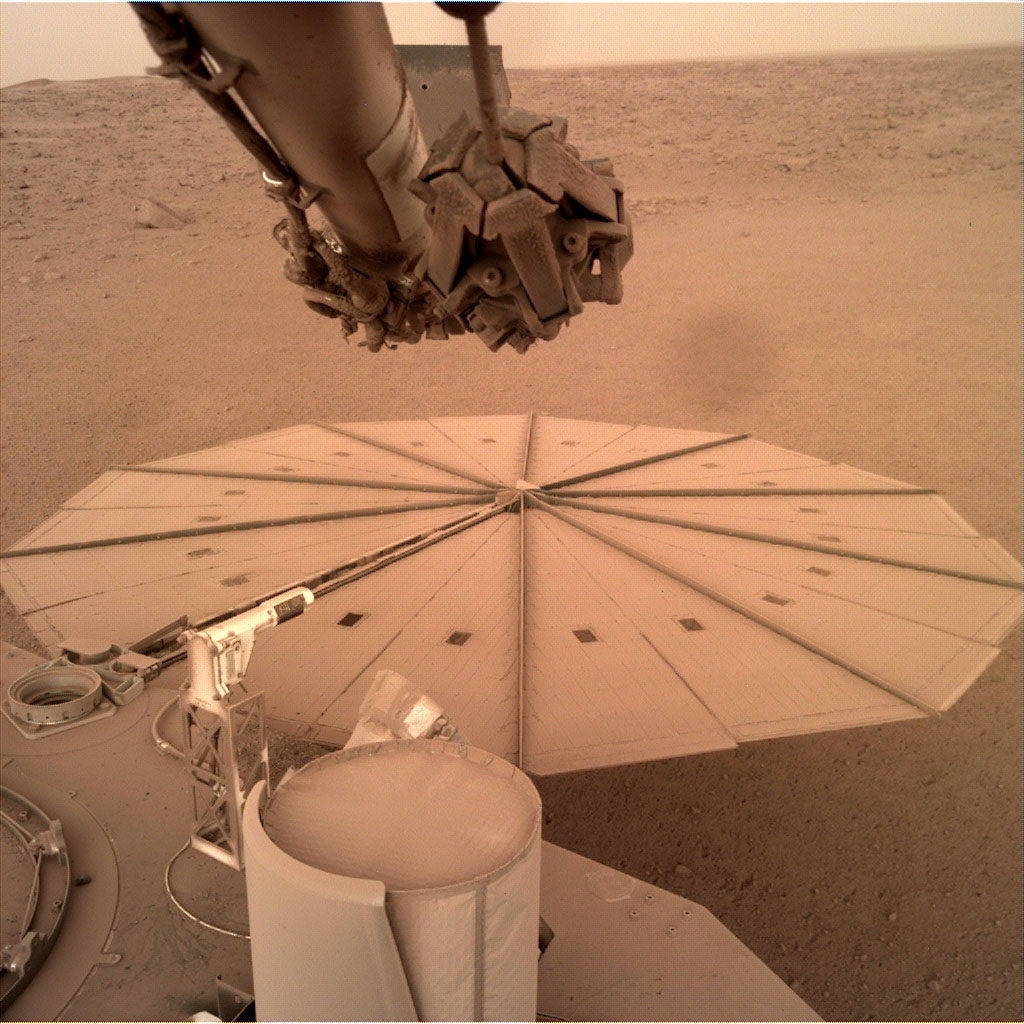 "Selfies" of the InSight module. Image: NASA/JPL-Caltech
Seismic wave analysis gives insight intocomposition of the rocks through which they pass. Cementing minerals such as calcite, clay, kaolinite and gypsum affect seismic velocities, the scientists explain. In their work, the researchers used computer modeling to determine the rock structure based on seismograph data.
The simulation results showed that the upper300 meters of subsoil below the landing site is a structure with large pores. At the same time, they are voids in which there are no signs of ice. It can only be there in the form of small balls. In addition, the observational data are best described by a model in which there are no cementing materials below the surface.
In future missions, the researchers plan to drill holes in the surface to study the rock composition in more detail.
Cover image: NASA/JPL-Caltech
Read more:
Einstein's prediction may come true: how an experiment with invisible atoms will change physics
On the pyramid in China found a portrait of the "king of ancestors". He ruled over 4,000 years ago
“This is science fiction”: scientists create a fundamentally new type of quantum computers