Skoltech's mass spectrometry laboratory is headed by a corresponding member of the Russian Academy of Sciences
What lies at the heart of building life processes
DNA is a long polymer chain that stores information about how the body should look and function.That is, how we differ from other speciesand how two individuals of the same species differ from each other. These molecules determine our uniqueness. Let me give you an example: a caterpillar and the butterfly into which it grows. Do you think their DNA molecules are different or the same? In fact, the correct answer is: the same. Genetic information does not change in any way during life. Actually, why are caterpillars and butterflies different in the end? Because not all the information stored in DNA is realized at the same time. Implementation occurs through the process of transcription, as a result of which, after reading individual genes, messenger RNA allows the synthesis of proteins.
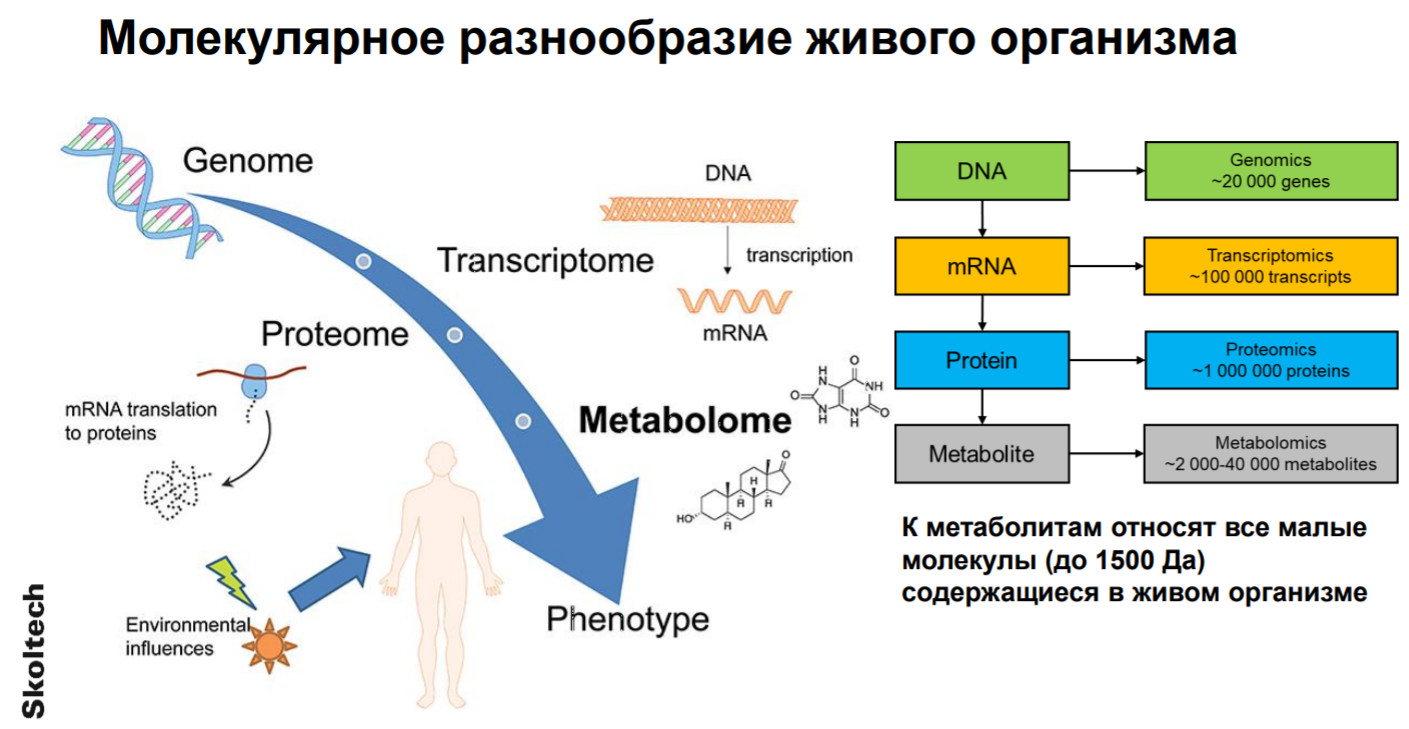
Proteins are universal molecular machines in our body that perform different functions: from construction to regulatory.One of the outdated definitions of life isordered existence and interaction of protein molecules. But the problem is that protein molecules are also large. Proteins are also polymer molecules with a large molecular weight: usually from 10 to several hundred kilodaltons. And building basic life processes on them is quite problematic, because they are quite sensitive to changes in temperature and the external environment. And this is probably why almost all vital processes in a cell are realized through small molecules. And the transformation of small molecules into each other is already controlled by proteins. The molecular weight of these small molecules is from several tens to several hundred kilodaltons. All small molecules that are found in a living organism are called metabolites.
1 dalton, or 1 atomic mass unit (amu)- an extra-system unit of mass used for the masses of molecules, atoms, atomic nuclei and elementary particles.
1 a. units = 1.660 539 066 60 (50) ⋅10−27 kg.
Primary metabolites are chemicals that are found in all cells of the body and are necessary for the maintenance of vital processes.All polymer molecules, proteins andnucleic acids. These metabolites are the same for all cells of one organism. During life, metabolites are converted into each other, for example, for the purpose of energy transfer. And these transformation paths - transformation chains - are called metabolic pathways.
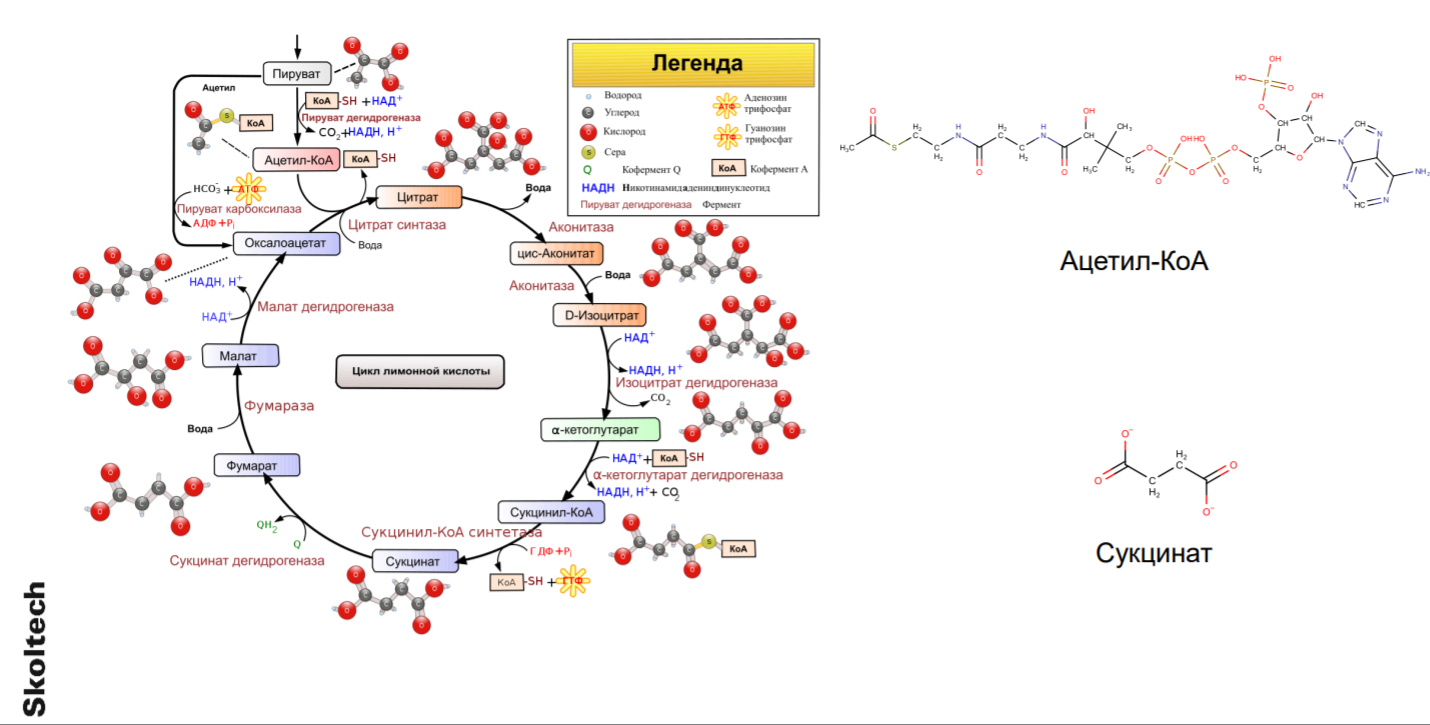 The Krebs cycle, or the tricarboxylic acid cycle, is responsible for the process of cellular respiration.
Different metabolic pathways in the human body intersect, that is, they have common participants.Thus, all processes that occur with metabolites are interconnected.
Secondary metabolites are substances that are not necessary for all cells to ensure their vital functions.They are usually used to adapt to conditionsexternal environment. For example, coffee plants produce caffeine to protect their leaves from pests. They are toxic to beetles that eat the leaves of coffee plants. But if we somehow remove all the caffeine from the plant, it will continue to live. No vital processes will be disrupted. The second example is antibiotics. You know that penicillin is the first antibiotic, and it was completely accidentally isolated from molds, which revolutionized medicine. Molds use penicillin to clear their living space. It is harmless to the parent organism, but toxic to other microorganisms. Actually, people use this property to treat various bacterial infections. Due to the fact that humans actively consume plants as food, our body is densely populated with various microorganisms that form microflora. These substances are secondary metabolites not only of the person himself, but also of living organisms that inevitably enter our body.
The natural filter and why it's wrong
Xenometabolites are antibiotics, compounds that are not associated with the activity of living organisms.It is usually something that a person has receivedartificially for different purposes. For example, medicines, food additives, dietary supplements, doping, drugs, tobacco combustion products, alcohol or hygiene products, household chemicals, ecotoxicants. These are also small molecules, and they enter the body both intentionally, in the case of drugs, and accidentally. For example, you brushed your teeth, swallowed toothpaste - and this is how new chemicals came into your system. And many of these substances can have certain effects on our body, even in very small concentrations. Moreover, this effect can be either positive or negative or vary depending on the amount of this substance.
The liver is the first barrier to the entry of foreign chemicals into the systemic circulation.It tries to filter out molecules thatthe body will be harmed and remove them, preventing them from being released further through the bloodstream into the organs. The liver has many filtration mechanisms, but none of them work 100%: otherwise there would be no poisoning and serious consequences of taking any toxins or drugs. However, the liver takes advantage of the fact that our body is largely water, that is, it consists of 80 percent water. Therefore, the liver tries to sort the molecules into hydrophilic ones, which dissolve in water, and hydrophobic ones. The liver “believes” that if the substance is hydrophilic, then it can be further released into the systemic circulation, since it should not cause much harm. And if a substance is hydrophobic, then something needs to be done with it to prevent it from being released further or at least to make it more hydrophilic.
The liver has two mechanisms - metabolic phases.In the first phase, the liver tries tospecial proteins and enzymes of the cytochrome P450 family oxidize these substances. As a result of oxidation, the structure of the molecule changes and it can become more hydrophilic. The liver can then release these metabolites into the bloodstream or try to remove them through the kidneys through urine or through the intestines. If this does not work, the liver can “sew” ready-made, guaranteed water-soluble molecules onto these oxidized molecules.
Hepatic metabolism increases the diversity of small molecules that can end up in our bodies.For example, at the oxidation stage, more than 500 different new other molecules are theoretically formed from one molecule, it is not possible to predict which of them are formed and which are not.
The Infinite Alphabet: Why It's So Difficult to Study Metabolites
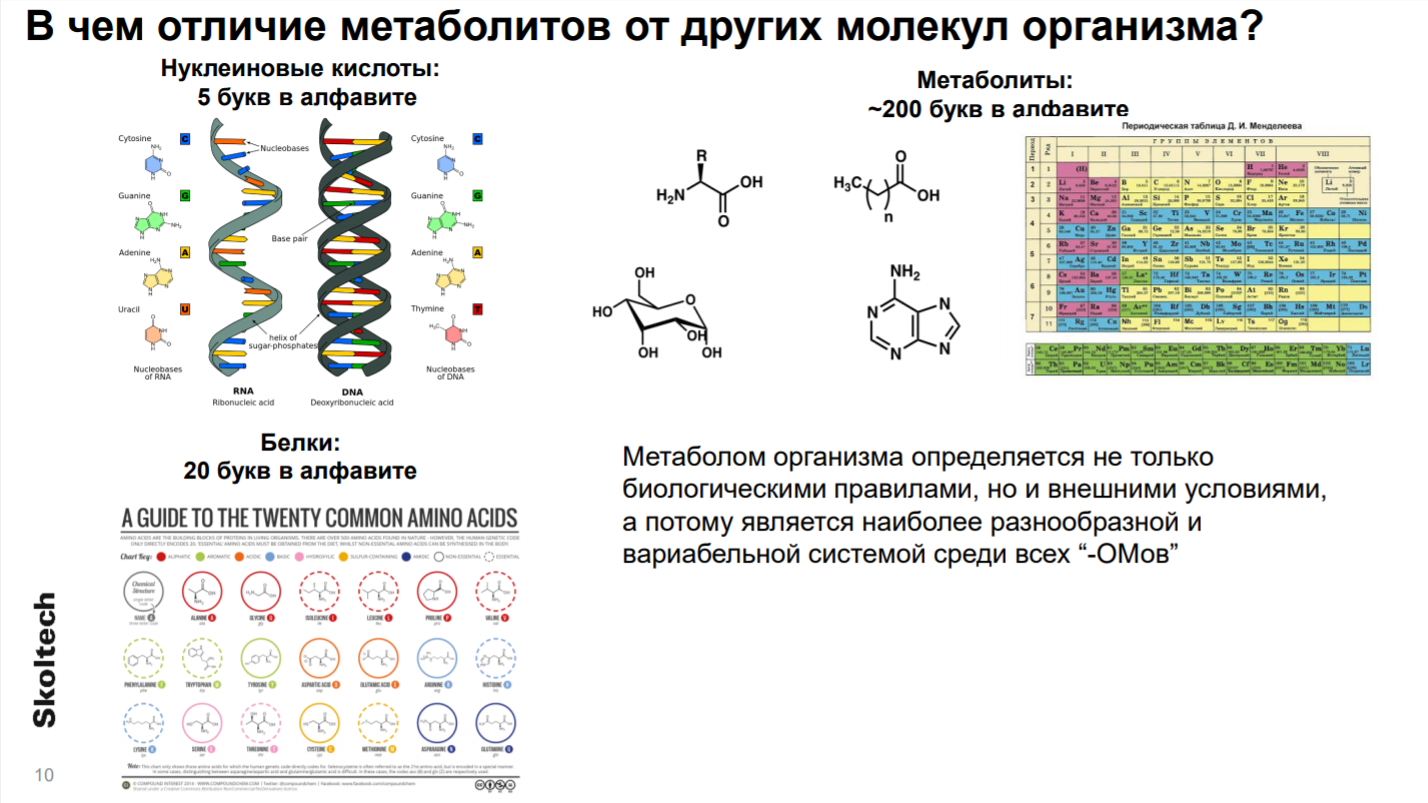
Nucleic acids can be represented as a five-letter alphabet from which a large text string is constructed.Yes, of course, the sequence of letters in thisline can be relatively chaotic, although during life the DNA does not change, but is simply copied. So we have certain restrictions on what this string will be. In the case of proteins, the situation is somewhat more complicated: there will already be 20 letters in the alphabet, that is, 20 amino acids from which proteins are built, but this also happens involuntarily. Therefore, from the researcher’s point of view, these objects are also quite similar to each other. And in the case of metabolites, it is extremely problematic to single out any alphabet: in fact, this is the entire periodic table. And among the rules of formation - only the rule of valence. In addition, there is a feature of carbon chemistry that allows two carbon atoms to bond with each other and then subsequently add an unlimited number of carbon atoms or other atoms from the periodic table, which gives rise to a huge chemical diversity of such molecules.
To study such small molecules and all their variety, special methods are required.There are simple ones:for example, an organoleptic analysis, which everyone who has taken a general blood or urine test and saw that there is a line “smell, color” in the direction has encountered. When it is necessary to find a specific molecule in a solution, a drop of a pre-selected reagent is added. If there was a molecule in the solution, coloring will occur; if it was not, only a precipitate will appear. Among the simple methods there is also optical spectroscopy, when you can use a microscope to draw conclusions from the structure of the sediment. Quite popular now are immunochemical methods: this is the same ELISA test for COVID-19.
Omics studies are those studies that study a complete population.And metabolomics implies the analysis of largedata that represent the complete set of small molecules in an organism, cell, or organ. The set of these data varies according to various estimates from several thousand, if we consider only the primary metabolites, to several tens of thousands, if we add secondary metabolites of known plants, bacteria and fungi to them. In fact, up to several hundred million, if we take into account all the chemical diversity that can enter the human body. And to study them, special methods are needed: nuclear magnetic resonance (NMR) spectroscopy and mass spectrometry.
Over the 80-year history of NMR, scientists involved in this method have received five Nobel prizes.Four - for NMR, and the fifth - formagnetic resonance imaging. A method slightly different from NMR spectroscopy, but very similar in principle. The NMR method is based on the fact that some atoms in the periodic table have a non-zero magnetic moment. They are small magnets and can interact with an external magnetic field. This interaction manifests itself in the splitting of energy levels. The NMR method allows one to distinguish between different atoms and atoms of the same element, but in different environments. Recently, NMR has been losing popularity, primarily due to its high cost.
How to make charged particles from a complex mixture and find out their composition
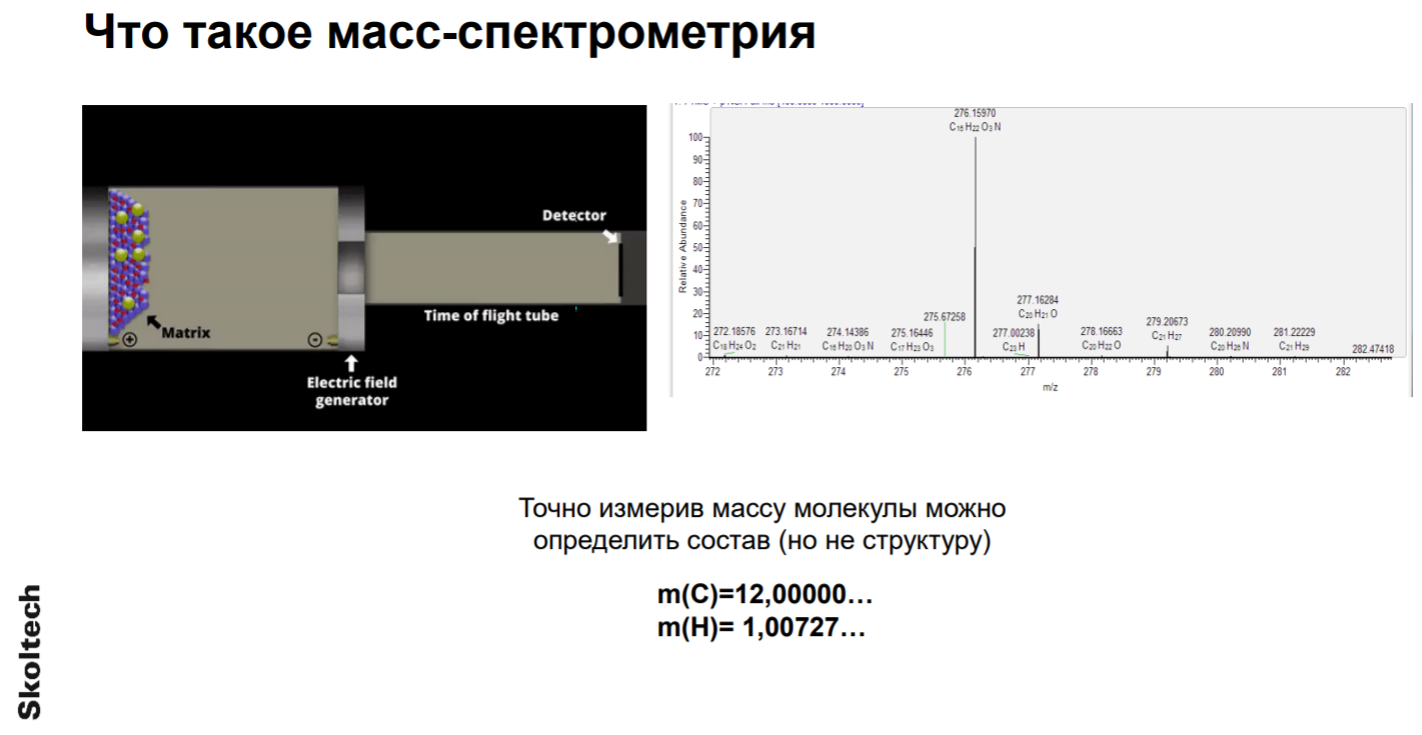
Mass spectrometry is a method of separating charged particles by interacting with an electromagnetic field.If we take some complex mixture consisting ofdifferent charged particles, and almost any molecule with modern mass spectrometry methods can be converted into a charged form by adding a proton to it or removing a proton from it, and applying an electromagnetic field to this mixture, then the particles in this field will begin to move and they will have either speed, or a trajectory depending on mass. Light particles will arrive at the detector earlier than heavy ones. After processing the data from the detector, a mass spectrum is obtained, in which along the Y axis there will be signal intensity, which is proportional to the number of ions, and along the X axis - the mass in the ions, or rather, the ratio of mass to charge. Moreover, mass spectrometry allows you to measure mass with very high accuracy. This means that it is possible to unambiguously establish the elemental composition of the ion, charged particles or molecule from which it was formed. Mathematically, this is called solving the Diophantine equation in integers: in fact, this is a selection of coefficients near each atom: m(C), m(H), k(O), z(N). And only one combination of integers m, n, k, z can give the mass measured by the mass spectrometer.
The method of mass spectrometry was proposed at the beginning of the twentieth century by Thompson.Scientists assembled the world's first mass spectrometer andwith his help he made a great discovery: he experimentally confirmed the existence of isotopes. On the other hand, he was unable to give a correct interpretation of his results. His student William Aston did this for him: in 1922 he received the Nobel Prize for this discovery. In the 20th century, due to a series of world wars, mass spectrometry developed as a method for the military. At the beginning of its development, it found its main application in the nuclear industry. Since mass spectrometry can separate substances by mass and determine isotopes, it can be used to separate isotopes such as uranium. Two more Nobel Prizes were awarded for mass spectrometry: in 1989 - Wolfgang Paul and Hans Demelt, and then in 2002 - a real revolution was carried out independently by John Fenn and Kaishi Tanaka. They proposed their own method that makes it possible to obtain a charged particle from a large polymer molecule: from proteins or from nucleic acids, without destroying it. This gave impetus to the study. Now not a single laboratory - biochemical or molecular biology laboratory - can operate without its own mass spectrometer or without a well-equipped shared use center at the institute.
Having determined the mass of an ion, we can only determine the elemental composition, but not the structure of the molecules.Because one elemental composition of different structures can correspond to a huge number. That is, the atoms in a molecule can be arranged in different ways. This is called the phenomenon of isomerism.
Mass spectrometrists have come up with a method that allows you to get a little more information about the structure of a molecule: a certain obstacle is placed in the path of flying accelerated molecules.Usually these are gas molecules.When the molecules collide with these gas molecules, they can break apart from the collision. And then the mass spectrometer measures the mass not of the original molecule, but of the pieces into which it broke up. And this decay does not occur randomly, but along the weakest bonds in the molecule. The resulting fragments are identical, and they are molecular fingerprints: unique to each molecule.
Chromatography is a method of separating substances based on their interaction with sorbents.Sorbents are something that can absorbother chemicals, and the simplest is activated carbon, which we take when poisoning. At the beginning of the 20th century, the Russian scientist Mikhail Tsvet demonstrated that if such a natural dye is passed through a column filled with chalk, then instead of one large green smeared spot, you will get several multi-colored spots: from yellow to green. Thus, he, firstly, realized that the green dye from the leaves is a mixture of different substances. And, secondly, he discovered chromatography, for which in 1952 other scientists who brought his method to some modern form were awarded the Nobel Prize. In modern chromatography, a mixture is passed through a column using a liquid or gas, depending on the type of chromatography. The liquid “drags” the molecules forward, towards the exit of the column, and the sorbent interferes with each molecule in different ways. They end up leaving the column at different times, which can be recorded and used as another fingerprint for identification.
From cerebrospinal fluid examination to dry blood method
Mass spectrometry is the only method currently available for studying cerebrospinal fluid.In some difficult cases for diagnosisdiseases, a puncture is required, the spine is pierced and a sample of cerebrospinal fluid is taken. But the problem is that on average a person has only 120 ml of cerebrospinal fluid. And this liquid is under pressure, so taking even 1 ml significantly affects this pressure and can lead to irreversible consequences for the body. Therefore, in reality, only a few microliters can be sampled. None of the existing methods except mass spectrometry can handle such small quantities of samples, because the smaller the sample, the fewer molecules it has and the more sensitive your equipment needs to be. The sensitivity of mass spectrometry is usually sufficient for this. After collection, the sample is removed from mechanical inclusions and proteins to avoid equipment breakdowns. After analysis, the result is processed using a computer and a “list of features” is obtained: the output is approximately 10–15 thousand lines. The columns produce a formula that we define with an exact mass, an intensity that is proportional to the amount of that molecule, and a “fingerprint.”
The most direct method of applying thismetabolomics mass spectrometry experiment - comparing sick and healthy people to identify which molecules appear, appear and change their concentration when such a difference occurs.Usually there are two groups:healthy people and people with a disease of interest to us, for example, with a specific form of oncology. For each sample, such plates are obtained, and then mathematicians compare and visualize them to find differences between them.
The first application of mass spectrometry is in neonatal screening.Each newborn, by order of the Ministry of Health with2006, they are required to test for a certain set of hereditary diseases. Now, in any case, in Moscow they test for at least 16 different diseases. There are such diseases, and they often manifest themselves right from the first minutes of life, which, if not stopped in time, in a week or a few days can make the child disabled for life. Therefore, such diagnostics must be made within the first few hours of a newborn’s life. The biomarkers of almost all of these diseases are small molecule metabolites. That is, diseases manifest themselves in the form of disruptions in metabolism, for example, the accumulation of certain organic acids in the blood or certain lipids. And, naturally, this accumulation occurs in very small concentrations; from them it is necessary to recognize the difference in changes in metabolism. Therefore, besides mass spectrometry, no other method will work here.
To solve the problem of collecting blood from children (not such a large amount of blood and children’s fear of invasive methods and doctors), they came up with a technology for analyzing dried blood spots.A small puncture is made and one or moretwo drops of blood directly onto a small piece of filter paper. The volume of blood here is several microliters. Then this card is dried and sent to the laboratory, and the sending is also very convenient: the sample does not need to be frozen or thawed. Just re-dissolve this card for analysis, and within a few hours the analysis is ready.
Another area of application for mass spectrometry is personalized medicine.All our substances go to the liver, and the liversomehow metabolizes them. Moreover, our livers work differently for all of us, not only because of some diseases or bad habits. For example, grapefruit juice can significantly affect your metabolism; it inhibits some enzymes and as a result, your concentration of some drugs may be several times higher than expected. Some people will have this concentration in their blood after taking the drug, while others will have twice the concentration. It turns out that the dosage needs to be halved so as not to cause unnecessary harm to the body. Hence the transition to personalized medicine. You take a pill, your blood is taken every hour and they look at the curve: how the substance travels through your body over time, what its concentration is in the blood. Then the doctor can adjust the dosage or even stop the drug for you and prescribe another one. And in this case, dry blood analysis is also very actively used.
Any new drug entering the market necessarily goes through a metabolic research stage.Some drugs may not be very toxic,but as a result of breakdown in the liver and some errors, these substances can turn into even more toxic ones. The simplest example is paracetamol. The instructions for paracetamol say that it should not be given to young children. That young children should only be given ibuprofen. And the reason for this is the accumulation of this molecule in the liver, which, as a result of metabolism, has a toxic effect. For an adult with a well-developed liver, this toxic effect is not very noticeable, although, of course, you should not swallow paracetamol in jars either. For young children, this, in fact, can lead to all sorts of unpleasant and even irreversible consequences. Therefore, every new drug must be studied for metabolism.
Imaging is a way of conductingmass spectrometric analysis, when we obtain information not only about a homogeneous, but also about a heterogeneous sample, and we can study its molecular composition in space.There is such an interesting example for studyingdistribution of the drug and its metabolites in the rat's body. The experiment is carried out as follows: a rat is given a certain medicine, after a few hours the animal is euthanized and then the animal is finely cut along the entire body. And then a special technique of mass spectrometry allows you to study the molecular composition of each point in this sample. After computer processing, it is possible to visualize where which metabolites have accumulated. It is important to study the distribution of metabolites, because if you are taking a pneumonia drug, it is important that it ends up in the lungs and not in the brain. A mass spectrometric scalpel is a "knife" that pumps molecules out of the incision site, and then, using computer technology, it is possible to determine which surgeon is cutting the tissue: diseased or healthy tissue. This method is now being implemented in the United States, and the first real operation with such a knife has already been performed.
Fingerprints for each molecule
The problem is that several hundreds or even thousands of chemical compounds can correspond to one elemental composition.Therefore it is necessary to identify all rowstables, and this is the main task of modern metabolomic analysis; unfortunately, it has not been fully resolved. The molecular fingerprints are compared with those found in databases of chemical molecules. If they match, then we can say with some confidence that this is the right molecule. But such databases contain a very limited number of substances. The complete fingerprint database contains about 20–30 thousand compounds; it does not even cover all the primary and secondary metabolites that are present in the human body. There is another problem: to replenish this database, you need a pure chemical substance, and they are usually expensive. That is, one pure chemical usually costs several tens or hundreds of dollars.
One approach to identification is to create new fingerprints.For example, the method is now being actively developedion mobility spectrometry. While mass spectrometry divides ions by mass, ion mobility allows them to be separated by size. That is, if you have two runners - not a heavy one and a light one, but a large one and a small one, and put some kind of obstacle on their way - for example, a net with cells, then a slender athlete will quickly crawl through this net and reach the finish line, but a fat one will Until he gets out of this network, he will come running after some time.
The second method is to try to find fingerprints that do not require clean standards to identify.In the laboratory we propose to use the so-called isotope exchange.
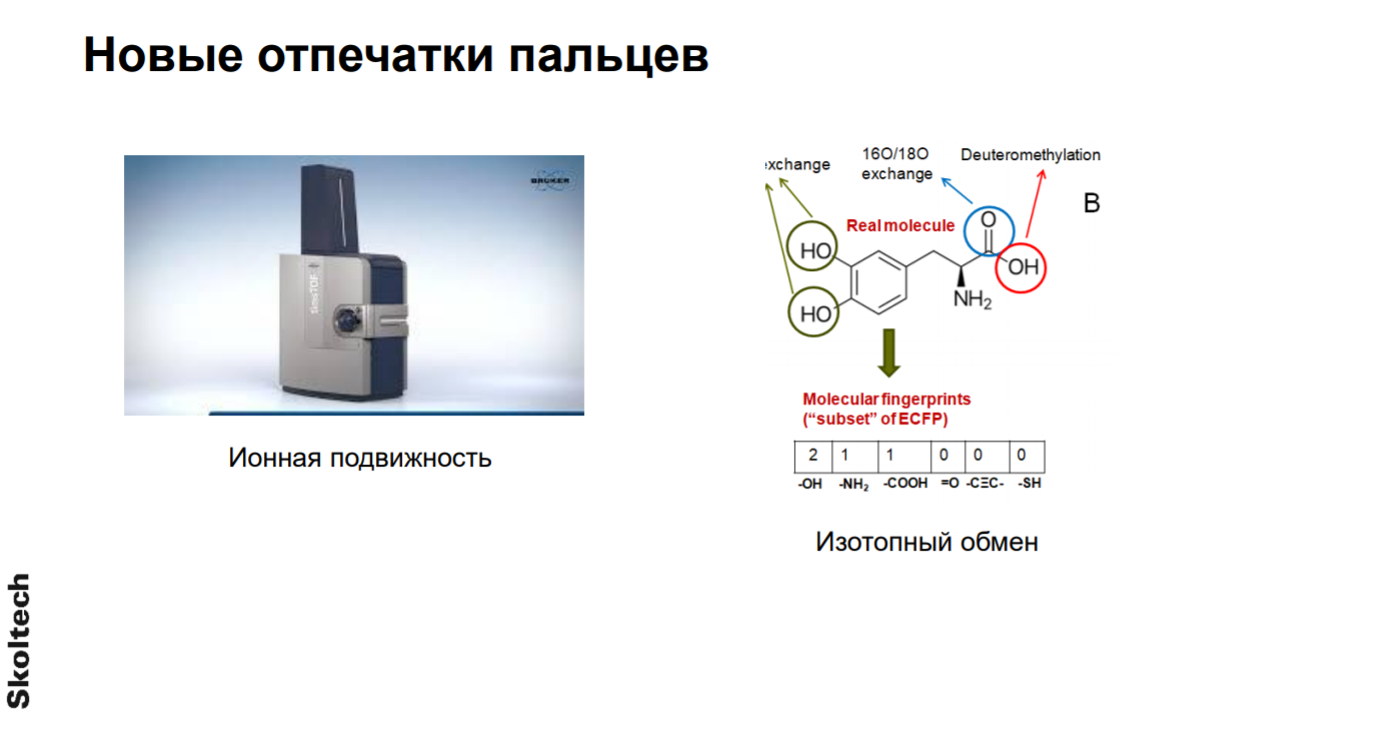 For example, if we look at such a molecule, thenwe will see that it has hydrogen atoms associated with oxygen. So, they are special. They can leave this molecule and return to it. If we have this molecule dissolved in water, then hydrogen can leave the molecule, and hydrogen can return from water. And if we take not just water, but heavy water, where instead of hydrogen there is deuterium, then hydrogen can leave the molecule, and deuterium can take its place. Deuterium is known to differ from hydrogen in molecular weight per unit, and a mass spectrometer can see such a shift. Simply by counting the number of such hydrogens, one can say whether this is a necessary or unnecessary molecule, whether we identified it correctly or not.
Artificial intelligence can be used to identify molecules.Based on the available information, you can completedatabases of missing information using deep learning methods. That is, we train the model, and it predicts the necessary fingerprints based on the structure of the molecule, which we can then use to compare with what was obtained in the experiment.
See also:
Uranus has received the status of the strangest planet in the solar system. Why?
Humans can withstand very low temperatures even without heat sources
Physicists have created an analogue of a black hole and confirmed Hawking's theory. Where it leads?