According to various estimates, the global economy loses up to a billion dollars annually due to cybercrime and hacker attacks.
For example, in August 2022, experts onCybersecurity has been informed of a new virus that uses the SMACS 0723 cluster image, the first full-color image taken by "James Webb," to propagate. For this attack, the criminals used the great public interest in all the news related to the new space telescope and the unprecedented detail of the frames that it creates.
The desire to share beautiful things with friendsthe first human weakness exploited by criminals. Computer viruses have been around for as long as computers have existed. During this time, many different attack technologies have been created in the world.
Cookie wants a cookie
The first computer viruses appeared beforewidespread use of complex networks and the creation of the Internet. For example, students from Brown University in the United States created a special Cookie Monster program in 1969. The program was sent manually via text messages over the internal network. And after infection, the “infected” computer was blocked until the user entered the word “cookie” on the command line.
Interestingly, the virus was originally named inhonor of the bear - the character of annoying TV advertising, constantly eating cookies. But with the popularization of the Sesame Street TV show, the image of Cookie Monster was firmly entrenched in the character of the same name, who was called Korzhik in Russian dubbing.
Cookie Monster wasn't exactly a virussince the program could not replicate itself and was easily removed when the computer was restarted. Originally created for PDP minicomputers, this program was later adapted for Atari computers in various incarnations. For example, one of them gradually began to ask for cookies more and more often, and the only way to stop the gluttonous Cookie was by offering him Oreo cookies.
 The character "Korzhik" from the show "Sesame Street". Image: @NonprofitOrgs
Love is worth a lot
Not all programs were so harmless andkind. For example, in 2000, a virus (ILoveYou) began to spread rapidly over the Internet. Initially, users received an email with the subject "I love you" and an attachment called "LOVE-LETTER-FOR-YOU.txt.vbs". The attackers exploited the fact that Windows hid the file extension (vbs) and made it look like a harmless text document to the recipient.
Many lonely hearts have paid dearly fordesire to know who loves them so much. After launching, the virus deleted all images and audio files from the computer, after which it sent new similar letters to the entire contact list from Outlook. The use of well-known recipients for distribution was one of the reasons for the widespread spread of the virus: users saw letters from familiar correspondents and fearlessly opened attachments.
Later, other modifications of this appeared on the network.virus speculating on curiosity. For example, the letter could be called "Very funny file", "Let's meet" or even encrypted under the antivirus companies that sent a program to check the computer for infection.
In total, about 55 million e-mail usersmail received messages containing an infected file. At the same time, 3 million of them could not resist and checked what a “secret admirer” was writing to them. And the total damage from the spread of the virus amounted to about $ 10 million. It is noteworthy that the creator of ILoveYou, Filipino student Onel de Guzman, was not injured in any way. The thing is that at that time in his country there were no laws prohibiting the creation of computer viruses.
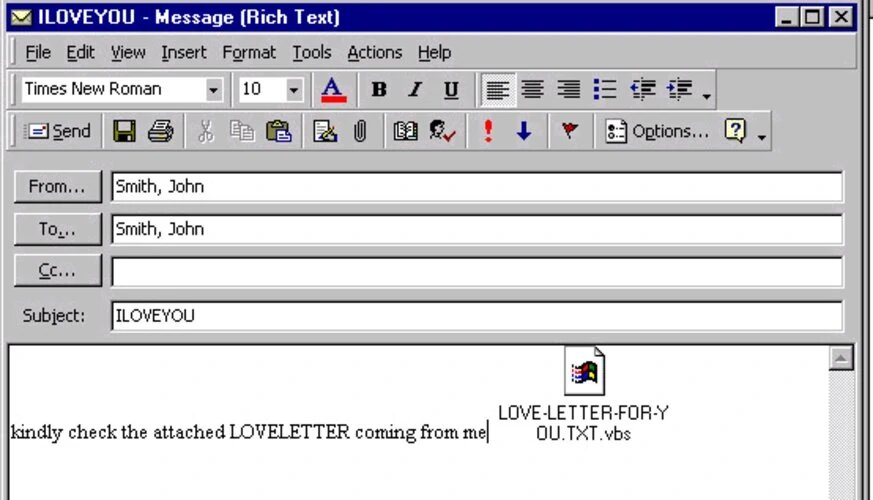 Email with ILoveYou virus
Polite Pikachu
Not all viruses were as successful.For example, in the summer of 2000, in the wake of the success of love letters, an analogue appeared, designed specifically for children. Users received an email with the text “Pikachu is your friend” and an executable file.
When starting the program, the following message appeared on the screen:message “Among millions of people around the world, I found you. Don’t forget to remember this day every time, MY FRIEND!” And then, according to the authors’ plan, the virus was supposed to send itself to all contacts and delete important Windows system files.
But, fortunately, the creators made a mistake inprogram code. Therefore, instead of just doing their job, Pikachu politely asked users if they really wanted to delete system files.
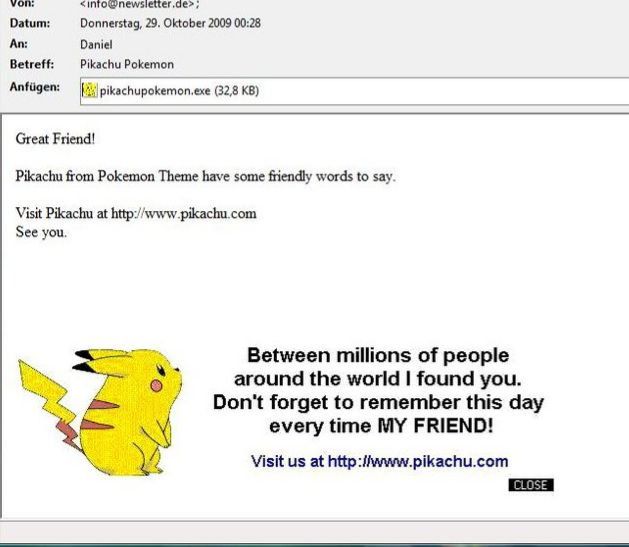 Pikachu virus. Image: Kyubi yo-kai watch, CC BY-SA 4.0, via Wikimedia Commons
Ika-tako
Infecting a computer with a virus is an unpleasant event.Therefore, some hackers add humor to “brighten up” the negative consequences a little. For example, the Ika-tako virus (which means "octopus squid" in Japanese) replaced all infected files with pictures of cute anime creatures.
This virus was spread by infectedmusic files originally uploaded to the file-sharing server Winny, popular in Japan. When the file is played, the malware lands on the computer's hard drive, infecting everything from family photos to important operating system files. Infected files are replaced with images of a squid, octopus or sea urchin and deleted.
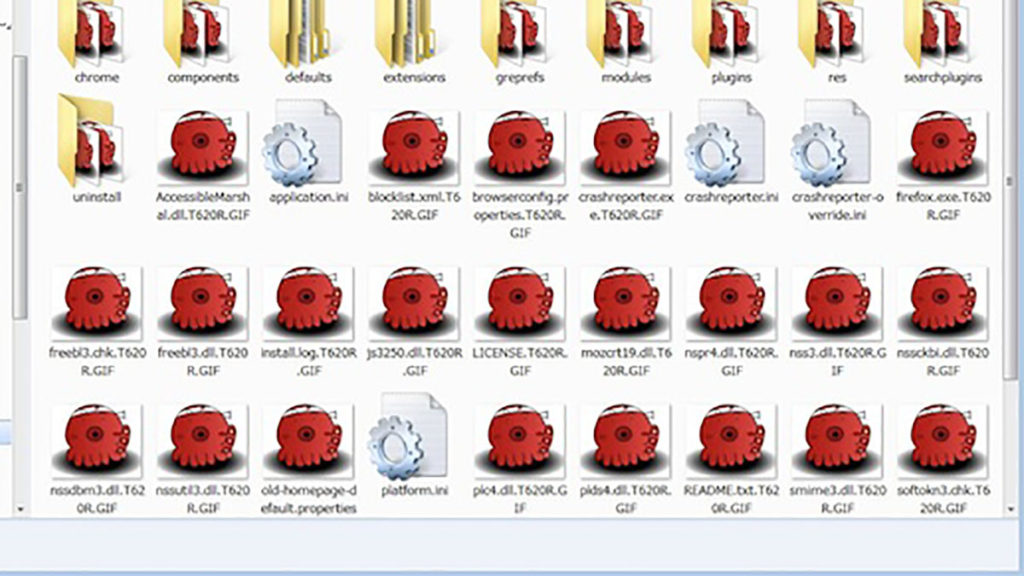 Ika-tako virus infection
Happy99
One of the most festive viruses appeared inearly 1999 is Happy99. It is believed to be the first computer worm to actively spread via e-mail and infect millions of computers around the world.
Although it served as the basis for future computer attacks, the virus itself was quite cute. When infecting a computer, it simply opened a window with an image of fireworks and the words “Happy New Year 1999.”
Video from a computer infected with the Happy99 virus
Lichen
Another similar harmless virus is Lichen(lichen). On modern computers, we might as well just call it a screensaver. This virus was developed for computers that ran under the DOS operating system. It did no harm, but whenever there was no keyboard activity on the app for more than a minute, it triggered visual effects that resembled lichen growing on cracks in stone.
Still, hackers are also not alien to the sense of beauty.
Trojan savior
Not all hackers pursue selfish goals.For example, in 2015, the Wifatch Trojan virus became widespread. This program infected WiFi routers and other connected devices and installed updates on them.
And besides, the virus left usersreminder asking you to change your password. The thing is that many users neglect security issues and leave factory passwords on connected devices, which are very easy to guess. And this makes the entire network vulnerable. With their program, the creators of Wifatch wanted to remind them how to avoid such troubles.
As cute and harmless as viruses are,they still carry a potential threat, since any of them can be adapted for selfish purposes. Now a significant part of life and a huge amount of confidential and sensitive information is stored on electronic devices. In an age like this, remembering these threats and practicing simple digital hygiene is as important as washing your hands before eating.
Read more:
The ancient Vikings suffered from a dangerous disease. It is caused by a parasite from Africa
Plant on Mars produces oxygen at the rate of an average tree
The largest human organ was recreated in the laboratory. It is twice as strong as ours.