Astrophysicists combined data collected by the Chandra X-ray Observatory over 15 years of operation with
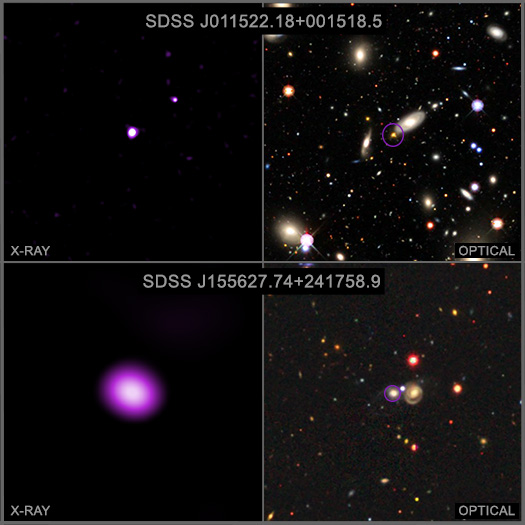 Example of Observation of Two Black Candidatesholes in the X-ray spectrum (left) and optical (right). Image: NASA/CXC/SAO/D. Kim et al. (X-ray observations); Legacy Surveys/D. Lang (optical observations)
The researchers found that at the center of severalgalaxies located at a distance of 550 million to 7.8 billion light-years from Earth, there are supermassive black holes, unlike traditional quasars. Recall that these are bright active galactic nuclei, representing a supermassive black hole that actively absorbs stellar gas and dust and glows like a bright star.
Supermassive black holes contain millions ofor even billions of times more mass than the Sun. Their presence can be detected by the emission of material they actively draw in as they grow. Scientists have shown that some of these black holes are surrounded by material that blocks most of the light from escaping.
X-rays help to see suchfast-growing black holes, because the material orbiting them is superheated to millions of degrees and glows strongly in this range. The thick cocoon of gas and dust that surrounds a black hole blocks most or all of the light in the optical range, but cannot contain X-rays.
Having studied the number of x-rays with differentenergy for each source, the researchers concluded that about half of the 817 candidates include supermassive black holes that are hidden under dense gas. This confirms the relatively small amount of low energy x-rays. They are more easily blocked by layers of surrounding gas than high-energy ones.
Read more:
The strongest class X flare occurred on the Sun
Nuclear fusion planet found
Humans still have fur genes, but they are temporarily turned off