Astrophysicists have studied the spectra of radiation from distant quasars. Data on the absorption of light by molecular
Dense gas clouds in the universe absorbpart of the light from distant quasars, creating lines in the emission spectra. In this case, depending on the composition of the matter, waves with a certain length are absorbed in these clouds. By analyzing the width of these lines, researchers can extract information about the density, temperature, and other characteristics of clouds.
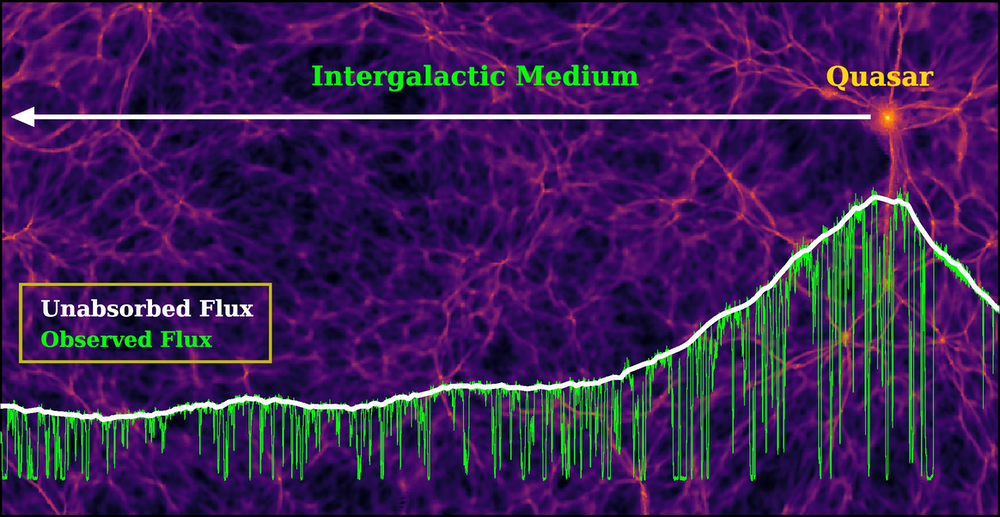 Light from a distant quasar passes through regionsdense gas (purple) in the intergalactic medium. The gas absorbs light at certain frequencies, resulting in a "forest" of absorption lines in the spectra of the quasar (green). Image: P. Gaikwad/Kavli Institute for Cosmology, Cambridge
Light absorption data by the Lyman-alpha linefor hydrogen coincide with modeling based on classical ideas about the composition of molecular gas in the Universe. But there is an exception: for relatively close gas clouds. Observations show that these low redshift clouds produce broader absorption lines than predicted.
The expansion of absorption lines is associated with heatingclouds Researchers believe this is due to exposure to dark photons. These are hypothetical massless particles that are the equivalent of photons for dark matter.
This dark photon can add a small amount of energy to the system and heat up the gas, [which makes] the lines a bit wider and more consistent with the data.
Andrea Caputo, CERN researcher and co-author of the paper
The dark photon theory suggests that particlescan spontaneously transform into normal photons. The probability of such a transformation is small, but the transformations can be accelerated when dark photons enter an ionized gas that satisfies the resonance condition.
Scientists' simulations have shown that dark photonswith an extremely small mass of about 10-14 eV/c 2 (approximately 10 19 times less than the mass of an electron) could be resonantly converted into photons in Lyman-alpha clouds with a small redshift. This conversion will introduce 5 to 7 eV of energy per hydrogen atom into the gas. This is enough to explain the observations.
Scientists are working on additional experiments that will confirm this hypothesis and reject possible alternative explanations for the observed heating of gas in molecular clouds.
Read more:
An ancient amulet rewrote the history of Europe's most mysterious language
Cows were fed hemp and checked what happened to their milk
Created a navigation system that is more accurate than GPS