Before deorbiting in September 2017, Cassini examined the plume of ice grains and water vapor that
"Detection of molecular hydrogen (H2) in the plumeshowed that there is free energy in the ocean of Enceladus, explains lead author Christine Rae. - On Earth, aerobic or oxygen-breathing creatures consume energy from organic matter. Namely, glucose and oxygen to create carbon dioxide and water. "
Previous studies have found more and moreevidence of hydrothermal vents and chemical imbalances at Enceladus, indicating livable conditions in the underground ocean.
Scientists wondered if other types couldmetabolic pathways provide energy sources in the ocean of Enceladus. Since this would require a different set of oxidants not yet found in the Enceladus plume, the researchers performed chemical simulations.
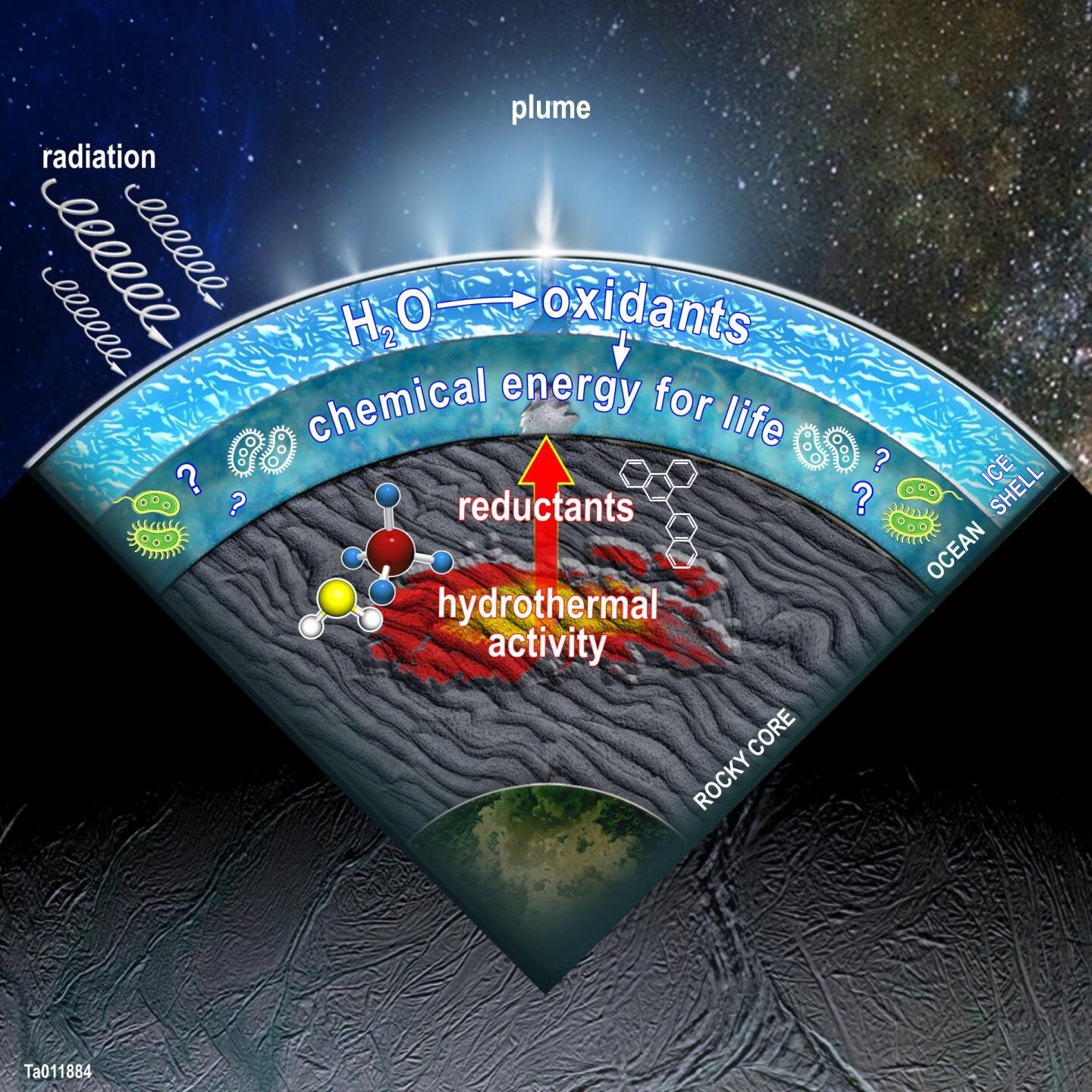 This figure illustrates a cross sectionEnceladus, showing a summary of the processes simulated by SwRI scientists on the moon of Saturn. Oxidants formed in surface ice when water molecules are destroyed by radiation can combine with reducing agents from hydrothermal activity and other water-rock reactions to create an energy source for potential life in the ocean. Image: SwRI
For example, the authors considered how ionizingradiation from space can create oxidants O2 and H2O2, and how abiotic geochemistry in the ocean and rocky core helps support metabolic processes. The team looked at whether these oxidants could build up over time.
“We compared our estimates of free energy withecosystems on Earth and determined that, in general, our values for aerobic and anaerobic metabolism meet or exceed the minimum requirements, ”concludes Ray. "The results show that oxidant production and oxidation chemistry can contribute to the maintenance of possible life and metabolically diverse microbial communities on Enceladus." Metabolic processes could support a potentially diverse microbial community in the ocean of liquid water under the icy facade of this moon of Saturn.
The conclusions drawn in the article are also of great importance for the next generation of researchers.
A spacecraft of the future could fly through the Enceladus plume to test the predictions of this article about the abundance of oxidized compounds in the ocean.
Read also
The most distant and ancient galaxy in the Universe has been found
20 new species of animals and plants found in the Andes
Scientists have found out where the red giants disappeared from the center of the Milky Way