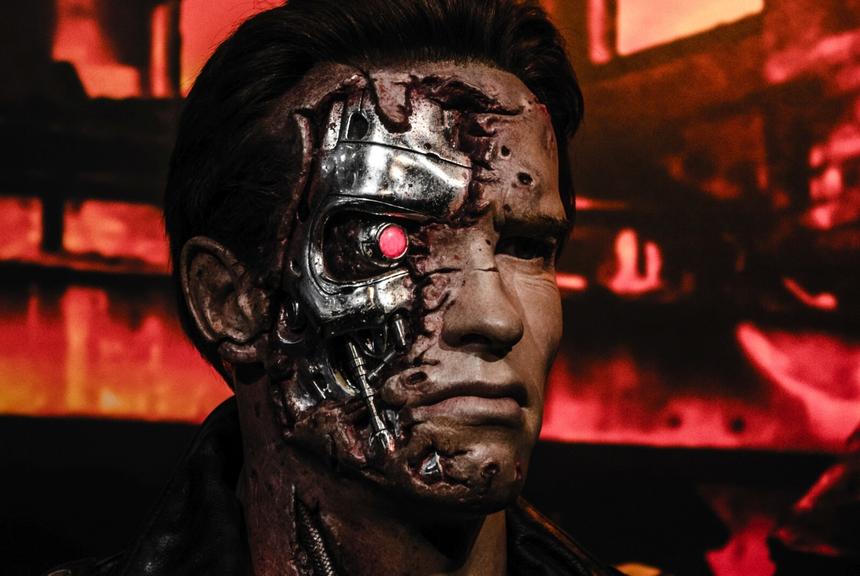
Developers still cannot combine realistic appearance and the ability to communicate in cars. What

 12
12
Voice assistant is fun
ECA
Embodied Conversational Agentsis a conversational agent (for example, a chatbotan online store that responds to the question “Where is my order?” - this is also him) in any visual form, be it an avatar, a robot, a hologram or a box with eyes. For example, researchers are creating agents that help users learn or maintain physical and mental health.

ECA on websites and applications in structure most often looks like this
Our laboratory deals specificallydirection of the ECA. We want to create a "new word" in disembodied robots, teach them how to communicate in a way that is really useful, enjoyable and saves everyone time.
Why complicate agents
Now everyone wants to create realistic robots,with bodily embodiment, eye movements, emotions, etc. This is not just a whim or a trend of the times, such a need lies in two planes - technical and theoretical.
- Technical. It used to be impossible to dohyper-realistic avatars. Now we can do more: both in terms of appearance and behavior. 3D modeling, neural networks and various versions of the semantic parsing of the user's speech help in this (robots, for example, can be taught to understand jokes or sarcasm).
- theoretical. Developers check whether the increase in realism is pleasant or, on the contrary, repels the user, whether people like to communicate with such robots. And you know? Yes, people love realism!
Only here in the ever-complicating scenarios there is one fundamental problem.
Imbalance of internal and external realism
You can’t do everything at once, you have to choose.On the one hand, developers complicate artificial intelligence systems. They are trying to increase the internal realism so that the system resembles the work of the human brain. On the other hand, external realism is important for people - this is the main factor in how a person reacts to communication with a robot. The "mind" of the machine must match its bodily appearance.
For example, the Tamagotchi does not need an anthropomorphic appearance,because the toy is primitive. But at the same time, it is perceived as natural due to the correspondence of the internal and external. This is the balance that must be considered when creating robots.
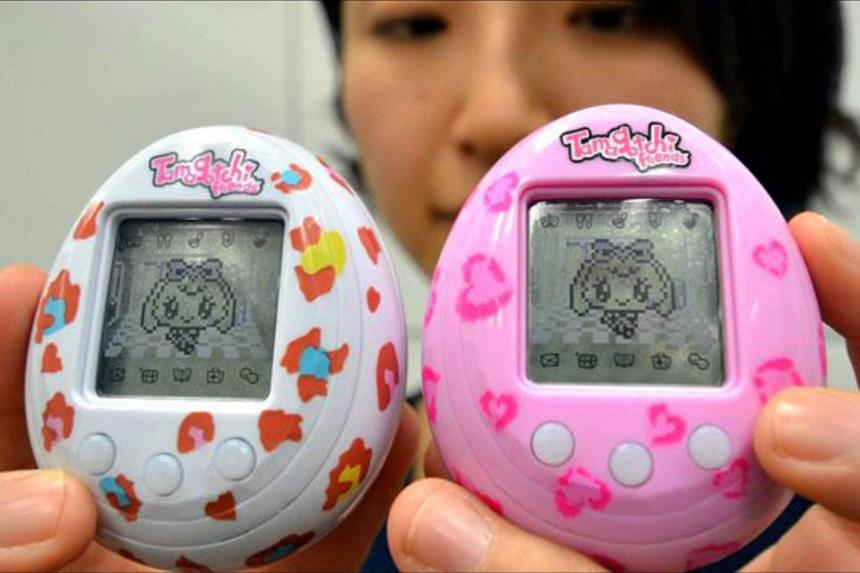
That Tamagotchi felt very alive. Although technically it was utterly primitive
If you set a goal to make the robot assmart, you have to plunge into the pool of cognitive architectures. They allow you to simulate entire social worlds, consisting of artificial agents that are realistic in their behavior. That is, this is such a basis that allows robots to make decisions, understand spoken human language and work autonomously, without the participation of a person and scripts.
Architectures began to be used in the late 20th century to control complex "smart" systems. For example, Soar was used to train military pilots and simulate the logic of air battles.
This technology is based on scientificresearch from the fields of neuropsychology and neurophysiology - but it is so complex that it is rarely used to create avatars. Cognitive architectures "eat" a lot of processor power due to complexity; it is not advisable to use them for simple games.
Such architectures are internally maximallyrealistic, but it is completely incomprehensible how much this is transmitted to the user and whether he will be able to feel the difference at all, to understand how “smarter” his interlocutor-robot has become.
The problem of multimodality
Modern technologies make it possible to createvisually quite realistic robots. For example, in December 2021, Engineered Arts introduced a robot with realistic facial expressions, but it can do almost nothing except wake up “humanly”. Other actions for him are carried out by the "hidden" operator. This is more of a toy than a real agent with whom you can communicate.
That is, it is technically possible to create an anthropomorphicrobot, but not particularly "smart". Or vice versa. Here contradictions arise between communicative and visual realism - a robot with a human appearance is expected to act and think like a human to the smallest detail. But a smart speaker on the table, in which, it seems, there is nothing but a microcircuit, a speaker and a battery, consistently pleasantly surprises with its lively speech. Because nothing extraordinary is expected from her on a subconscious level.
- External realism + stupidity of the robot
In this case, the user will immediately feeldistrust of an avatar that looks like a human but acts like a five year old or doesn't look like a human at all in their abilities. Such robots always get on people's nerves or serve as an object for jokes.
The more realistic the appearance, the higher the expectationsusers. For example, if an agent has a face, it is expected that it will react in a human way: track the direction of the gaze, express emotions through facial expressions, and so on - and all this is not random, but appropriate and timely. Today it is technically impossible.
- Super smart robot + technical difficulties
Developers can create for talking machinesa complex cognitive architecture, due to which the robot will behave very logically and “reasonably”, almost like a human being. But all this is difficult to translate into movements, facial expressions and other visual details of the robot's body. Technologies do not yet allow a system that would allow high-quality translation from a “robotic” language into a human one.
For example, you invented a robot and came up with a formulawhich takes into account dozens of factors and teaches the machine to correctly determine its "emotions". Are you sure that this will be felt by people in practice? Truly smart robots, as research shows, often seem to people as realistic as very simple ones, so there is no economic sense to invest in the real “mind” of avatars yet.
How far from ideal are we?
The main idea now is to find a balance of internal andexternal realism, and this requires research and development. At this stage in the development of technology, it is important to understand how “the race for realism” is expedient.
When robots transform from industrial machinesinto gadgets or people's interlocutors, it's time to think: what should and should not be done to make the robot feel realistic? what needs to be taken into account so that robots do not get lost in the conversation, starting with remarks and continuing with etiquette? how to teach a machine to navigate space as naturally and freely as a human does?
The answers to these questions have a direct bearing on development. Sometimes it's better to make a Tamagotchi than another anthropomorphic robot that can only blink.