Austrian astrophotographer Michael Jäger published new images of comet C/2022 E3 (ZTF) on his Twitter -
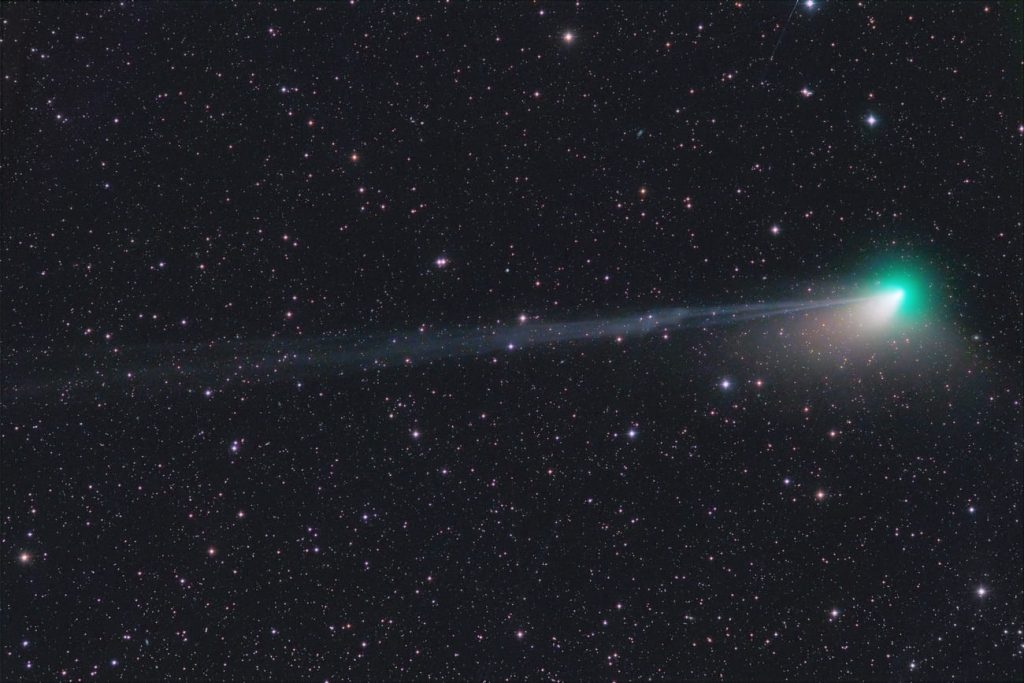 Separation of the tail of comet C/2022 E3 (ZTF). Image and video: Michael Jager
The photo was taken on January 17 in Bavaria, whereYeager set off in search of a clear night sky. SpaceWeather.com experts believe that the disruption in the structure of the comet's tail is caused by an increase in the solar wind after one of the last coronal mass ejections on the Sun. Recall that a coronal mass ejection is a large-scale ejection of the plasma of the solar corona, in which high-energy particles break away from the atmosphere of a star and move through the solar system.
The tail of a comet is made up of vaporized matter anddust thrown out by the icy body (coma) of this celestial body, which heats up when approaching the Sun. Despite the name, the tail does not always follow the comet - it is deflected by the solar wind and therefore always points away from the star. For example, C/2022 E3 (ZTF) has already passed perihelion and is moving away from the Sun, so the comet's tail roughly coincides with its direction of motion.
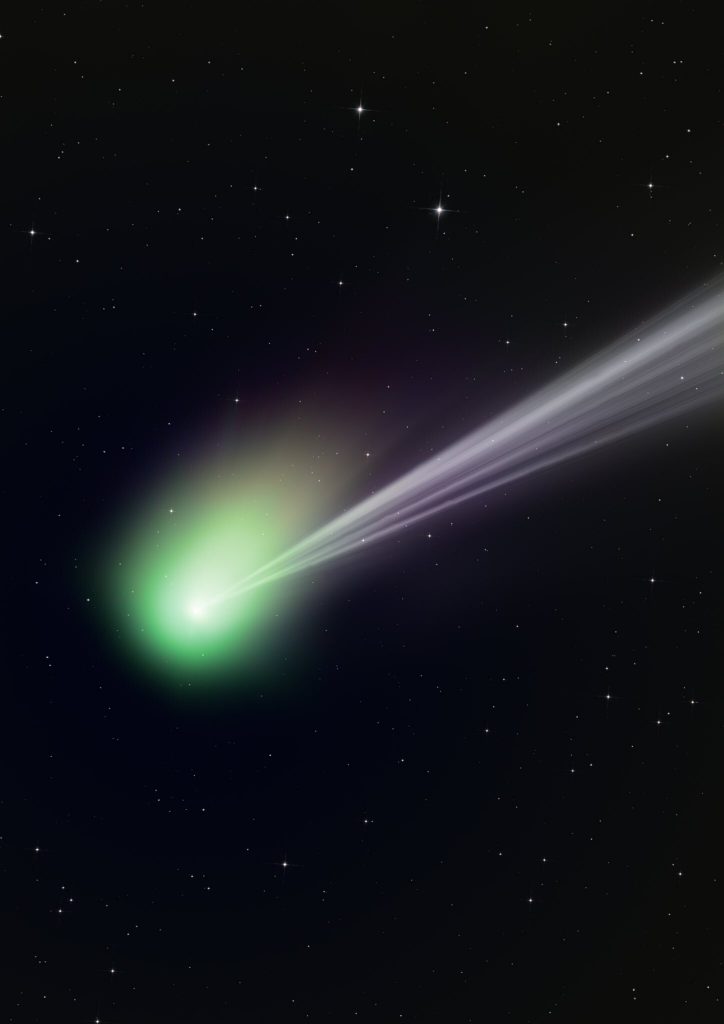
Comet C/2022 E3 (ZTF).Left: Image taken by Arizona astrophotographer Andrew McCarthy. Right: Exposition including one hour of observations of the comet after midnight on January 17th from the UK. Observation by amateur astronomer Adrian Jannetta
Yeager isn't the only comet huntermany amateur astronomers publish recent photographs and even videos taken during night observations of the comet. The photographs and time-lapses show a striking blue-green coma, a feature often seen in comets entering the inner solar system (inside the asteroid belt). UV radiation from the star breaks down the large organic molecules of the comet's nucleus into simpler compounds, including green-glowing diatomic carbon.
The large number of observations is not surprising.C / 2022 E3 (ZTF) continues to approach the Earth, it is not yet visible to the naked eye, but nevertheless binoculars or an amateur telescope are enough to observe. At the same time, the ideal time for observation is when the Moon is absent in the night sky - scattered radiation from the Earth's natural satellite gives too much illumination. You can find the comet in the night sky in the northern hemisphere using the map below.
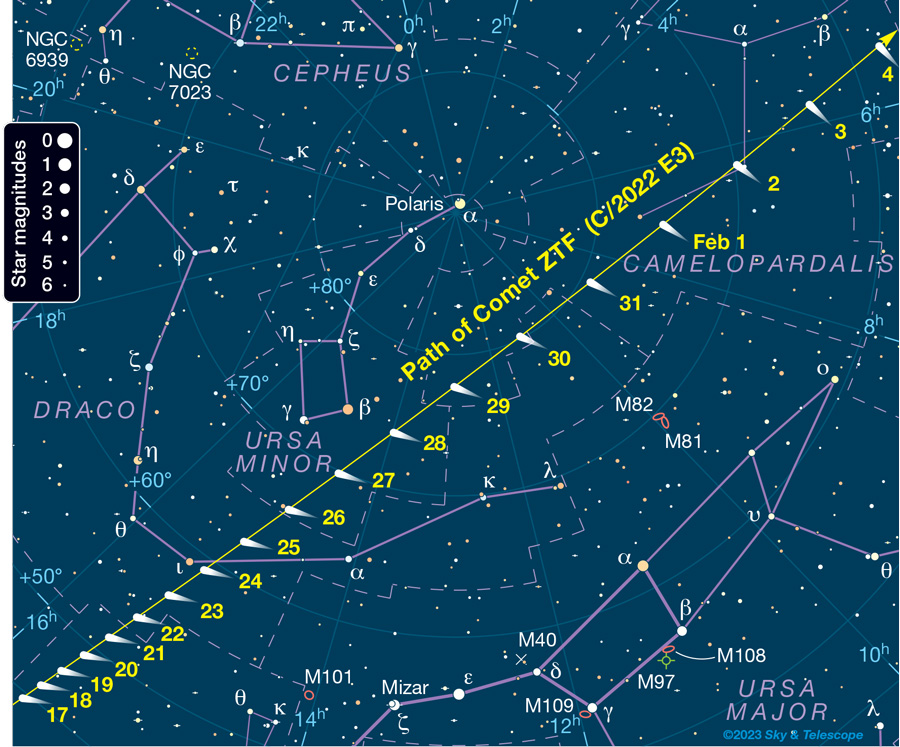 Approximate path of Comet C/2022 E3 (ZTF) in the night sky when observed in the northern hemisphere from January 17 to February 4, 2023. Image: Sky & Telescope
Read more:
A giant sunspot is turning towards the Earth. It is visible to the naked eye
See how a bladeless plane flies. Its speed exceeds 900 km/h
"Sparklers" in the corona precede solar flares