Why did old cartoons from the USSR look so high quality and realistic, but today they don’t?
Discuss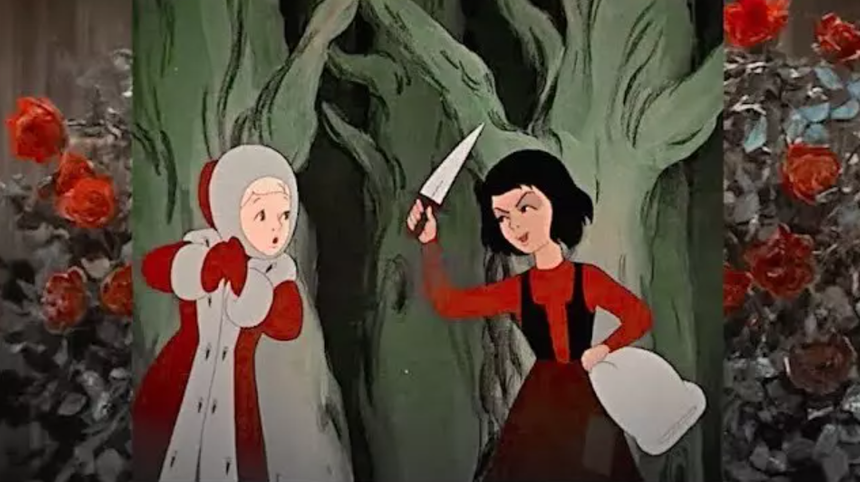
Table of contents
- How Rotoscopy Became the Mainstream Animation Technique
- Rotoscopy is more durable than expected
- Rotoscopy in the USSR
- death eclair
- Rotoscopy is not dead
You probably often hear from "grandfathers", they say,these are the vulgar American cartoons - with "freaks" (especially the animated series gets), mediocre and stupid. Not like the Soviet ones used to be, the old ones - "The Scarlet Flower", "Kashtanka", everything is drawn like in a movie, realistically.
But what if I tell you that "those same" cartoons were a crisis and stagnation in domestic animation, which the animators themselves considered a temporary period?
The point is that they were created using technologyrotoscopy, or, as it was called in the USSR, "eclair". Why this method was considered not creative, but handicraft, and, in general, a dead end on the path of animation development - in our article.
How Rotoscopy Became the Mainstream Animation Technique
Animation is a technically complex genre, but it givesmany advantages compared to movies, as there is more space for fantasy and creative freedom (well, imagine how much one episode of Rick and Morty would cost if it were a movie). In general, from the moment of birth, animation was not considered some kind of purely children's genre.
A typical cartoon from 1911
However, in order to develop one kind or anotherart, it is necessary to bring it to the market, earn money on it, and for enthusiasts to become professionals. Early cartoons were characterized by poor color, twitchy or sometimes very conditional character movements, and most importantly, they were hardly more than a minute long. And yet, they cost a lot of effort, a long time to produce.
Once a native of Polish Krakow (thenAustria-Hungary) from the Jewish suburbs (yes, not only Hollywood was created by the Jews, even here without them there is nowhere) Max Fleischer moved to New York, took up animation and invented the rotoscope.
Rotoscopy (or phototranslation) representedIt was a filming of a live actor who performed the necessary actions of the character, and then on the animation disk the film was redrawn frame by frame with the smallest nuances - this was how it turned out to “correctly”, proportionally and reliably recreate the character’s movements. In addition, the problem of synchronizing sound and music was solved (at that time there was a lot of singing and dancing in cartoons).
Rotoscopic revolution - Coco the clown masterfully copies the plasticity of the popular singer Cab Calloway
Wrong to think it was an easy jobquite the contrary - it was necessary to painstakingly and accurately shift everything from the cinematic image to the animated one. The slightest errors spoiled the picture, causing desynchronization. However, rotoscopy made it possible to kill many birds with one stone - the drawing and actions of the characters became more naturalistic, the image quality allowed the characters to act more actively in the frame, and most importantly, the action became more spectacular.
Fleischer himself began to gradually withdrawof the method he invented after 1924, by the early 1930s, rotoscopy seemed to be a thing of the past. It was left only for dynamically complex scenes - dances or battles, and also often for human characters when they were in contact with the magical world and its inhabitants, in order to emphasize the contrast.
In 1934, Fleischer's patent for rotoscopy expired, since then it has been allowed to be used by any studio without problems. At the same time, the niche of this method was designated - the image of human characters.
Early Disney productions were wildly popular, but no one would pay for rubber animation. And, even more so, watch this in full meter
Animation in the West has almost completely becomefocus on a children's audience, and it was dominated by anthropomorphic animal characters - Mickey Mouse, Buggs Bunny, Tom and Jerry and others who did not need rotoscopy.
It would seem that rotoscopy was finally supposed to die out, but one person prevented this, and it's easy to guess who ... of course, Walt Disney!
Rotoscopy is more durable than expected
Disney is tired of sitting on the sidelines of life, makingshort template cartoons, he wanted something more - epic creations for a full meter to fill the cinema with one cartoon (previously, cartoons were shown before the main show or several separate shows), and adults were also interested in watching them. In short, a complete family leisure.
It is in the dance scene that the contrast of the rotoscopic Snow White with the fully animated gnomes is clearly visible.
By that time, it had already been inventeda multi-plane camera with a glass machine (also a revolution by the way) - this made it possible to create a deep panorama and a realistic, proportional space with a perspective. In four years, they created the first masterpiece - "Snow White", where the dwarfs were drawn with ordinary animation, and Snow White and the prince - with the help of rotoscopy.
Separate techniques of rotoscopy made it possible to createworks with animals, when they were not given an anthropomorphic look, as, for example, in another hit of the studio - "Bambi". Disney Studio used real animals, where the animators trained their hands for a long time, copying the habits and movements of real deer.
In post-war cartoons, more and moreused alternative solutions, but it was not possible to completely move away from rotoscopy - Cinderella, Alice in Wonderland. After Walt Disney moved away from animation and turned his attention entirely to theme parks, his animators gradually began to move away from this method in the 1960s. The first signs of a new era were "101 Dalmatians" and, especially, "The Jungle Book", released after the death of Disney.
The final battle in The Lord of the Rings by Ralph Bakshi
But to say that rotoscopy is all is too early,the last major success of a rotoscopic film was 1997's Anastasia by Don Bluth. In the same technique, he created the cartoons "All Dogs Go to Heaven" and "American Tail", although, just there, all the characters were animals.
Separately, of course, it is worth talking about RalphBakshi is an animator whose work was either idolized or hated. The complex and quarrelsome artist had problems with financing projects, and when the budget for the film The Magicians was cut, he took up rotoscopy to reduce the cost of processes, becoming a fan of it.
In the future, he first filmed the Lordrings - for mere pennies it turned out to realize such a huge epic canvas, although he later got it from fans. In addition, in the 1980s, "Pop America" was created - an adult and dramatic canvas about several generations of a family of Jewish emigrants from the Russian Empire in the United States.
The production process of Alice in Wonderland with animators working off
Rotoscopy in the USSR
Seriously take up cartoons in the Union decided afterwar. Under Lend-Lease, the Soviets got not only Shermans, Aircobras and stew, but also Hollywood and Disney products. And, of course, the unspoiled Soviet public experienced a culture shock - the country simply did not have the capacity for such works at that time.
The problem was solved by Comrade Stalin himself (well, who else)— Soyuzmultfilm was given new premises and given way to young and ambitious artists and directors — Vinokurov, Shvartsman, Atamanov and many others.
Rotoscopy in the USSR was also considered obsoletetechnique, but in poor post-war times, it helped to reduce the cost of processes. Moreover, Comrade Stalin wanted cartoons no worse than American ones. At that time in the country this method was called "eclair", after the French Éclair film camera (well, as with copiers, the story).
A striking example of Rotoscopy-eclair in the Soviet Kashtanka
In 1951, in an oral presentation by a cartoonistIvanov-Vano, in the spirit of that time, they branded "Disneyism", the corrupt girl of capitalism - for sugariness, pandering to the bourgeoisie and commercial orientation. The new Soviet cartoon art was obliged to go its own way.
However, this did not mean that the cartoons would be aboutstruggle of the working class against capitalism. On the contrary, in the spirit of the late Stalinist empire and the fight against cosmopolitanism, they began to turn to folk fairy tales and classics of literature, as well as to the modern agenda, which exposes and castigates vices, educates hardworking and responsible citizens.
It was during this period, from 1949 to 1960.the era of short "eclairs" of Soviet animation began, but with a Disney scale. Of course, full-length films did not become Soyuzmultfilm's standard, but there were also original inventions, such as oil paints for the film Polkan and Mongrel, which gave out a more saturated color.
Polkan and Shavka - rich color and detailed background inspired by the artistic tradition of Shishkin
And this, by the way, was a luxury in comparison withAmerican studios, which after 1941 began to save money and switch to watercolor (the first such film was about Dumbo the elephant). But this is partly because the Americans created an incomparably greater timekeeping of cartoons in a year, so they could not squander on materials.
Of course, one can argue a lot about whatthe quantity in the US did not necessarily translate into the quality of the cartoons themselves. But the real breakthrough happened in Lev Atamanov’s feature film The Snow Queen, which was rare for those times, which was “our answer to Disney” and really had a great worldwide box office success, inspiring Hayao Miyazaki himself in distant Japan, then still a very young man who did not know what to do in life.
Atamanov used eclair for hiscartoon, but there were also a lot of cartoon elements - the character of Ole Lukoe was fully animated. This cartoon then also meant a qualitatively new transition for Soyuzmultfilm, which grew out of the framework of a local producer and inspired animators to turn to new techniques.
Ole Lukoe was completely a "cartoon character" - the only one in the film. But the cartoon itself became a revolution, giving the "Disney" quality and scope
death eclair
“Thaw” in politics led to changesanimations. As we have said, rotoscopy was considered a very primitive technique already in the 1930s. Her life was extended by the commercialization of studios and the need to make large full-length canvases.
The same Disney, and other studios, had hugestaffs of multipliers with a high turnover of staff, which is why real professionals were always in short supply - often for projects it was necessary to recruit armies of newcomers or temporary almost day laborers. Therefore, rotoscopy was a way out in such a situation - it saved the budget and made it possible to work with a large staff of low-skilled animators.
From an artistic point of view, cartoonsturned out to be visually monotonous - it was difficult to realize the full artistic potential of the animators. The cartoon itself looked like a kind of “little brother of cinema”, that is, cartoons did not offer something visually cooler compared to cinema, but were hand-drawn movies.
L. Amalrik's magic shop is a typical example of "drawn cinema" and limitations of rotoscopy techniques
In the early 1960s, the USSR began the process of searchingnew creative and technical solutions. In addition to hand-drawn animation, they paid attention to puppet animation (Shvartsman and Kachanov "Crocodile Gena"), in this area the USSR quickly became a leader. Later, plasticine animation (Harry Bardin) will also join here.
But hand-drawn animation has now become verythe cartoon “Wild Swans” by the Tsekhanovskys and “The Story of a Crime” by Khitruk, which later gave us the Soviet “Winnie the Pooh”, became an individual, first sign here. You can talk about this endlessly, and if the topic comes to you, we will tell you more about the golden age of Soyuzmultfilm (1960 - 1980s).
It was then that there was a qualitative transition incompared with the "Disney" tradition, which, although also moving away from rotoscopy at this time, has much more difficulties in creative experiments, due to market pressure and competition.
Wild Swans – one of the first cartoons that marked a departure from “naturalism” in favor of freer solutions, later rotoscopy was completely abandoned
Rotoscopy is not dead
Although rotoscopy (photo-translation, eclair - also it) has ceased to be the main tool for animation, this technology has not completely sunk into oblivion.
First, the cinematography where rotoscopy played inthe reverse side - on its basis, early special effects were created, when it was still far from the birth of computer graphics - magic, fantastic creatures, space travel were created by animation and complex combinations on the pasteboard.
The most notable application of rotoscopyfalls on Star Wars - with its help, the main feature of this saga, namely lightsabers, was created. Ordinary dummies on which the actors fight were painted in several layers during the production process, which created a luminous effect and a characteristic pulsation of the “plasma glow”.
It was possible to find a lightsaber fight in the original pre-remaster quality only in a documentary
Secondly, rapidly developing in the 1980s-1990sgame industry. It became a big problem for the gaming industry to create anatomically correct human characters, especially in action, so we had to re-experience all the experience of cartoonists of the past.
Rotoscopy was especially useful for fighting games, butthe most famous game here is Prince of Persia. Game creator Jordan Meckner has already experimented with rotoscoping in the Karateka fighting game, and for Prince of Persia he filmed his brother David's parkour moves, digitizing the movements step by step. Thus, it was possible to create a game with amazingly reliable dynamics and realistic character animation.
But the creators got out of the situation much easierimmortal Mortal Combat, the most iconic fighting game in the world. Models, athletes and professional martial artists were hired to create the characters, all of their movements were filmed and clearly recorded. As a result, the characters were incredibly “live” for the gaming capacities of that time, and their battles looked amazingly realistic.
Learned? Get class!!!
This is not even rotoscopy in its purest form, but the principle is the same. The low-budget studio Midway was able to create its own flagship, which for many years was almost the main computer game in the world.
The ideological successor of rotoscopy, but at a new technical level, can be considered technologymotion capture, which makes it easy to integratecomputer graphics in the cinema by creating animated "skeletons" of live actors pasted over with sensors. The most notable and famous actor here is Andy Serkis and his Gollum in The Lord of the Rings, later Serkis would become the main actor in computer animation in dozens of projects.
Today in Hollywood (and not only) streammovie attractions, when advertising and marketing eat up exactly half of the film's budget, green backgrounds and motion capture have become commonplace for any project - no plans, no expensive costumes, no stunt tricks are needed, we'll draw everything. Whether the movie will try to get out of this creative impasse ... we'll see.