What is space debris?
Space debris refers to all man-made objects and their
In some cases, large or containingon board, hazardous (nuclear, toxic, etc.) materials, objects of space debris can pose a direct danger to the Earth - with their uncontrolled de-orbit, incomplete combustion when passing through dense layers of the Earth's atmosphere and falling debris onto settlements, industrial facilities, transport communications.
The problem of littering near-Earth space with "space debris" as a purely theoretical one arose essentially immediately after the launches of the first artificial Earth satellites in the late 1950s.
It received official status at the international level after the report of the UN Secretary-General entitled "The Impact of Space Activities on the Environment" on December 10, 1993.
What does it consist of?
At present, in the region of low Earth orbit (LEO) up to the altitude ofAccording to various estimates, there are about 2,000 km.(300,000 according to the United Nations Office for Outer Space Affairs, October 2009) of man-made objects with a total mass of up to 5,000 tons.
On the basis of statistical estimates, it is concluded that the total number of such objects with a diameter of more than 1 cm is rather uncertain and can reach 60–100 thousand.
Only a small part of them (about 10%) wasdetected, tracked and cataloged using ground-based radar and optical means. For example, as of 2013, the US Strategic Command catalog contained 16,600 objects (mostly larger than 10 cm), most of which were created by the USSR, the USA and China.
Russian catalog, GIATs ASPOS OKP (TsNIIMash),contained in August 2014 15.8 thousand objects of space debris, and in total there were more than 17.1 thousand objects (including operating satellites) in near-earth orbits, a collision with any of which will lead to the complete destruction of the spacecraft.
About 6% of monitored objects are active;about 22% of objects ceased functioning; 17% are spent upper stages and boosters of launch vehicles, and about 55% are waste, technological elements associated with launches, and debris from explosions and fragmentation.
Most of these objects are in high-inclination orbits whose planes intersect, so the average relative speed of their mutual passage is about 10 km/s.
Due to the huge reserve of kinetic energya collision of any of these objects with an active spacecraft could damage it or even disable it. An example is the first collision of artificial satellites: Kosmos-2251 and Iridium 33, which occurred on February 10, 2009; as a result, both satellites completely collapsed, forming over 600 debris.
The most contaminated areas are those of the orbits around the Earth, which are most often used for the operation of spacecraft. These are LEO, geostationary orbit (GSO) and sun-synchronous orbits (SSO).
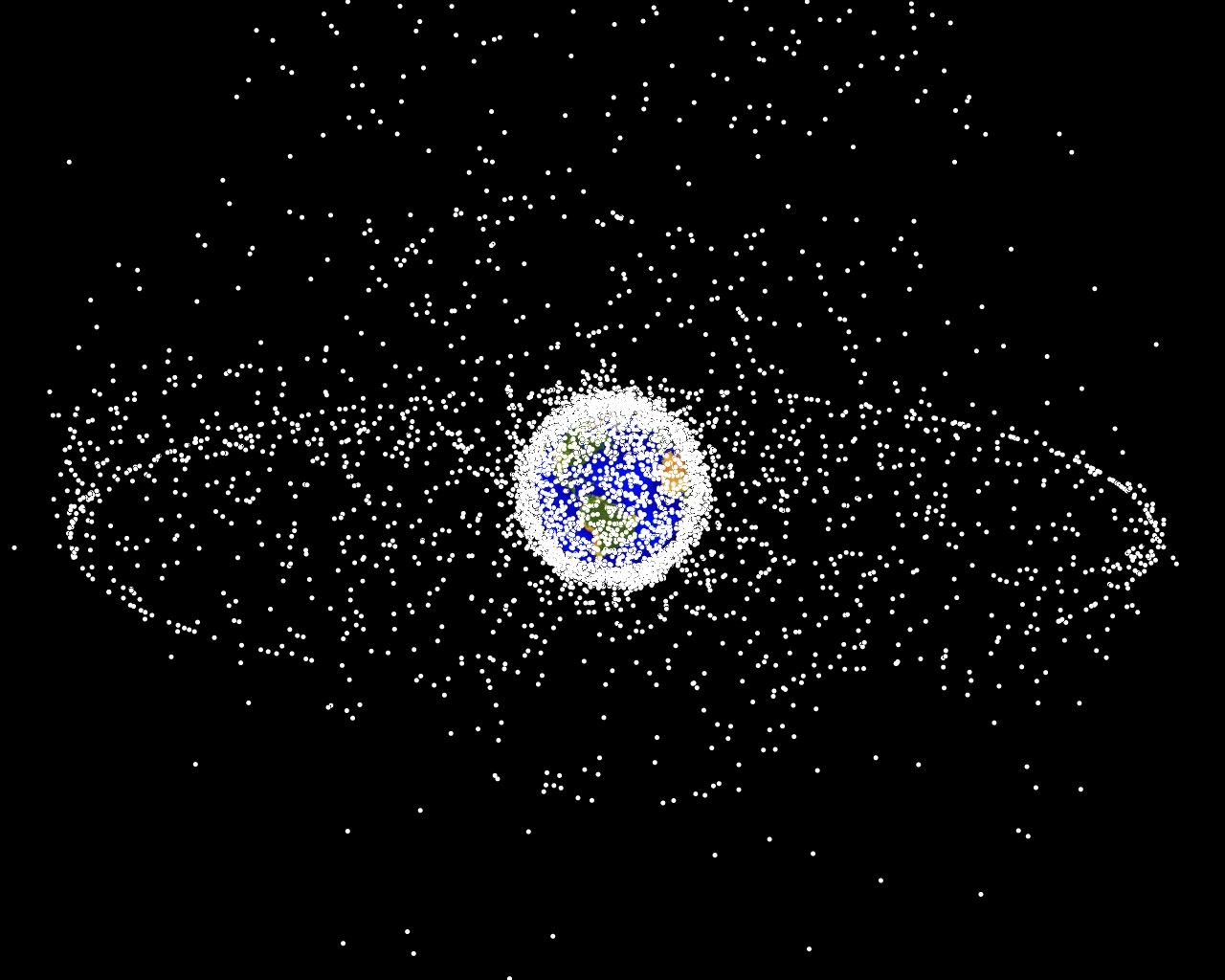 Computer model of the distribution of space objects in near-earth space, according to NASA's description 95% of them are debris
Why is space debris dangerous?
Large objects located at lowin near-earth orbits, gradually slow down and after some time enter the atmosphere. Some of their fragments reach the surface of the planet. Small objects of space debris fall into the dense layers of the atmosphere almost daily, larger objects - several times a month. According to NASA's Nicholas Johnson, fragments of satellites or rockets reach the surface almost every year.
- Fall of object WT1190F
On November 13, 2015, one of thefragments of a rocket that previously participated in the lunar program. A fragment with a size of 1–2 m and a density of 0.1 g/cm³ entered the atmosphere in the Indian Ocean region approximately 60 km from the coast of Sri Lanka.
According to some opinions, this was the firsta recorded case of space debris returning to Earth from a high elliptical orbit, the apogee of which is approximately 2 times the distance from the Moon to the Earth. Object WT1190F entered the Earth's atmosphere on November 13, where it burned up safely.
- Garbage asteroid
According to scientists, a celestial body is moving towards Earth,of earthly origin. Scientists from the US National Space Agency note that a celestial body of artificial origin will approach the Earth at a distance equal to 10% of the distance from the Earth to the Moon. This became known in early February 2021.
US National Aerospace Agencyrecognized the “asteroid” as a fragment of the Centaur launch vehicle of the Surveyor 2 mission. Space debris became an artificial satellite of our planet, trapped by gravity. Scientists, having carried out modeling, found that the rocket fragment will soon leave the Earth's orbit, making an extremely close approach.
It is worth noting that the artificial asteroid has been flying in space for a long time, since Surveyor 2 was launched in 1966. Scientists have yet to find out if this is actually the case.
Methods for cleaning and destroying space debris
Effective practical measures for destructionspace debris in orbits of more than 600 km (where the cleansing effect of braking on the atmosphere does not affect) has not yet been developed at the current level of technological development of mankind.
Satellite projects were also considered,evaporating debris with a powerful laser beam or changing their orbit with ion beams, which should slow down the debris for their entry into the atmosphere with partial or complete combustion in it or, in the case of devices in geostationary orbit, take them into a burial orbit, or ground-based lasers (Laser broom), or a device that will collect waste for further processing.
At the same time, the urgency of the task of ensuringsafety of space flights in the conditions of technogenic pollution of near-Earth space (OKP) and reducing the danger for objects on Earth in the case of uncontrolled entry of space objects into the dense layers of the atmosphere and their fall to the Earth is growing rapidly.
International cooperation to solve the problem of "space debris" is developing in the following priority areas:
- Environmental monitoring of the OKP, including the area of the geostationary orbit (GSO): observation of "space debris" and maintaining a catalog of objects of "space debris".
- Mathematical modeling of "spacedebris "and the creation of international information systems for predicting the debris of the NCP and its danger for space flights, as well as information support of events of a dangerous approach of SOs and their uncontrolled entry into the dense layers of the atmosphere.
- Development of methods and means of protecting space vehicles from the impact of high-speed particles of "space debris".
- Development and implementation of measures aimed at reducing contamination of the waste area.
Search and tracking of space debris
There are many tools for monitoring near-Earth orbits in order to search for objects in it. They can be divided into radar and optical.
Detection of orbital objects can also beadditional function of universal tools for space exploration or defense systems. There are a number of specialized tools.
The USSR and the USA created powerful space tracking tools. There are also a number of specialized instruments in Europe and other countries.
There are a number of national programs for tracking near-Earth objects and space debris mitigation. The Inter-Agency Space Debris Coordination Committee was created to coordinate their activities.
- Iodine engine
A small but potentially useful innovation could help clear the skies of space debris: it would allow tiny satellites to cheaply and easily self-destruct at the end of their mission.
The technology uses a new fuel - iodine - inan electric motor that controls the satellite's height above the Earth. Iodine is cheaper and uses simpler technologies than traditional fuels. Unlike many traditional rocket fuels, iodine is non-toxic and remains solid at room temperature and pressure. This makes it easier and cheaper to work on Earth.
When heated, it turns into gas without passingthrough the liquid phase, making it ideal for a simple propulsion system. In addition, it is denser than traditional fuel, so it takes up less space on board the satellite.
- Spaceship garbage collector
Russian scientists have proposed clearing the Earth's low-Earth orbit using a spacecraft. There are special modules with engines on board.
These modules will be attached to objectsspace debris and move them away. As for geostationary orbit, the preferred way to clear it would be to tow a spacecraft, scientists say.
Its task is to transport space debris objects to the "destruction orbit" (600 km high, where objects are gradually destroyed from braking against the atmosphere).
Assembly spacecraft proposedteam to clean up near-Earth orbits, has a length of 11.5 m, a diameter of 3 m and a weight of just over 4 tons. Such a collector can carry from 8 to 12 modules with engines on board.
To move the stages of a passenger ship, from 50 to 70 kg of fuel will be required, to transport a Zenit-2 stage weighing 9 tons - about 350. The total weight of such an assembler at the start will be from 8 to 12 tons.
Modern accelerators can easily deduce suchcargo to any orbit up to 1000 km. After the collector runs out of modules, it will join the last stage of the booster, move with it to the upper atmosphere and burn.
- Japanese startup for cleaning garbage
The Japanese startup plans to launch devices that will find and eliminate space debris from March 2021. If all goes well, they will send a full mission.
Japanese startup Astroscale sent its ELSA-d spacecraft to the Baikonur Cosmodrome in Kazakhstan. There, engineers will integrate it with the Soyuz rocket, scheduled to launch in March 2021.
The company noted that this is the most important flight forthem, as this is the first demonstration of the company's debris abatement technology - one of the most important challenges in ensuring the sustainability of space activities.
The small-sized device will demonstrate key technologies: targeting, which will help locate debris using a GPS-based targeting sensor.
This data will be used by a so-called "service" satellite, which can intercept a piece of space debris.
Read more
Look at an 8 trillion pixel image of Mars
Scientists have developed a replacement for the theory of relativity. What is the essence of the "theory of everything"?
Abortion and science: what will happen to the children who will give birth