Researchers from the Northwest Research Associates have identified
For their analysis, the researchers useda database of images of solar active regions taken by NASA's Solar Dynamics Observatory. The researchers analyzed images of active regions on the Sun taken over eight years in ultraviolet and extreme ultraviolet light.
Analysis of a large amount of data and more than 160various parameters showed what signs on the surface of the Sun indicate a high probability of a future flare. The researchers found that the most characteristic sign of a future outbreak is increased variability in the intensity of ultraviolet and extreme ultraviolet light over a short period of time.
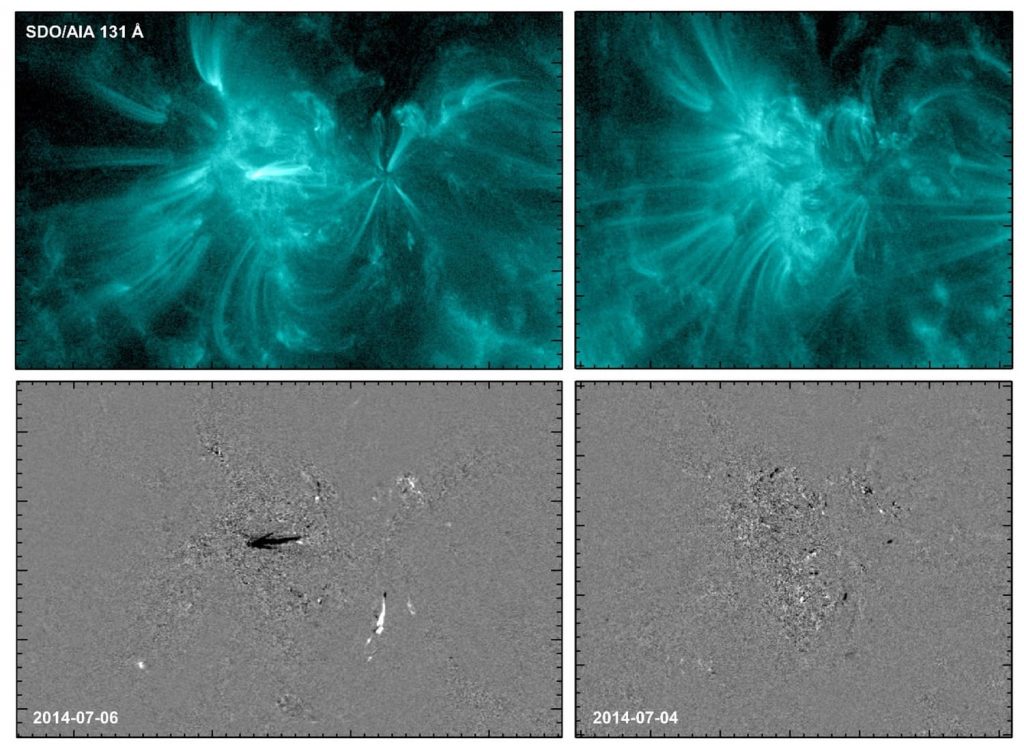 Images of the active region of the Sun (NOAA AR 2109)show what the active region looked like in the extreme ultraviolet (top) one day before the outburst (left) and one day before the lull (right). Brightness analysis (bottom images) in these two time periods show different patterns. A day before the outbreak (left), areas of intense change (black and white areas) are visible, and before the lull (right), the image appears gray, indicating low variability. Image: NASA/SDO/AIA/Dissauer et al. 2022
The authors of the work note that the developmentThe sensitivity of measuring instruments makes it possible to consider details that were previously inaccessible to observation. Traditional approaches to forecasting solar weather were based on large phenomena associated with processes in the lower layers of the solar atmosphere. For example, changes in active regions marked by sunspots. The new data will expand predictive models.
In the crown we can get a completely differentinformation than we get from the photosphere or "surface" of the Sun. Our results may give us a new marker to determine which active regions are likely to erupt soon and which will remain quiet for the near future.
K. D. Leka, co-author of the study, professor at the Japanese National University in Nagoya
Read more:
Blazar, which was found 20 years ago, turned out to be an extreme object
TESS discovered a "new Earth": a stone planet with water is in the habitable zone
Look at the consequences of the collision in 1181 of two stars
Cover image: NASA/SDO