Researchers from Hubei University in Wuhan discovered a mechanism in the uloborid spider (Philoponella prominens), using
Video: Shichang Zhang et al., Curent Biology
The researchers note that the principle of the catapult -the slow accumulation of energy in order to quickly move in space if necessary - previously found in the wild. It is usually used when catching prey or fleeing from a predator. Spiders were the first species to eject to avoid sexual cannibalism.
Biologists conducted 155 successful matings andsaw that 152 males immediately after completion of sexual intercourse ejected and ran away from their partners. All of these males survived, but the remaining three were captured, killed and eaten by the females. In a second experiment, the researchers blocked the spiders' ability to eject. As a result, all 30 experimental arthropods were eaten.
Scientists believe that spiders bend when matinglegs around the body of the female, after the completion of intercourse, the legs are released, hydraulic pressure causes them to expand rapidly and throws the male. At the same time, he continues to stay on the web and can return to his partner for repeated sexual intercourse. Some spiders come back up to six times, scientists say. If this "safety cable" is cut during mating, the spider will still jump away, but will fall to the ground, scientists say.
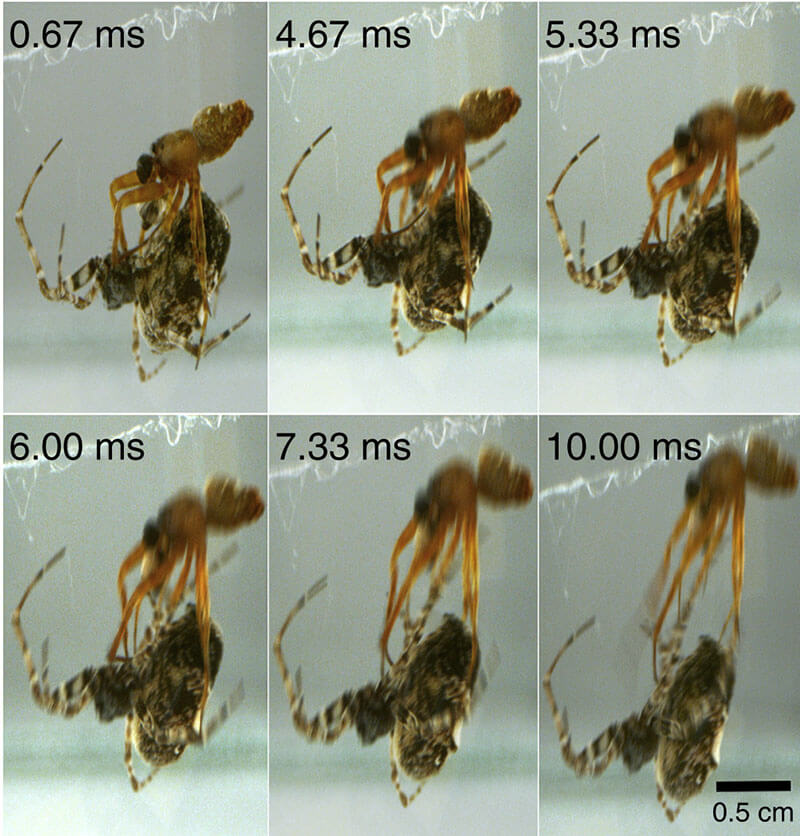 Image: Shichang Zhang et al., Curent Biology
Researchers tried blocking in spidersmechanisms for throwing out a safety web or cut off the front legs responsible for ejection. The experiment showed that in all these cases, the spiders continue to care for the females, but do not attempt to mate.
Biologists note that males with excellentmotor and physical abilities can quickly catapult several times, thereby increasing their chances of fatherhood. This, the authors of the paper believe, sets the stage for antagonistic co-evolution, where females can afford high levels of sexual cannibalism and males develop behaviors such as fast tethered catapults to save their lives.
Read more
It has been hunted for centuries: what do we know about the planet Vulcan next to the Sun
Astronomers have found a planet near the Earth: it has a very strange orbit
Scientists from China have proved that modern plate shifts date back 2.5 billion years