What are brown dwarfs?
Brown dwarfs, or brown dwarfs, are substellar objects (with masses of
As in the stars, thermonuclear reactions take place in them.nuclear fusion on the nuclei of light elements (deuterium, lithium, beryllium, boron), but, in contrast to the stars of the main sequence, the contribution to the heat release of such stars from the nuclear fusion of hydrogen nuclei (protons) is insignificant, and after the exhaustion of the nuclei of light elements, thermonuclear reactions in their bowels cease, after which they cool down relatively quickly.
In brown dwarfs, in contrast to the stars of the mainsequence, there are also no spherical layers of radiant energy transfer - heat transfer in them is carried out only due to turbulent convection, which determines the homogeneity of their chemical composition in depth.
Dwarf rotation
All discovered brown dwarfs rotate rapidly—from an hour to several tens of hours per full rotation.
For example, the trio of fastest-rotatingdwarfs reaches an equatorial speed of 360,000 km/h, and has come quite close to the theoretical limit beyond which a celestial body should be destroyed by centrifugal force, and which is 50-80% greater than observed.
The rapid rotation of dwarfs is explained by the absence ofof the mechanisms for transmitting the torque that exists in stars. For example, the Sun, which has a period of revolution at the equator of 25 days and an equatorial speed of 7284 km/h, transmits rotational torque through a magnetic field: the field rotating with the Sun deflects the movement of solar wind protons in the direction of rotation.
Thus, the speed of rotation of the Sun slows down more and more as it evolves.
Origin
One of the mechanisms of origin of browndwarfs are similar to planetary. A brown dwarf forms in a protoplanetary disk on its outskirts. At the next stage of their life, under the influence of the surrounding stars, they are thrown into the surrounding space of their parent star and form a large population of independent objects.
Like regular stars, brown dwarfs can form independently of other objects. They can form individually or in close proximity to other stars.
In 2015, a group of browndwarfs in the process of formation, and some of them showed the same jets as more massive stars in the process of formation.
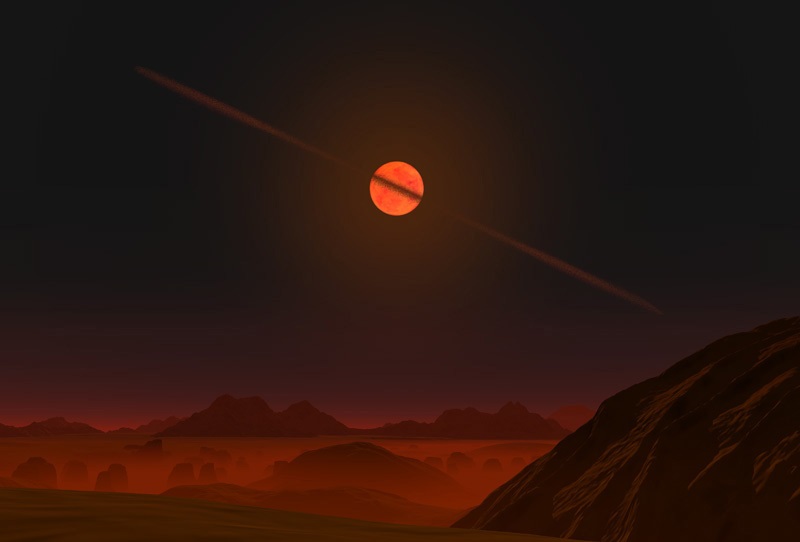 An asteroid disk around a brown dwarf. View from a hypothetical planet from a distance of about 3 million kilometers.
Observations
Unlike main sequence stars, whose minimum surface temperature is about 4000 K, the temperature of brown dwarfs lies in the range from 300 to 3000 K.
Unlike the stars that warm themselves updue to the thermonuclear fusion taking place inside them, brown dwarfs constantly cool down throughout their life, while the larger the dwarf, the slower it cools.
Properties of brown dwarfs, transitional betweenplanets and stars by mass, are of particular interest to astronomers. A year after the discovery of the first object of this class, weather phenomena were discovered in the atmospheres of brown dwarfs. It turned out that brown dwarfs can also have their own moons.
Recent observations of known brown dwarfs have revealed some patterns in the intensification and attenuation of radiation in the infrared.
This suggests that the brownthe dwarfs are covered with relatively cold, opaque clouds obscuring the hot interior. These clouds are believed to be in constant motion due to strong winds much stronger than the known storms on Jupiter.
Planets around brown dwarfs
Super-Jupiters of planetary mass 2M1207B and 2MASSJ044144, which orbit brown dwarfs at large orbital distances, may be formed by accretion rather than from a cloud of gas and dust, and may therefore be subbrown dwarfs rather than massive planets.
Discovered disks around brown dwarfshave many of the same functions as the disks around stars. Thus, they are expected to form planets orbiting brown dwarfs over time. Given the low mass of brown dwarf disks, most planets will be terrestrial planets rather than gas giants.
If a gas giant were orbitingbrown dwarf and the Sun would lie in the plane of its orbit, then it would be easy to detect by the transit method, because they have approximately the same diameter.
The accretion zone for planets around a brown dwarf is very close to the brown dwarf, so tidal forces will have a big impact on the planets formed.
Planets orbiting brown dwarfslikely to be water-scarce silicate planets. An exception is the planets formed at the outer edge of the gas and dust disk, which, due to the lower accretion temperature, can theoretically retain part of the water in their composition.
Habitability
Habitability has been studied for planets rotatingaround brown dwarfs. Computer models show very strict conditions for habitability of such planets, as the habitable zone is narrow and decreases over time due to the cooling of the brown dwarf.
Because brown dwarfs are much dimmer than the Sun, an Earth-mass planet would have to orbit much closer to receive as much heat as Earth receives from the Sun.
Hypothetical habitable planets aroundbrown dwarfs probably have an orbital period of no more than a few Earth days. The habitable zone of a brown dwarf is an area of space around a brown dwarf where temperatures are neither too high nor too low for liquid water to exist on the surface of a planet of Earth's mass.
The development of simple or even complex life onAn Earth-mass planet orbiting a brown dwarf is expected to depend largely on the amount of time the planet spends within the habitable zone, or “Goldilocks” zone.
On Earth, the emergence of simple life took at least 0.5 billion years, while the emergence of complex multicellular life may have taken approximately 3 billion years.
As a result, the planet must long enoughbe in the shrinking habitable zone of a brown dwarf so that simple life or even advanced life forms have time to develop. Andreeshchev and Scalo (2002) calculated that a planet in close orbit around a 0.07 solar mass brown dwarf could remain within the habitable zone for up to 10 billion years.
The duration of the habitable period decreasesfor brown dwarfs of lesser mass. For example, a planet around a brown dwarf of 0.04 solar masses can remain habitable for no more than 4 billion years.
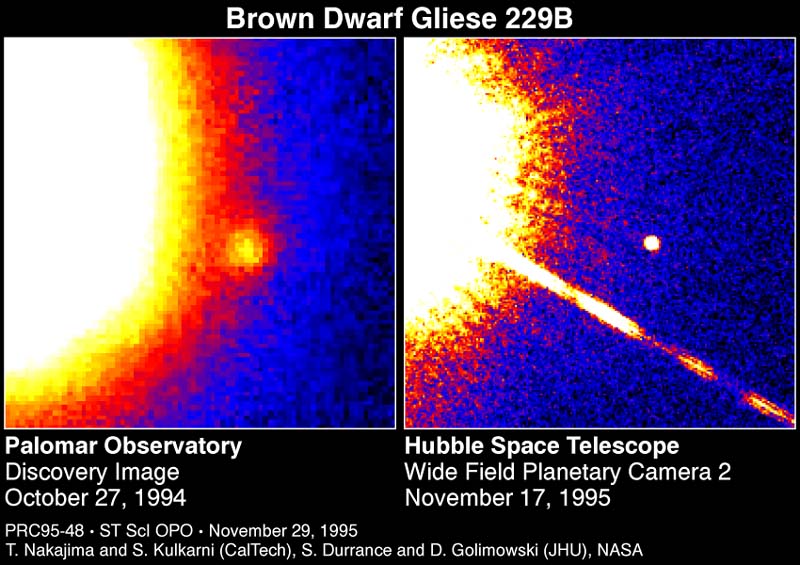 Brown dwarf (smaller object) rotatingaround the star Gliese 229, which is located in the constellation Hare, about 19 light years from Earth. The brown dwarf Gliese 229B has a mass of 20 to 75 Jupiter masses.
The latest study of brown dwarfs
- Brown dwarf map
Astronomers have compiled the most complete listnearby brown dwarfs thanks to discoveries made by thousands of Backyard Worlds volunteers. The list and 3D map of 525 brown dwarfs, including 38 first reported, include observational data from a variety of astronomical instruments.
As a result, a location map of more than500 cool brown dwarfs in the vicinity of the Sun. An international team of astronomers, supported by volunteer scientists from the Backyard Worlds: Planet 9 collaboration, announced an unprecedented census of 525 cool brown dwarfs within 65 light-years of the Sun, including 38 new discoveries.
By determining the distances to all census objects, astronomers were able to build a three-dimensional map of the distribution of cold brown dwarfs in the vicinity of the Sun.
- Winds and jet currents
A research team led by the University of Arizona has discovered winds and jet currents on the closest brown dwarf to Earth.
Knowing how winds blow on dwarfs and how heat is redistributed is important, as it helps us understand climate, extreme temperatures and their evolution.
To find out, a team of researchers used NASA's Transiting Exoplanet Survey Satellite, or TESS, space telescope to study the two closest brown dwarfs to Earth.
They are 6.5 light years away.The brown dwarfs are named Luhman 16 A and B. Luhman 16 A is about 34 times as massive as Jupiter, and Luhman 16 B, which was the main subject of research, is about 28 times more massive than Jupiter and about 815 degrees hotter.
- The binary system of brown dwarfs
Scientists have discovered an exotic binary system of two young planet-like objects. Although they look like giant exoplanets, they formed in the same way as stars.
Researchers led by Clemence Fontanive of the Center for Space and Habitability (CSH) at the University of Bern have discovered a curious starless binary system of brown dwarfs.
The CFHTWIR-Oph 98 system (or Oph 98 for short) consists of two very low-mass objects Oph 98 A and Oph 98 B. It is located 450 light-years from Earth in the Ophiuchus star cluster.
This pair is a rare example of two objects similar in many aspects to extrasolar giant planets orbiting each other without a parent star.
More massive component, Oph 98 A - younga brown dwarf with a mass 15 times that of Jupiter. Scientists note that the object is located on the border separating brown dwarfs from the planets. Its companion, Oph 98 B, is only 8 times heavier than Jupiter.
- Wind speed on a brown dwarf
Astronomers have measured wind speed for the first timebrown dwarf. The technique, developed by researchers from the National Radio Astronomy Observatory, will make it possible to measure wind speed on other stars outside the solar system.
Researchers based on orbital dataThe Spitzer telescope studied the brown dwarf 2MASS J10475385 + 2124234. The size of this object is comparable to the size of Jupiter, but it is about 40 times more massive than the gas giant. The dwarf is located 34 light-years from Earth.
Studying the data collected by the telescope allowed scientists to compile a model of the object's atmosphere. Astronomers have found that the brown dwarf's outer atmosphere rotates faster than its inner part.
The wind speed on it is approximately 2293.315 km / h. This is significantly higher than the wind speed on Jupiter, which is about 370 km / h.
Read more:
The first accurate map of the world was created. What's wrong with everyone else?
Infrared radiation from human hands was used for encryption
Bacteria found in Death Valley that have been in evolutionary stagnation for millions of years