Starry sky in August
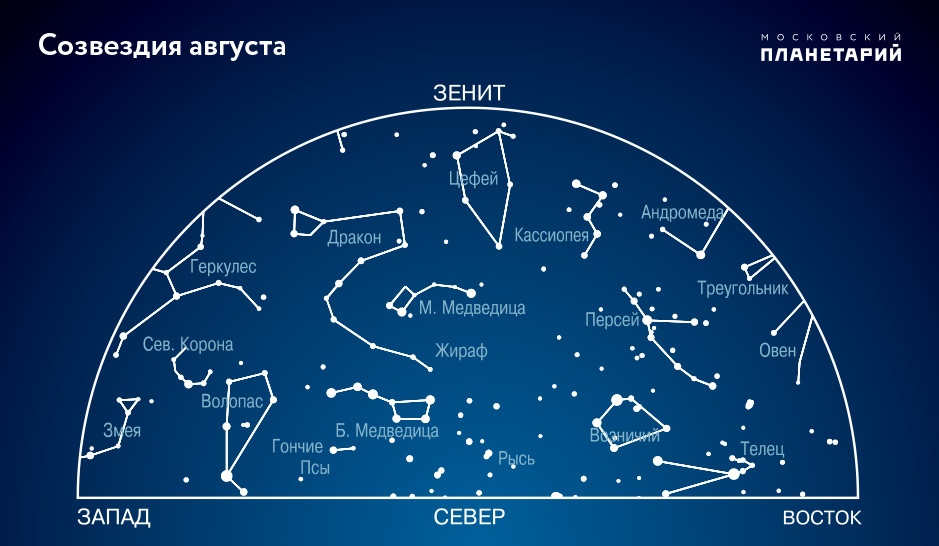
In the zenith region are the constellation Cepheus, to the east of it is Cassiopeia.
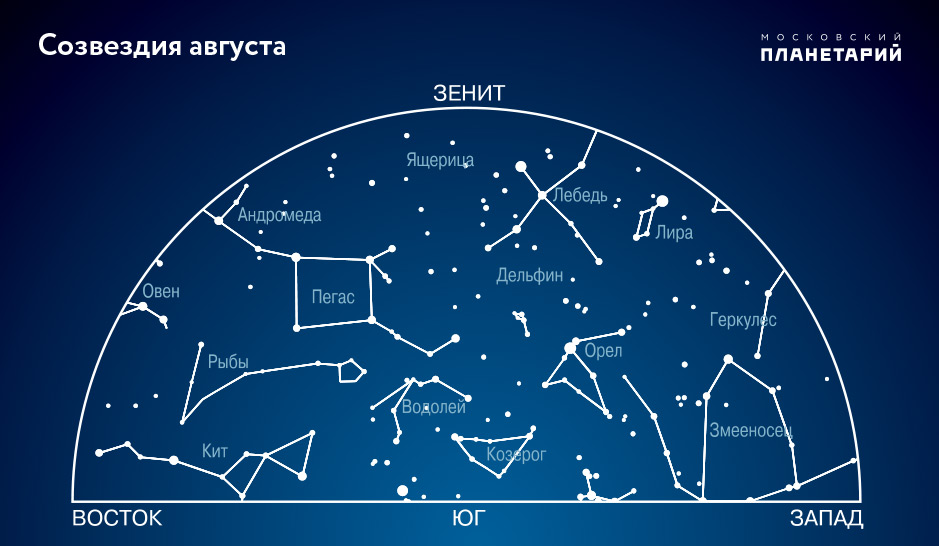
The southern part of the sky is dominated by the Summer Triangle, formed by the bright stars Vega, Deneb and Altair:
Perseid stream 12 Aug-13 Aug
The starry sky of August will decorate the traditionalAugust starfall from the constellation Perseus - Perseids, which takes place for the period from July 23 to August 24, and the maximum - on the night of August 12-13.
The peak of the Perseid meteor shower will be in 2021 on August 12-13, in the sky you can see up to two shooting stars per minute.
Under favorable weather conditions and nocity flares starting from midnight and all night long, you can observe up to 110 meteors per hour, or 1-2 meteors per minute! The Perseids promise to be the best starfall of the year.
Press Service of the Moscow Planetarium
Watching the Perseids in the planetarium is recommended from midnight to dawn, and the increased background of meteoric activity will begin on August 5 and end on August 20. Meteors will fly evenly across the sky, so you can look at any part of it.
Bright white meteors will be visible in the sky, sharply tracing the sky. The speed of the meteors will reach 60 kilometers per second, some of them will glow for several seconds.
Perseids are formedas a result of the Earth's passage through a plume of dust particles released by comet 109/Swift-Tuttle.Tiny particles, the size of a grain of sand, burn up in the Earth's atmosphere, forming bright tracks called "star showers".At first, it "spills" with the greatest force, then gradually weakens.
Bright white meteors will be visible in the sky, sharply tracing the sky. The speed of the meteors will reach 60 kilometers per second, some of them will glow for several seconds.
Perseid Observation Conditionsfavorable in 2021.The Moon has passed the New Moon phase on August 8 and will not interfere with its observations!If the weather conditions are favorable and there is no city light, you can observe up to 110 meteors per hour, or 1-2 meteors per minute, starting from midnight and all night!The Perseids promise to be the best starfall of the year!
Noctilucent clouds
In August, there will also be an opportunity to observe noctilucent clouds.appear throughout the summer.
Noctilucent clouds are the tallest cloud formations in the earth's atmosphere, occurring at altitudes of 70-95 km. They are also called polar mesospheric clouds or night glowing clouds.
These are light translucent clouds that are sometimes visible against the background of a dark sky on a summer night in mid and high latitudes.
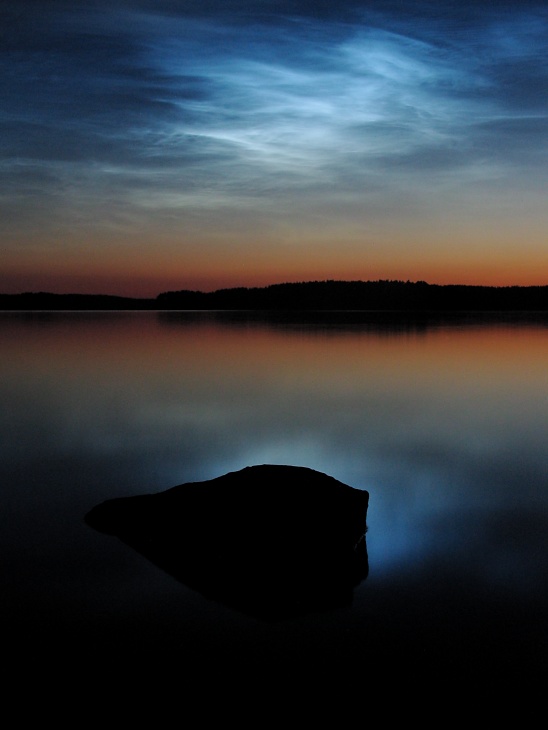 Noctilucent clouds over Lake Saimaa, Finland
Sun in August
The sun moves through the constellation Cancer until August 10,and then moves to the constellation Leo and remains there until the end of the month. The declination, compared to the first two summer months, decreases faster and faster every day.
Therefore, the length of the day decreases:from 16 hours 04 minutes at the beginning of the month to 13 hours 57 minutes by the end of the described period (more than two hours). These data are relevant for the latitude of Moscow, where the midday height of the Sun will decrease from 52 to 43 degrees in a month.
Moon in august
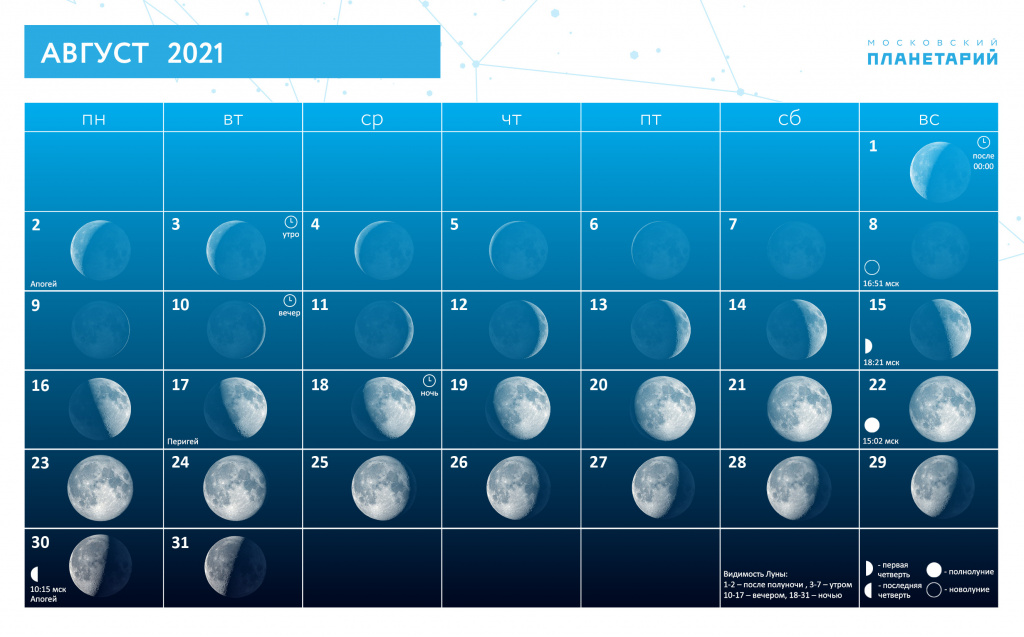
- August 2 – Moon at its apogee — distance from Earth 404412 km (10:35)
- August 8 - New Moon (16:51)
- August 15 - Moon in the first quarter phase (18:21)
- August 17 – Moon at perigee — distance from Earth 369126 km (12:25)
- August 22 - Full Moon (15:02)
- August 30 – Moon at apogee — distance from Earth 404098 km (05:23)
- August 30 - Moon in the last quarter phase (10:15)
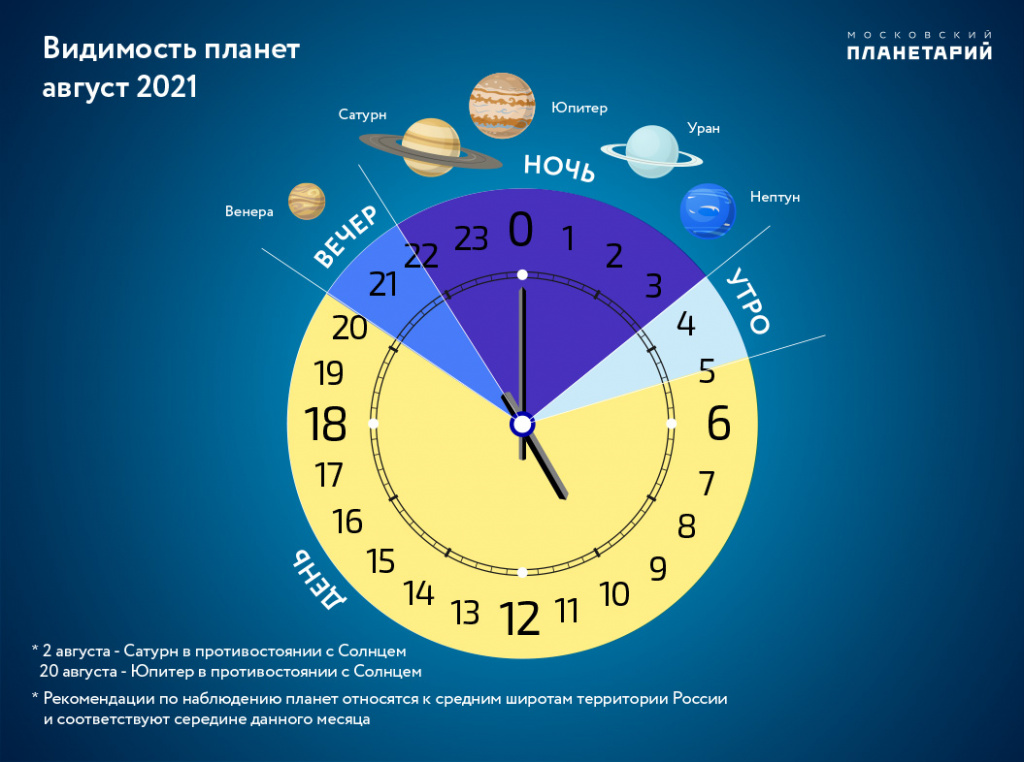
Planet visibility in August
August is suitable for observing Saturn, August 2, and Jupiter, August 20, the planets can be observed all night.
What can be seen through a telescope
- double stars: η Perseus, η Cassiopeia, α Capricorn, β Cygnus, δ and ε Lyrae, ζ B. Dipper;
- variable stars: δ Cepheus, β Perseus, β Lyrae, η Eagle;
- open star clusters: M24 in the constellation Sagittarius, M11 in the constellation Shield, M39 in the constellation Cygnus, Ϧ and χ Perseus;
- globular star clusters: M15 in the constellation Pegasus, M13 in the constellation Hercules;
- nebulae: M27 in the constellation Chanterelle, M57 in the constellation Lyra; M8 and M17 in the constellation Sagittarius;
- galaxies: M81 and M82 in the constellation Ursa Major.
Read more:
See how a black hole begins to destroy a star
Which lakes have disappeared from the face of the Earth and why
New particle discovered at the Large Hadron Collider