This may give an idea of the point of view of the Roman emperor who adopted the traditional Greco-Roman
Gaius the Messiah Quintus Trajan Decius, also known asEmperor Decius, reigned for only two years, between 249 and 251 AD, before he and his son were killed by the Goths during the Battle of Abrit in 251 AD in what is now Bulgaria.
The statue was found near the Via Appia("Appian Way"), the main road that connected Rome with Brundisium (Brindisi) in southern Italy. It was discovered in a trench near a sewer in Scott Park in Rome, archaeologists said.
Despite the robes, the face of the statue is not a faceHercules. Archaeologists compared it with surviving images of Emperor Decius, such as those depicted on coins, and found that it resembled him. The facial wrinkles appear similar, as do the eyes, nose, lips and beards, the team said in a statement.
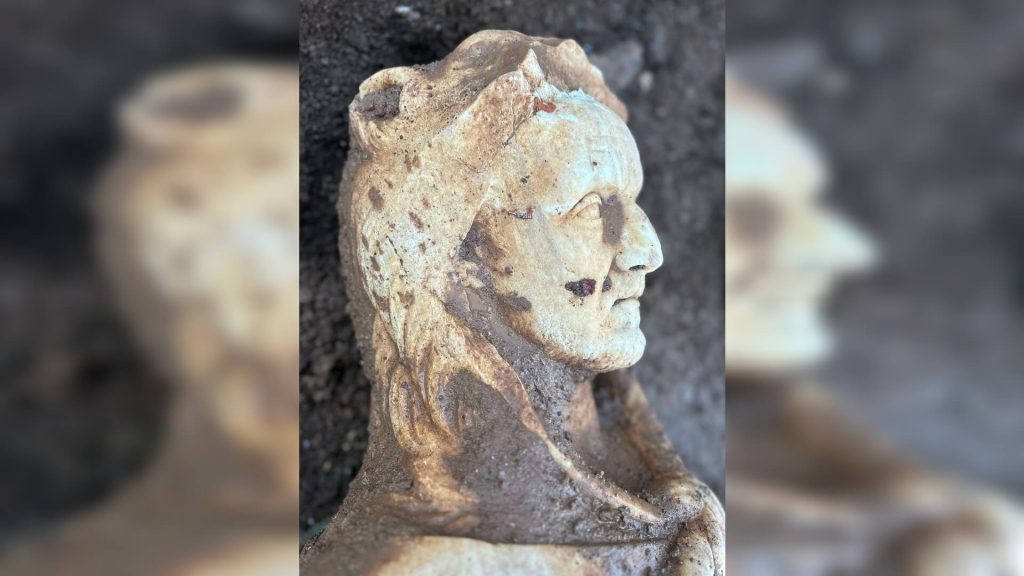 Discovered statue of Decius
Several scientists not involved in the research agree that the face resembles Decius.
"Shortly cropped hair and beard are traitssimilar to famous images of Decius,” says Sam Heynen, a researcher at the Vrie University in Amsterdam, who wrote his doctoral dissertation on portraits of Roman emperors. “We don’t have many statues of the so-called ‘soldier-emperors’ who ruled the Roman Empire between about 235 and 284 AD,” Heinen said, noting that “this period saw a rapid succession of more than 20 emperors in less than half a century during which the empire's frontiers were under constant pressure."
Other scholars agreed that the statue,probably depicts Decius. "Of course, the iconography is common to Hercules and the face is reminiscent of other portraits of Decius," James Reeves Kenan, distinguished professor of classics at the University of North Carolina at Chapel Hill, told Live Science in an email.
Read more:
Two photos of the Earth with a difference of 50 years were compared at NASA: what scientists found
Scientists transplanted human “brain” into rats and told what happened in the end
ChatGPT interviewed at Google for $183,000 engineer